Missing cut shots by a fraction of an inch is the single most frustrating hurdle for billiard players. The truth is, shooting straight isn’t about guesswork or natural talent—it is a matter of geometric alignment and disciplined visual perspective. Whether you struggle with thin back-cuts, 30-degree standard angles, or freezing the cue ball for position, mastering proven aiming systems will revolutionize your consistency. In this comprehensive 2026 masterclass, we break down the Ghost Ball Method, the Fractional Aiming System, and the Contact Point Alignment technique used by professional champions.
The Line of Centers
At the moment of impact, an imaginary line drawn through the center of the cue ball and the center of the object ball will point directly into the center of the target pocket. Every aiming system is designed to achieve this alignment.
Table of Contents
The Geometry of Pool: The Line of Centers
To understand why balls pocket, you must understand the basic physics of spherical collision. When two identical billiard balls collide, the force vector acts entirely along the Line of Centers—the straight line connecting the center of the cue ball to the center of the object ball at the precise millisecond of contact.
No matter where the cue ball originated from, the object ball will always travel along this line of centers (assuming no throw or extreme spin is applied). Therefore, your goal when aiming is not to look at where the cue ball is currently sitting, but to visualize where the cue ball must be when it strikes the object ball.
Aiming System 1: The Ghost Ball Method (The Foundation)
The Ghost Ball Method is the foundational technique taught to every aspiring player. It translates the abstract line of centers into an easy-to-visualize phantom target on the slate:
- Find the Pocket Line: Stand behind the object ball and look directly into the target pocket. Imagine a laser beam drawn from the center of the pocket through the object ball.
- Spot the Ghost Ball: Follow that laser beam out the back of the object ball exactly one ball-radius (1-1/8 inches). Imagine an invisible “ghost ball” resting in that exact spot touching the object ball.
- Aim the Cue Stick: Step back into your shooting stance, align your cue stick through the center of the real cue ball, and aim your strike directly at the center of the ghost ball.
Aiming System 2: The Fractional Ball Aiming System
While the ghost ball method is visual, the Fractional Ball System gives you mathematical precision for standard cut angles. In this system, you overlap the cue ball and object ball by specific fractions:
| Ball Overlap | Cut Angle | Aim Point on Object Ball | Shot Type |
|---|---|---|---|
| Full Ball (100%) | 0° | Dead center of object ball | Straight-in shot |
| 3/4 Ball (75%) | 14.5° | Halfway between center and edge | Gentle cut angle |
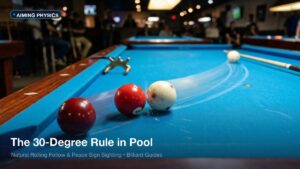
| 1/2 Ball (50%) | 30.0° | Edge of cue ball aligns to center | Standard 30° natural roll angle |
| 1/4 Ball (25%) | 48.6° | Edge of cue ball hits 1/4 into ball | Sharp acute cut |
| Thin Cut (< 15%) | 60.0° – 75.0° | Outer edge clips outer edge | Extreme rail cut |
The Pre-Shot Routine & Finding Your Dominant Eye
You can understand all the geometry in the world, but if your head is misaligned over your cue stick, optical parallax will make straight shots look crooked:
👁️ The Triangle Hand Eye Dominance Test
- Extend both arms out in front of you. Form a small triangular opening between your thumbs and index fingers.
- With both eyes open, look through the opening and center an object across the room (such as a clock or light switch).
- Close your left eye. If the object stays centered, you are right-eye dominant. If the object jumps out of view, close your right eye; if it stays centered, you are left-eye dominant.
How to apply this: If you are right-eye dominant, position your cue stick directly beneath your right eye, rather than dead-center under your chin. (Pair your alignment with proper cue grip fundamentals in our guide to How to Hold a Pool Cue).
3 Progressive Practice Drills to Perfect Your Aim
- Drill 1: The Long Rail Alignment Drill: Place the object ball on the foot spot and cue ball on the head string. Shoot dead straight into the corner pocket. Repeat 20 times until you make 18 out of 20.
- Drill 2: The 30-Degree Half-Ball Matrix: Set an object ball 2 diamonds from the side pocket. Position the cue ball at a 30-degree cut angle. Using the 1/2 ball alignment, pocket the ball 10 times consecutively with smooth follow.
- Drill 3: The Ghost Ball Object Marker: Place a small piece of chalk or a marker coin exactly where the ghost ball should be. Practice swinging through that mark, then remove the coin and execute from muscle memory.
Frequently Asked Questions (FAQ)
What is the most accurate aiming system in pool?
For beginners and intermediate players, the Ghost Ball Method paired with the Fractional Ball System is universally considered the most reliable, mathematically sound method. Advanced players rely on visual muscle memory and Center-to-Edge (CTE) perception.
Why do I miss cut shots when I think I aimed correctly?
The two most common culprits are Cut-Induced Throw (CIT) and optical parallax. When the cue ball contacts the object ball with friction, it throws the object ball slightly off-line. Additionally, unintentional side English causes cue ball squirt (deflection).

Marc Robert is the founder and lead equipment tester at Billiard Guides. With over 15 years of competitive amateur league play (APA & BCA) and extensive hands-on experience in slate table leveling, cloth refelting, and cue repair, Marc conducts independent bench tests on cues, cloth, and billiards gear to help players make informed decisions.