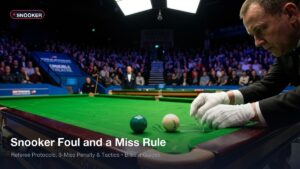
If you are an American pool player captivated by the drama of the World Snooker Championship or Ronnie O’Sullivan’s legendary 147 maximum breaks, you have likely wondered: Can you play snooker on a standard pool table? The short answer is yes, you can—thousands of players enjoy snooker on home pool tables. However, because a regulation snooker table is a massive 12-foot beast with curved pocket jaws, playing snooker on a 7-foot or 8-foot pool table requires specific equipment adjustments, adapted ball counts, and modified spot layouts to ensure balanced, realistic gameplay.
⚡ Quick Comparison at a Glance
Table of Contents
The 4 Fundamental Differences Between Pool & Snooker Tables
Before adapting snooker rules to your home table, you must understand the physical and mechanical differences between the two table designs:
| Feature | Standard American Pool Table | Regulation Snooker Table |
|---|---|---|
| Playing Surface Size | 7ft (39″ × 78″) or 8ft (44″ × 88″) | 12ft (70″ × 140″ / 3.56 × 1.78 m) |
| Pocket Openings & Jaws | 4.5″ to 4.75″ wide; flat, mitered 135° cushion bevels | 3.35″ to 3.5″ wide; radiused curved cushion jaws |
| Ball Sizes & Weights | 2 1/4 inches (57.15 mm) / 6.0 oz (170g) | 2 1/16 inches (52.5 mm) / 5.0 oz (142g) |
| Cushion Rubber Profile | Triangular K66 gum rubber bumpers | L-shaped Northern rubber / steel block cushions |
| Cloth Characteristics | Smooth, napless worsted speed cloth (Simonis 860) | Heavy directional napped English wool (Strachan 6811) |
Why Pocket Geometry Changes Everything
The single greatest difference when playing snooker on a pool table is the pocket entrance profile:
Mitered Pockets vs. Curved Jaws
On an American pool table, the rubber cushion meets the pocket at a straight angle. If you cut a ball slightly off-line, the ball strikes the angled facing and deflects straight into the pocket pocket hole. The pocket “forgives” minor aim errors.
On a regulation snooker table, the cushion jaws are rounded curves. If a snooker ball strikes the curved rubber jaw with even a fraction of an inch of error, the curved profile kicks the ball directly back out into the open table. Consequently, potting snooker balls on an American pool table feels dramatically easier, leading to much higher break scores than on genuine snooker slate.
The Ball Problem: Why You Shouldn’t Play with 15 Reds
A full set of official snooker balls contains 22 balls (1 white cue ball, 15 reds, and 6 colors: yellow, green, brown, blue, pink, black). If you try to rack 15 red balls onto a 7-foot or 8-foot home pool table, you encounter severe game design problems:
- Severe Cluster Congestion: A 12ft table has nearly four times the surface area of an 8ft pool table. Packing 22 balls onto a compact home table turns the playing field into an impassable traffic jam where balls cannot separate, leading to endless safety stalemates.
- Cushion Height Mismatch: If you buy a set of 2 1/16″ snooker balls for your pool table, the cushion nose (calibrated for 2 1/4″ American balls) strikes the smaller balls slightly above their equator. This can cause smaller balls to hop or make a thudding noise off hard cushion impacts.
- The Pro Solution (The 10-Red & 6-Red Formats): To make snooker fast, strategic, and balanced on a home pool table, professional billiard coaches recommend playing 10-Red Snooker on 8-foot and 9-foot tables, or 6-Red Snooker on 7-foot bar box tables.
How to Set Up a Snooker Table on Your Pool Table
To convert your pool table for snooker, mark or imagine the official spot coordinates using table diamond markers:
The Home Snooker Spotting Layout
- The Baulk Line & The “D”: The head string on your pool table (connecting the second diamonds from the head rail) serves as the Baulk Line. The “D” is a semi-circle with an 11-inch radius drawn behind the baulk line toward the head rail.
- Brown Spot: Dead-center on the baulk line.
- Green Spot: Left intersection of the “D” and baulk line.
- Yellow Spot: Right intersection of the “D” and baulk line.
- Blue Spot: Placed dead-center in the middle of the table (between the center side pockets).
- Pink Spot: Placed halfway between the Blue spot and the foot rail. The apex red ball of the triangle rests as close as possible to the Pink ball without touching it.
- Black Spot: Placed on the table’s centerline, exactly 11 to 12 inches off the foot rail cushion.
Can You Use a Pool Cue to Play Snooker?
While you can legally use a pool cue, the differences in shaft dimensions will significantly affect your shotmaking:
- Snooker Cues (9.0mm to 10.0mm Tip): Feature a stiff, conical taper crafted from North American ash or maple with a solid brass ferrule. The narrow tip allows precise contact with smaller 52.5mm balls. (See our guide to the 10 Best Snooker Cues for Beginners).
- Pool Cues (11.75mm to 13.0mm Tip): Feature a longer pro taper designed for heavier 57.15mm balls. Using a thick 13mm tip on small snooker balls feels like swinging a club and makes precise cue ball positioning and stun shots difficult.
- Chalk is 100% Compatible: Elite snooker chalk like Taom Pyro Blue and Taom V10 was actually invented for professional snooker before taking over American pool!
Frequently Asked Questions (FAQ)
Can you play with standard pool balls when playing snooker on a pool table?
Yes! If you don’t own a dedicated snooker ball set, you can designate your pool balls: use all solid balls (1 through 7) as “Reds” (1 point each), the 8-ball as the Black ball (7 points), and striped balls for the remaining colors. It’s a fantastic way to practice snooker scoring without buying extra equipment.
Why are snooker tables so much bigger than pool tables?
Snooker was developed in the 1870s by British Army officers stationed in India on full-size 12ft × 6ft English billiard tables. The massive scale was designed to emphasize long potting precision, defensive safety battles, and tactical endurance across vast expanses of green felt.
Can I install snooker cushions on my American pool table?
Generally no. American pool table rails are routed specifically for triangular K66 cushion profiles and 135-degree pocket angles. Installing steel block snooker cushions requires custom wooden rail rebuilds and extensive structural modifications that are rarely cost-effective.