When people ask, “How many pool balls are there?”, the answer depends entirely on which cue game you are playing. While a standard set of American pool balls contains 16 balls (1 white cue ball and 15 numbered object balls), other popular worldwide cue sports use anywhere from 3 to 22 balls. Whether you are setting up an 8-ball tournament, racking a rotation game of 9-ball, or stepping up to a 12-foot snooker table, knowing the exact ball counts, colors, numbering schemes, and physical dimensions is essential for proper play.
⚡ Quick Reference: Ball Counts by Game
Table of Contents
Complete Ball Count Breakdown by Billiard Game
Each cue discipline uses a distinct set of balls engineered to create specific tactical challenges on the table:
| Game / Discipline | Total Balls | Composition Breakdown | Standard Ball Diameter |
|---|---|---|---|
| American 8-Ball | 16 Balls | 1 Cue Ball + 7 Solids (1–7) + 1 Black (8) + 7 Stripes (9–15) | 2 1/4″ (57.15 mm) |
| 9-Ball Rotation | 10 Balls | 1 Cue Ball + Balls #1 through #9 | 2 1/4″ (57.15 mm) |
| 10-Ball Rotation | 11 Balls | 1 Cue Ball + Balls #1 through #10 | 2 1/4″ (57.15 mm) |
| Straight Pool (14.1) | 16 Balls | 1 Cue Ball + 15 Unrestricted Object Balls | 2 1/4″ (57.15 mm) |
| English 8-Ball (Blackball) | 16 Balls | 1 Cue Ball + 7 Red + 7 Yellow + 1 Black 8-Ball | 2″ (50.8 mm) |
| Snooker | 22 Balls | 1 White Cue + 15 Red Balls (1 pt) + 6 Colors (2–7 pts) | 2 1/16″ (52.5 mm) |
| Carom / 3-Cushion Billiards | 3 Balls | 1 White Cue + 1 Yellow Cue + 1 Red Object Ball | 2 7/16″ (61.5 mm) |
| Russian Pyramid | 16 Balls | 15 White Numbered Balls + 1 Red/Yellow Cue Ball | 2 11/16″ (68 mm) |
Standard American Pool Ball Colors & Numbers
In standard American pool (governed by the World Pool-Billiard Association), the 15 object balls follow a strict color-coding standard. The balls are split into two groups—Solids (1 through 7) and Stripes (9 through 15)—separated by the black 8-ball:
The Official Color Chart
Why Are Some Tournament Balls Pink and Cyan? (The TV Ball Set)
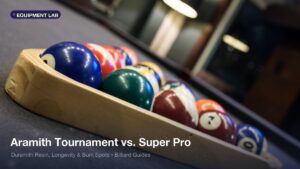
If you watch modern pro broadcasts on Matchroom or ESPN, you may notice the #4 and #12 balls are bright pink instead of dark purple, and the #7 and #15 balls are tan/cyan instead of maroon. This is not a manufacturing error—it is an engineered innovation known as the Super Aramith Pro-Cup TV Set. Under high-definition broadcast studio lighting, dark purple and dark maroon look identical to the black 8-ball on TV monitors. Shifting to high-visibility pink and light cyan ensures viewers and referees never mistake ball identities.
Physical Specifications: Diameters, Weights & Tolerances
Billiard balls look deceptively simple, but high-end tournament balls are marvels of material engineering:
- Diameter: Standard American pool balls measure exactly 2 1/4 inches (57.15 mm) with a tolerance of ± 0.005 mm. By comparison, British pool balls are smaller at 2 inches (50.8 mm), while Russian pyramid balls are massive spheres measuring 2 11/16 inches (68 mm).
- Weight: Regulation American balls weigh between 5.5 and 6.0 ounces (156 to 170 grams). In a premium tournament set, the maximum weight variance between any two balls in the rack is less than 1.5 grams, ensuring perfectly balanced momentum transfer during collisions.
- The Cue Ball Difference (Bar Box Coin Tables): On older coin-operated commercial tables without magnetic or optical ball-return sensors, the cue ball was either an oversized “rock” (2 3/8 inches) or a heavy weighted ball so the table’s internal trap mechanism could separate it from object balls and return it to the player after a scratch. Modern commercial tables use standardized 2 1/4″ magnetic cue balls that play true to tournament physics.
Materials Matter: Phenolic Resin vs. Polyester/Acrylic
The material your balls are made from determines how long they stay shiny, how true they roll, and how much damage they cause to your pool table cloth:
1. 100% Pure Phenolic Resin (Aramith Standard)
Engineered exclusively by Saluc in Belgium, genuine phenolic resin is molecularly homogeneous with a solid core and no cast layers. It is five times more resistant to impact than polyester and withstands instantaneous friction temperatures of up to 482°F (250°C) during breaks without scorching or developing white flat spots.
- Top Tournament Pick: Super Aramith Pro-Cup TV Ball Set — The undisputed world championship choice with 6 red dots for spin visualization.
- Lifespan: Up to 40 years in home use; never delaminates or loses its high-gloss vitrified surface.
2. Polyester & Polyresin (Budget Family Sets)
Most pool tables under $1,000 ship with budget polyester balls. While adequate for casual kids, polyester has a lower thermal threshold. When struck with high-speed break shots, friction melts microscopic spots on the ball surface, leaving white burn marks across your table cloth.
- Best Budget Upgrade: Viper Master 2.25″ Regulation Ball Set — Excellent high-gloss polyresin finish for casual family play.
- Classic Value Pick: Empire USA 2.25″ Regulation Billiard Ball Set — Standard American tournament dimensions at a budget-friendly price.
To keep your ball set spinning true and free of chalk film, wipe down periodically with a dedicated Aramith Billiard Ball Cleaner.
Frequently Asked Questions (FAQ)
How many balls are in a standard set of pool balls?
A standard American pool ball set contains 16 balls total: 1 white cue ball and 15 numbered object balls (numbered 1 through 15).
What are the two groups of balls called in 8-ball?
The two groups are Solids (low balls, numbered 1 through 7) and Stripes (high balls, numbered 9 through 15). The solid black 8-ball is the neutral target pocketed last.
How many balls are used in 9-ball?
In 9-ball, exactly 10 balls are used: the white cue ball plus object balls numbered 1 through 9. Players must strike the lowest numbered ball first on every shot.
What are pool balls made of today?
Historically made from elephant ivory and wood in the 1800s, modern quality pool balls are manufactured from high-density phenolic resin (such as Aramith) or cast polyester/acrylic for budget sets.

Marc Robert is the founder and lead equipment tester at Billiard Guides. With over 15 years of competitive amateur league play (APA & BCA) and extensive hands-on experience in slate table leveling, cloth refelting, and cue repair, Marc conducts independent bench tests on cues, cloth, and billiards gear to help players make informed decisions.