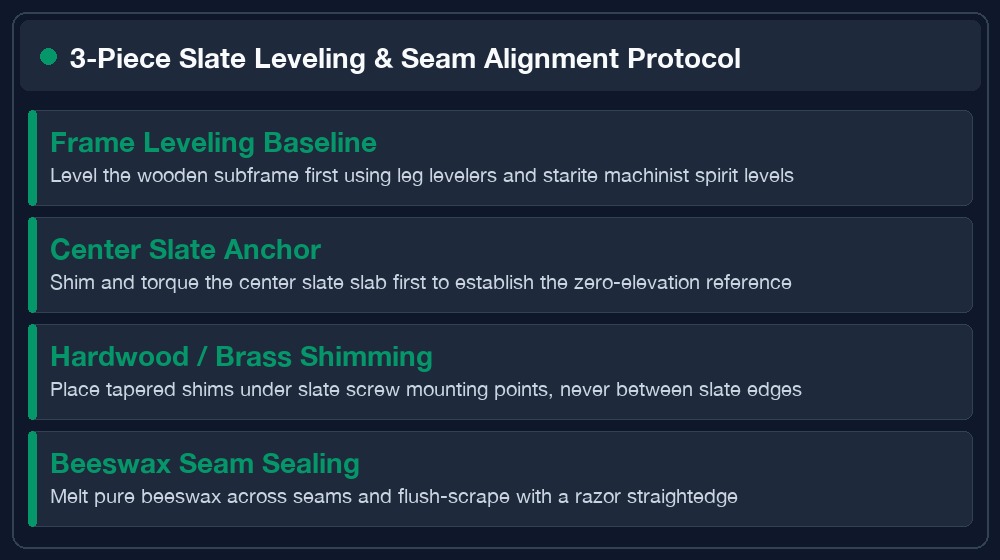
Quick Summary: 3-Piece Slate Leveling Protocol
Leveling a 3-piece slate pool table requires a two-stage process: first, leveling the structural wood frame via the leg levelers; second, precision shimming the individual slate slabs using a 12-inch machinist level (sensitive to 0.005″ per foot) and hardwood shims. The center slate is dialed in first, and the two outer slates are matched flush before sealing seams with beeswax.
The Difference Between Good and Perfect: Why Carpenter Levels Fail
There is nothing more frustrating in cue sports than executing a flawless slow-speed rolling shot, only to watch the cue ball wobble, curve, and miss the pocket because the table has a subtle slope. In tournament play, a deviation of just 1/32 of an inch across a 9-foot table will throw a ball offline by several inches.
Most DIYers grab a standard 24-inch yellow hardware store carpenter’s level, place it on the cloth, and assume their table is level when the bubble looks centered. Carpenter levels are completely useless for billiards! A carpenter’s level only detects slopes greater than 0.05 inches per foot—ten times too coarse for tournament slate.
In this master technician’s guide, we detail the step-by-step procedure used by professional table mechanics to level a 3-piece slate bed down to micro-millimeter perfection using hardwood shims, Starrett machinist levels, and beeswax joint sealing.
Required Tools for Professional Slate Leveling
- 12-Inch Precision Machinist Level: Sensitive to 0.005 inches per foot (or digital angle finder measuring to 0.05 degrees).
- Hardwood Leveling Shims: Oak or birch wedges (never use soft pine or cardboard, which compress over time).
- Feeler Gauge or Steel Straightedge: To verify seam lip flushness down to 0.001 inches.
- Propane Torch & Pure Beeswax: For melting and sealing slate seams.
- Wide Palette Knife: For scraping cooled beeswax flush to slate.
Recommended Precision Calibration Gear
Calibrate table pitch with a Precision Digital Angle Finder & Inclinometer on Amazon.
The 5-Step Slate Leveling Master Protocol
Step 1: Level the Wooden Frame First
Before touching the slate, the wooden cabinet frame must be level. Place your precision level across the head rail frame, foot rail frame, and both long side rails. Adjust the threaded metal leg levelers (or wooden floor shims under the leg pads) until the frame bubble is centered across all axes.
Step 2: Mount & Level Center Slate #2
On a 3-piece table, always establish the center slate slab first. Place Slate #2 in the middle of the frame, install the frame screws loosely, and place your machinist level across the center width and length. Insert hardwood shims under the slate frame contact points until the center slab is dead level in all directions. Tighten the frame screws down firmly.
Step 3: Align Outer Slates #1 and #3 to the Center
Now slide Slate #1 (head end) and Slate #3 (foot end) into place. Insert shims beneath their outer edges until their surface is 100% flush with Center Slate #2. Run your finger and a steel straightedge across the seam: if you feel even a fingernail’s edge of a lip, adjust your shims. Tighten all slate screws to 15 ft-lbs of torque.
Step 4: Seal the Seams with Beeswax
Do not use plaster of Paris or drywall spackle—they crack under room vibration. Use pure beeswax:
- Gently warm the slate seam with a propane torch.
- Melt beeswax along the seam line, allowing liquid wax to seep into the screw holes and dowel crevices.
- Let the wax cool for 15 minutes, then scrape it perfectly flush using a sharp 6-inch palette knife. Learn more in How to Repair Cracked Slate with Beeswax.
Step 5: The Slow Roll Ball Test
Roll a clean phenolic ball at 1 MPH across each seam and in circles across the center. If the ball rolls true in a straight line with zero wobble or deflection, your table is tournament certified.
Frequently Asked Questions: Slate Leveling
Why do cardboard or playing card shims fail?
Paper and cardboard contain porous wood pulp that compresses under the 800-pound weight of slate. Over 6 months, the table will sag and lose level. Always use dense oak or birch shims.
Can I level a pool table without removing the felt?
You can adjust the whole table by turning the leg levelers at the floor. However, if an individual slate slab has shifted or a seam has cracked, you must remove the rails and felt to access the internal slate shims.

Marc Robert is the founder and lead equipment tester at Billiard Guides. With over 15 years of competitive amateur league play (APA & BCA) and extensive hands-on experience in slate table leveling, cloth refelting, and cue repair, Marc conducts independent bench tests on cues, cloth, and billiards gear to help players make informed decisions.