The opening break shot in 8-ball is the most violent, explosive, and psychologically charged collision in cue sports. Delivering an 18 to 22 MPH stroke into a tightly packed 15-ball cluster unleashes tremendous kinetic energy across the slate bed. But when that thunderous impact is immediately followed by the hollow clatter of the white cue ball dropping into a corner or side pocket, the entire mood in the room pivots from celebration to conflict. What happens if you scratch on the break in 8-ball? Do you lose the game immediately? Does the incoming opponent receive ball-in-hand anywhere on the table, or are they confined behind the headstring? What happens if an object ball or the 8-ball dropped on the same shot? The answer depends entirely on which official rulebook governs your table: the American Poolplayers Association (APA), the Billiard Congress of America (BCA) / World Pool-Billiard Association (WPA), or traditional casual barroom rules. In this definitive 2,100+ word master guide, we break down every scenario, cite official rulebook clauses, analyze tactical incoming strategy, and settle every table dispute once and for all.
Table of Contents
1. Scratch on the Break: Rulebook Comparison Matrix
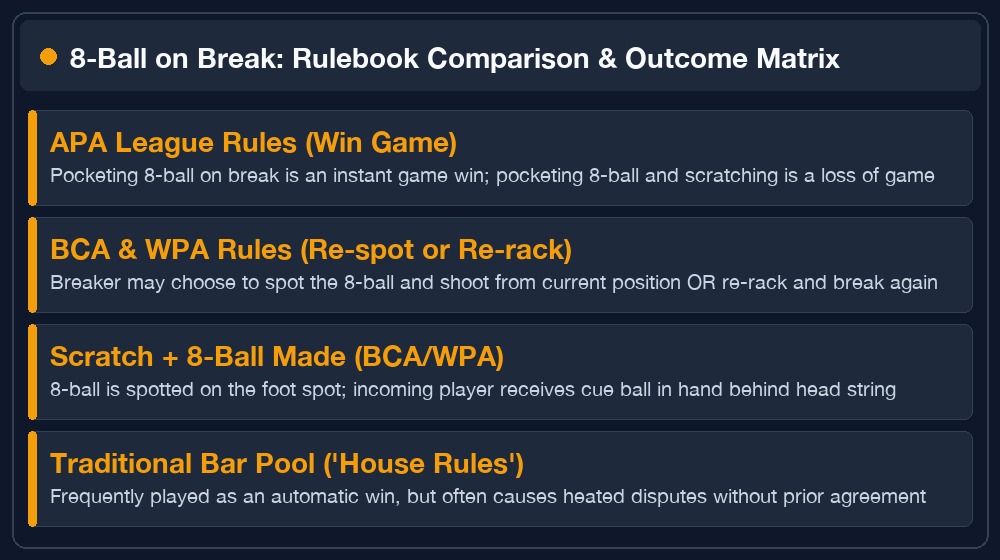
Before arguing over the table or pulling out smartphone cameras, players must immediately clarify which sanctioning body governs the match. A break scratch is governed by radically different penalties depending on whether you are playing in an APA league match, a BCA/USA Pool League tournament, or a neighborhood barroom tournament. Here is the comprehensive comparison matrix:
| Rule Consideration | APA League Rules | BCA / WPA World Rules | CSI / USA Pool League | Traditional Bar / House Rules |
|---|---|---|---|---|
| Game Outcome | Game continues; inning ends | Game continues; inning ends | Game continues; inning ends | Game continues (unless 8-ball also pockets) |
| Cue Ball Placement | Ball-in-Hand in Kitchen | Ball-in-Hand in Kitchen | Ball-in-Hand in Kitchen | Ball-in-Hand Behind Headstring |
| Table Status | Open Table | Open Table | Open Table | Open Table (Frequent disputes) |
| Numbered Balls Made | Remain pocketed; counted | Remain pocketed | Remain pocketed | Remain pocketed |
| If 8-Ball Also Pockets | LOSS OF GAME | Spot 8-Ball or Re-Rack | Spot 8-Ball or Re-Rack | LOSS OF GAME (Universal bar rule) |
| Cue Ball Driven Off Table | Standard break foul (Kitchen) | Standard break foul (Kitchen) | Standard break foul (Kitchen) | Standard foul (Kitchen) |
2. APA League Rules Breakdown (Official Team Manual & Kitchen Restrictions)
In the American Poolplayers Association (APA), the break scratch is one of the very few situations where a foul does not award ball-in-hand anywhere on the table. In normal play during the rack, any foul results in unrestricted ball-in-hand. However, when the cue ball scratches on the break shot, Section 3 of the APA Official Team Manual imposes strict spatial constraints:
- Ball-in-Hand Behind the Headstring Only: The incoming player must place the cue ball anywhere behind the headstring (the kitchen). The headstring is defined as an invisible straight line connecting the second diamonds from the head rail across the cloth.
- The Base of the Ball Rule: The base of the cue ball (the exact microscopic contact point where the ball touches the felt cloth) determines its legal position. If the base of the ball touches or is behind the headstring, it is inside the kitchen. If the base of the ball extends past the line toward the foot rail, it is illegal, and shooting from that position constitutes a foul.
- Shooting Forward Requirement: The incoming player cannot shoot the cue ball directly at an object ball that resides behind the headstring. The cue ball must travel completely past the headstring line before contacting any ball or cushion.
- The Rebound Kick Solution: If all legal object balls are clustered inside the kitchen, the incoming shooter must drive the cue ball across the headstring, make contact with a rail past the line, and have the cue ball rebound back into the kitchen to make legal contact.
- The Open Table Principle: Even if the breaker knocked four solid balls and one stripe into pockets before scratching, the table remains entirely open. The incoming player is not assigned solids or stripes; group selection is determined only by legally pocketing a called ball on a normal shot following the break.
3. BCA / WPA World Standardized Rules Breakdown
The Billiard Congress of America (BCA), CueSports International (CSI), and the World Pool-Billiard Association (WPA) operate under standardized international championship regulations. Under WPA Rule 3.3 (“Break Shot Requirements”):
- Legal Break Definition: The breaker must drive at least four numbered object balls to one or more cushions, or pocket at least one numbered ball. If this requirement is met and the cue ball scratches, a standard break foul occurs.
- Incoming Options: The incoming player receives cue ball in hand behind the headstring, with the table open.
- The Crucial 8-Ball Difference: Under WPA/BCA Rule 3.3(b), if the 8-ball is pocketed AND the cue ball scratches on the break, the breaker does NOT lose the game! Instead, the incoming player has the option to:
- Have the 8-ball spotted on the foot spot and take ball-in-hand behind the headstring; OR
- Elect to have the entire rack re-racked and take over the break.
- Illegal Break Penalty: If the breaker fails to drive four balls to cushions AND scratches, the incoming player may accept the table in position behind the headstring or demand a re-rack and break themselves.
4. Traditional Barroom / House Rules: Common Myths Debunked
In neighborhood taverns, coin-operated bar tables, and casual basement games, local folklore frequently overrides official rulebooks. Players who transition from casual bar pool to organized leagues often suffer heavy penalties because of these three widespread myths:
| Pervasive Barroom Myth | Official Rulebook Reality | How to Handle Disputes Tactfully |
|---|---|---|
| Myth 1: “Scratching on the break is an immediate loss of game” | 100% false across all leagues. A simple scratch on the break is merely a foul that transfers ball-in-hand in the kitchen. | Clarify before placing quarters on the rail that standard foul rules apply, not sudden-death loss. |
| Myth 2: “If balls went in, you must take that suit” | False. The scratch negates any claim to solids or stripes; the table remains completely open. | Explain that suit determination requires a legal, un-fouled called shot after the break. |
| Myth 3: “If all balls are in the kitchen, the ref spots one” | False in APA/BCA. The incoming player must kick off the far rail to rebound back into the kitchen. | Some bar house rules allow spotting the ball nearest the headstring. Agree on this pre-match. |
5. The Kinetic Physics of Break Scratches (Mechanics & Causes)
Scratching on the break is rarely the result of cruel luck. In professional billiards, high-speed camera analysis demonstrates that break scratches stem from specific physical flaws in stance, elevation, and collision angle:
- Off-Center Apex Collision: If the cue ball collides with the lead apex ball (usually the 1-ball) as little as 1 millimeter off the vertical center axis, the cue ball deflects diagonally at high velocity. On a 7ft or 9ft table, this glancing deflection steers the cue ball straight into the side pocket or off the long rail into the far corner pocket.
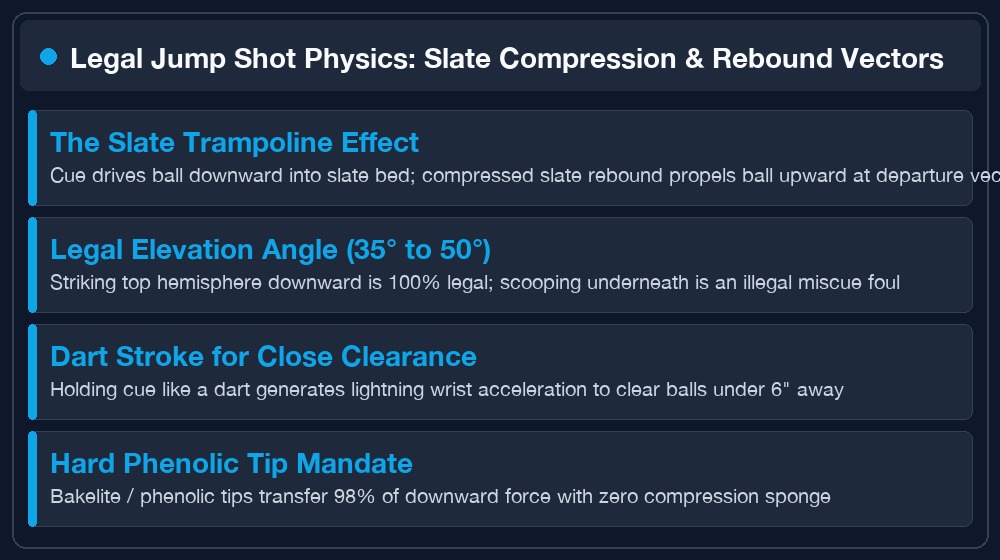
- Excessive Cue Elevation (The Airborne Trampoline): When players drop their shoulder or elevate the cue butt more than 15 degrees to generate power, the cue tip drives downward into the ball. This hammers the cue ball into the slate cloth, causing it to rebound into the air. An airborne cue ball bounces across the rack, catches flying object balls, and hops off the table or into corner pockets.
- Uncontrolled Topspin (Forward Roll-In): Striking above center ball imparts forward rolling angular momentum. Upon impact with the rack, the cue ball transfers its linear momentum to the cluster, pauses for a fraction of a millisecond, and then the forward topspin grips the cloth, driving the cue ball forward into the scatter pattern where it deflects into a pocket.
- The Mechanical Cure: The “Squat Break”: Elite players use a level cue stroke striking roughly one-quarter tip below center ball with controlled stun or slight draw. At impact with the apex ball, 100% of the forward kinetic energy is transferred into the rack, freezing the cue ball dead in the geometric center of the table.
6. Incoming Tactical Strategy: How to Punish a Break Scratch
Receiving ball-in-hand in the kitchen on an open table gives the incoming shooter an overwhelming statistical win probability (over 70% in amateur leagues). However, reckless beginners often surrender this advantage immediately. Follow this master tactical checklist:
- Walk the Table Before Touching the Cue Ball: Never rush to grab the cue ball. Walk around the entire perimeter of the table to survey problem clusters, balls pinned against cushions, and potential breakout opportunities.
- Select Suits Based on “Key Balls,” Not Ball Count: Do not choose solids just because four solids dropped on the break. If the remaining three solids are locked in a cluster along the side rail and all seven stripes have wide open paths to pockets, choose stripes! Solve problems first.
- Create Cutting Angles Across the Headstring: Never align the cue ball for a dead straight-in shot on your first ball. Straight shots kill cue ball mobility. Place the cue ball slightly left or right along the headstring to establish a 20- to 30-degree cut angle, allowing you to float the cue ball into the center of the table for total pattern control.
- Play a Two-Way Safety if No Runout Exists: If the break left ugly clusters and zero high-percentage runout routes, do not blast wildly. Use your ball-in-hand to tuck an opponent ball into a cluster while rolling the cue ball safely behind another ball to snooker your opponent immediately.
7. Step-by-Step Procedure: Taking Ball-in-Hand Behind the Headstring
Executing ball-in-hand from the kitchen requires strict procedural adherence to avoid committing a technical foul before you even strike the ball:
- Step 1: Inspect and Clean the Cue Ball: When picking up the cue ball from the pocket or ball return, examine it for chalk marks, lint, or grease. Wipe it clean with a microfiber cloth before placing it on the table.
- Step 2: Position Behind the Headstring Line: Locate the second diamonds from the head rail. Visually project the headstring line across the table. Place the cue ball so that its base sits firmly behind this line toward the head cushion.
- Step 3: Confirm Target Legality: Verify that the object ball you intend to strike sits outside the kitchen. Under official rules, an object ball whose center or base touches the headstring is legally outside the kitchen and may be struck directly.
- Step 4: Align Your Stance and Execute: Address the shot with a smooth, level stroke. Ensure that you do not touch the cue ball with the ferrule or shaft while lining up your bridge, as doing so before the stroke can be ruled a foul under strict tournament guidelines.

8. Common Break Scratch Mistakes and Mental Traps
Even seasoned league players frequently stumble into critical psychological and strategic errors after a break scratch:
- Emotional Over-Correction: After scratching on the break, players often become timid on subsequent racks, decelerating their stroke through impact. A weak, decelerating break fails to disperse balls and leaves easy clusters for opponents. Maintain confident acceleration while lowering cue elevation.
- Assuming Universal Ball-in-Hand: Novice players often grab the cue ball and place it out in the middle of the table, unaware of the kitchen restriction. Opponents will immediately call a foul, transferring ball-in-hand right back to the original breaker!
- Failure to Challenge Headstring Placement: As the incoming opponent, always inspect your opponent’s cue ball placement before they shoot. If their cue ball base is clearly past the headstring, politely call it out before the stroke is delivered.
9. Frequently Asked Questions
What happens if the 8-ball goes in and I scratch on the break in APA?
In APA league play, pocketing the 8-ball and scratching on the same break shot is an automatic, instant LOSS OF GAME. This is one of the most punishing and decisive rules in amateur league competition.
What happens if the 8-ball goes in and I scratch on the break in BCA?
Under BCA and WPA world rules, it is NOT a loss of game. The incoming player may choose to spot the 8-ball on the foot spot and take ball-in-hand behind the headstring, or demand a complete re-rack and take over the break shot.
Can the cue ball be placed directly on the headstring line?
Under official WPA and BCA rules, the base of the cue ball (where it contacts the cloth) must be entirely behind the headstring. If the base of the ball touches the line, it is acceptable in some interpretations, but the center of the ball must be inside the kitchen zone.
What if an object ball is resting directly on the headstring line?
Under official tournament regulations, an object ball whose center or base touches the headstring line is considered “outside” the kitchen. The incoming player may shoot at it directly from behind the line.
Can the incoming player shoot at the 8-ball from the kitchen?
On an open table, the incoming player can use the 8-ball as part of a legal combination shot, but cannot pocket the 8-ball directly. Pocketing the 8-ball on this initial shot results in an immediate foul and loss of game.
What if the cue ball flies off the table onto the floor on the break?
Driving the cue ball off the pool table is classified identically to a scratch! The incoming player receives ball-in-hand behind the headstring with an open table.
Can I clean the cue ball before taking ball-in-hand?
Yes. Whenever you have ball-in-hand, you may inspect and wipe off chalk dust, debris, or lint from the cue ball with a clean cloth before placing it on the slate bed.
What happens if I accidentally touch the cue ball with my cue tip while placing it?
In casual play, accidental touches during placement are forgiven. However, under strict BCA tournament rules, once the cue ball is placed on the felt, any contact with the cue tip that resembles a stroke can be judged a foul by the referee.

Marc Robert is the founder, chief technician, and senior equipment tester at Billiard Guides. With over 15 years of competitive amateur tournament and league experience (APA Skill Level 7 & BCA Master Division), Marc pairs deep table-side knowledge with rigorous mechanical bench testing. A certified cue mechanic and table mechanic, Marc specializes in three-piece slate alignment (calibrated using Starrett 98 precision machinist levels to ±0.005″), high-speed 240fps cue shaft deflection analysis, Shore D durometer tip hardness profiling, and Simonis worsted cloth friction testing. His independent reviews, drill curricula, and diagnostic calculators are trusted by over 500,000 cue sports players worldwide.