The American Poolplayers Association (APA) is the largest amateur billiard league in the world, boasting over 250,000 active members competing across thousands of host locations in North America and Asia. The cornerstone of the APA’s massive international success is its proprietary Equalizer Handicap System, a mathematical framework that allows an absolute beginner (Skill Level 2) to compete on equal footing with an elite regional master (Skill Level 7). Yet to new players, seasoned league captains, and tavern competitors alike, the inner calculations governing APA scoring, innings tracking, defensive shot logging, and handicap movement often seem shrouded in mystery. How exactly does the APA calculate your skill level? Why did your handicap jump after losing a match? What is the famous “23-Rule” in team roster composition? In this definitive 2,100+ word master guide, we deconstruct the complete APA 8-ball scorekeeping manual, publish official race charts, explain the mathematical algorithm, and teach you how to properly log defensive shots to protect team integrity.
Table of Contents
1. Official APA 8-Ball “Race-to-Wins” Handicap Chart
In APA 8-ball, matches are scored on a direct “race-to-wins” format based on each player’s Skill Level (SL). A lower-skill player needs fewer rack wins than a higher-skill opponent, establishing an equitable competitive balance. Here is the official race requirement chart:
| Skill Level (SL) | Player Profile & Mechanics | Standard Games to Win | Timeouts Allowed per Game | Average Innings per Rack |
|---|---|---|---|---|
| SL 2 | Novice / Beginner (learning basic stance, grip, and line of sight) | 2 Games | 2 Timeouts per game | 8 – 14 Innings |
| SL 3 | Developing Amateur (makes straight shots, learning follow and draw) | 2 Games | 2 Timeouts per game | 6 – 9 Innings |
| SL 4 | Intermediate (strings 2-3 balls together, basic safety awareness) | 3 Games | 1 Timeout per game | 4 – 6 Innings |
| SL 5 | Advanced Intermediate (strong speed control, occasional break-and-run) | 4 Games | 1 Timeout per game | 3 – 4 Innings |
| SL 6 | Expert Amateur (routinely runs racks, masters defensive tactics) | 5 Games | 1 Timeout per game | 2 – 3 Innings |
| SL 7 | Elite Regional Master (breaks and runs multiple racks, high FargoRate) | 5 Games (Must give huge spots) | 1 Timeout per game | 1 – 2 Innings |
The Psychology of Asymmetrical Races: If an SL 7 plays an SL 2, the SL 7 must win five complete racks while the SL 2 only needs two. A single lucky break or missed safety can put the beginner on the hill immediately, creating massive competitive tension.
2. The Equalizer Mathematical Algorithm: How Ratings Are Calculated
While the exact mathematical coefficients remain a closely guarded trade secret of APA National Headquarters in Lake Saint Louis, Missouri, the core formula is based on three foundational statistical metrics:
- Innings per Game Ratio: The primary metric is your average number of turns at the table required to win a game. An SL 7 averages 1.2 to 2.0 innings per rack. An SL 3 averages 7.0 to 10.0 innings per rack.
- The Best 10 of Last 20 Scores: Your handicap is not a cumulative lifetime average. The Equalizer evaluates your best 10 scores out of your last 20 recorded match scores. This critical design feature ensures that an occasional bad night, fatigue, or illness does not artificially drag your rating down, while genuine mechanical improvement is rewarded promptly.
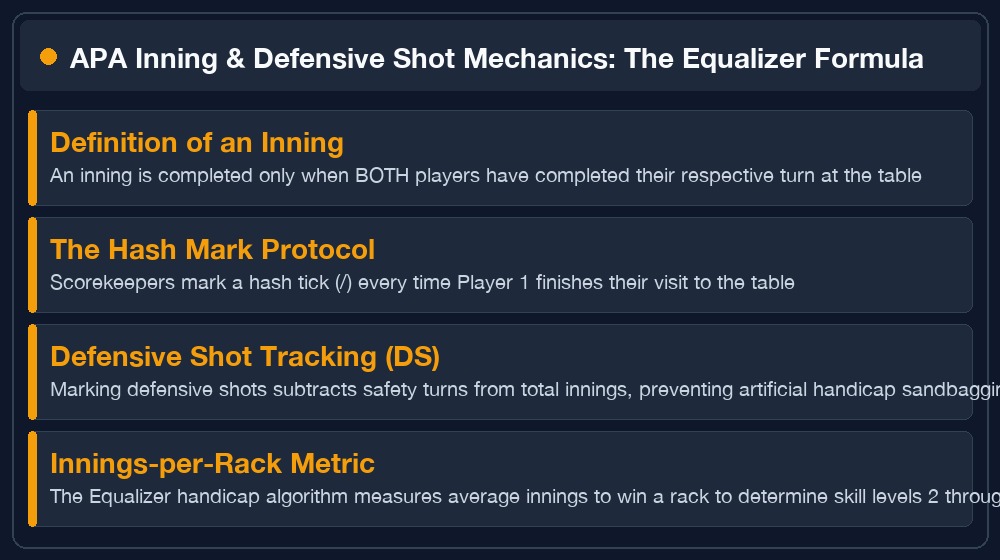
- Defensive Shots Filter (The True Efficiency Metric): This is the most widely misunderstood aspect of the system. If a game takes 14 innings, but 8 of those innings were spent engaged in tactical safety battles, logging all 14 innings as shooting misses would falsely classify the players as novices. By subtracting recorded Defensive Shots from total innings, the algorithm evaluates true offensive pocketing skill!
3. How Innings Are Counted and Evaluated (The Scorekeeper’s Standard)
Accurate scorekeeping is the lifeblood of the APA. An “inning” represents one complete turn at the table by both players:
- When Is an Inning Marked? An inning is marked on the scoresheet after the second player completes their turn. If Player A breaks and misses, no inning is marked yet. When Player B finishes their turn, Inning 1 is officially completed and marked.
- The Break Shot: The break shot is considered part of the first inning. If the breaker runs out the rack from the break (a Break and Run), the game concludes with zero innings recorded!
- Game-Ending Inning: If Player A pockets the 8-ball to win the game, that half-inning is counted, and the total innings for that rack are finalized.
4. How to Properly Mark Defensive Shots (And Stop Sandbagging)
Failing to log defensive shots is the single biggest cause of distorted handicaps and “sandbagging” complaints in the APA:
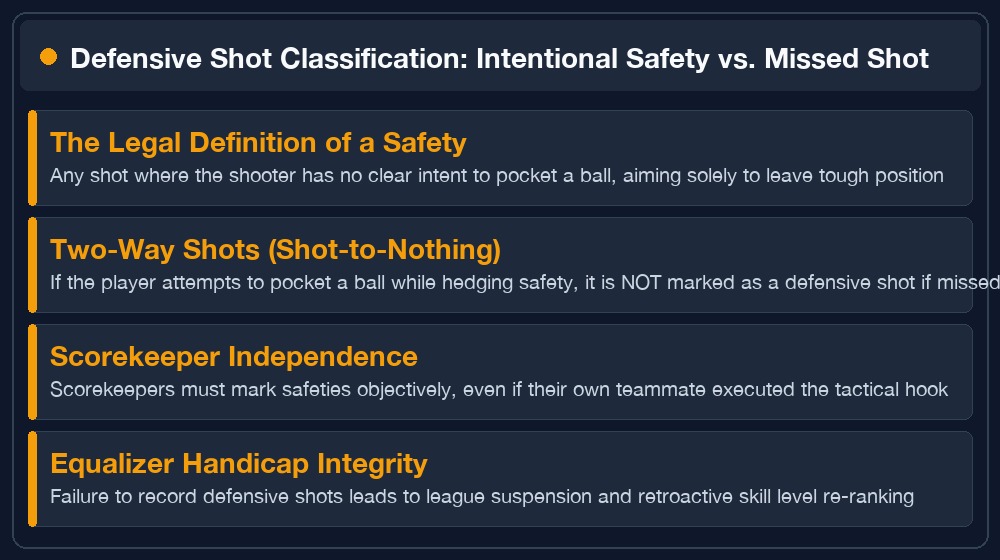
- What Constitutes a Defensive Shot? A defensive shot occurs whenever a shooter’s primary, deliberate intention is not to pocket an object ball, but rather to leave the opponent hooked, trapped on a rail, or facing an awkward layout.
- The Rule on Two-Way Shots: If a player attempts a difficult bank or cut shot while deliberately routing the cue ball behind a cluster in case they miss, the scorekeeper must evaluate: was the player genuinely trying to make the ball, or was safety the primary intent? If the player openly plays position to safe the opponent, it must be marked as defensive.
- Ethical Responsibility for Both Teams: The scorekeeper has a strict obligation under APA bylaws to mark defensive shots for both their own teammates and the opposing team. Deliberately withholding defensive marks to inflate innings and keep a teammate’s rating low is considered sportsmanship fraud.
5. The Famous 23-Rule in APA Team Roster Strategy
In standard APA team league play, weekly matches consist of five individual head-to-head singles matches. To prevent teams from stacking their rosters with semi-professional talent, the APA enforces the famous 23-Rule:
- The Rule: The total combined Skill Levels of the five players fielded on match night cannot exceed 23.
- Legal Roster Example: SL 7 + SL 5 + SL 4 + SL 4 + SL 3 = 23 (Perfect legal lineup).
- Illegal Roster Example: SL 7 + SL 6 + SL 5 + SL 3 + SL 3 = 24 (Illegal lineup; automatic forfeit of the 5th match).
- The High Value of Low-Skill Players: Because of the 23-Rule, Skill Level 2 and 3 players are the most highly prized assets on any championship team. Fielding an SL 2 or 3 allows a captain to deploy powerhouse SL 6s and 7s at the top of the roster without breaking the 23-point cap.
6. Match Points Calculation: The 3-Point System
Weekly team standings are determined by match points accumulated across all five individual sets:
| Match Outcome Scenario | Winner Match Points | Loser Match Points | Total Points Awarded |
|---|---|---|---|
| Shutout (Loser wins 0 games) | 3 Points | 0 Points | 3 Points |
| Loser reached “Hill Minus 1” | 2 Points | 1 Point | 3 Points |
| Hill-Hill Decider (Loser on the hill) | 2 Points | 1 Point | 3 Points |
7. Step-by-Step Guide: How to Fill Out an APA 8-Ball Scoresheet
Whether using a traditional paper scoresheet or the digital APA Scorekeeper app on a tablet, follow this exact workflow:
- Step 1: Record Match Metadata: Fill in team names, table number, match start time, player names, and their official Skill Levels as listed on the weekly roster sheet.
- Step 2: Track Each Inning: Use hash marks or numerical counters to record each completed inning. When a player plays a safety, immediately add a checkmark or tick in the Defensive Shots column.
- Step 3: Log Rack Winners: When the 8-ball is legally pocketed, record the game winner with a distinct mark (such as circling the rack number) and log any special accomplishments (Break and Run, 8-on-the-Break).
- Step 4: Audit and Sign Off: At the conclusion of the match, both scorekeepers must cross-check total innings, verify match points won, and sign the scoresheet before submitting it to the League Operator.
8. Pro vs Amateur Scorekeeping Case Study
Consider a match between John (SL 5) and Dave (SL 4). The match lasted 6 games. In Game 3, John played three brilliant safeties, locking Dave behind clusters. Dave responded with two legal kick safeties. The rack lasted 7 total innings.
- Amateur Scorekeeping Error: An inexperienced scorekeeper marks 7 innings and zero defensive shots. The Equalizer algorithm interprets this as two players who took 7 turns each of sloppy, missed shots. Both players’ calculated efficiency drops.
- Professional Scorekeeping Execution: The disciplined scorekeeper logs 7 innings, 3 defensive shots for John, and 2 defensive shots for Dave. The Equalizer subtracts the 5 defensive turns, calculating that the offensive pocketing took only 2 innings! Both players’ ratings remain true to their actual abilities.
9. Frequently Asked Questions
Why did my skill level increase after I lost a match?
Because the Equalizer evaluates your best 10 of last 20 match scores. If an older, lower-performing match from 20 weeks ago rolled off your record and was replaced by a match where you played exceptionally well (even if you narrowly lost 3-4), your overall statistical average rose!
Can a team violate the 23-rule if they have no other players present?
No. If a team cannot field five players without exceeding the 23-point maximum, they must forfeit the fifth match (or whichever match causes the violation). You cannot intentionally violate the 23-rule under any circumstances.
How many matches must a player complete to establish a permanent handicap?
A player requires a minimum of 10 completed match scores to establish an initial benchmark handicap, and roughly 20 scores to achieve full statistical stability.
What is the difference between an APA 8-ball and 9-ball handicap?
In 8-ball, ratings range from SL 2 to SL 7 and use a race-to-wins format. In 9-ball, ratings range from SL 1 to SL 9 and use a points-based system where ball pocketing values determine match progress.
What is a “Break and Run” patch?
If a player legally breaks the rack and pockets all seven of their suit balls followed by the 8-ball in that single inning without surrendering the table, they earn the prestigious APA Break and Run patch.
What is an “8-on-the-Break” patch?
If a player pockets the 8-ball on the opening break shot without scratching or committing a foul, they immediately win the rack and receive the APA 8-on-the-Break patch.
How long is a coaching timeout allowed to last?
Official APA rules limit coaching timeouts to one minute. Deliberate delays exceeding one minute can be penalized as a sportsmanship foul by the referee or League Operator.
Can a coach physically touch the table during a timeout?
A coach may point at balls or rails, but may never touch the cue ball or any object ball, nor place marks or chalk cubes on the rails to aid alignment. Doing so is an illegal coaching violation.

Marc Robert is the founder, chief technician, and senior equipment tester at Billiard Guides. With over 15 years of competitive amateur tournament and league experience (APA Skill Level 7 & BCA Master Division), Marc pairs deep table-side knowledge with rigorous mechanical bench testing. A certified cue mechanic and table mechanic, Marc specializes in three-piece slate alignment (calibrated using Starrett 98 precision machinist levels to ±0.005″), high-speed 240fps cue shaft deflection analysis, Shore D durometer tip hardness profiling, and Simonis worsted cloth friction testing. His independent reviews, drill curricula, and diagnostic calculators are trusted by over 500,000 cue sports players worldwide.