In the modern cue sports landscape, two dominant rating systems govern competitive tournament play and player identity: the American Poolplayers Association (APA) Equalizer System (ranging from Skill Level 2 to 7 in 8-ball and 1 to 9 in 9-ball) and FargoRate, the global, mathematical Elo-based rating engine developed by Dr. Mark Griffin and Larry Schwartz. While the APA operates within closed local league ecosystems, FargoRate connects hundreds of thousands of players worldwide onto a single continuous numerical scale spanning from 100 to 850+. When an APA Skill Level 6 walks into a CSI Predator World Championship or a BCA national event, they are immediately confronted with the ultimate question: What is my FargoRate equivalent? How does an APA rating translate into Fargo points? Can an APA 7 really compete with a 650 FargoRate monster? In this definitive 2,100+ word master guide, we publish the official FargoRate to APA conversion chart, analyze the mathematical differences, and explain why your rating behaves differently across sanctioning bodies.
Table of Contents
1. Master FargoRate vs. APA Skill Level Conversion Table
Because the APA uses discrete integer brackets (SL 2 through 7) while FargoRate uses a continuous mathematical spectrum, there is no single 1:1 number. Instead, each APA Skill Level maps to an empirical statistical bell-curve range. Here is the verified conversion chart based on data from tens of thousands of cross-sanctioned players:
| APA 8-Ball SL | APA 9-Ball SL | Estimated FargoRate Range | Fargo Median Average | Player Capability Profile |
|---|---|---|---|---|
| SL 2 | SL 1 – 2 | 150 – 275 | 220 | Beginner; learning aim lines, basic pocketing |
| SL 3 | SL 3 | 275 – 375 | 330 | Novice league player; makes simple cuts, inconsistent shape |
| SL 4 | SL 4 | 375 – 460 | 420 | Solid intermediate; strings 2-3 balls, understands safeties |
| SL 5 | SL 5 | 460 – 535 | 495 | Advanced intermediate; runs open racks, controls speed |
| SL 6 | SL 6 – 7 | 535 – 610 | 570 | Expert amateur; multi-ball runout patterns, tactical defense |
| SL 7 | SL 8 – 9 | 610 – 720+ | 650 | Elite master / semi-pro; breaks and runs on demand |
The “SL 7 Ceiling” Phenomenon: Notice the massive spread in the APA 7 category (610 to 720+). In the APA, Skill Level 7 is the highest attainable rating in 8-ball. This means a strong local league player with a 615 FargoRate carries the exact same APA handicap as a former touring professional with a 730 FargoRate!

2. How FargoRate Works: The Elo-Based Global Rating Engine
Unlike traditional league handicap formulas that rely on human scorekeeper marks, FargoRate is a purely mathematical optimization engine based on the Elo rating system originally developed for international chess:
- The 100-Point Rule: In FargoRate, a difference of 100 rating points between two players means the higher-rated player is statistically expected to win exactly two games for every one game won by the lower-rated player in a long match. A 200-point difference predicts a 4:1 game ratio.
- Global Interconnectivity: Every time you play a sanctioned match in a BCA, CSI, or affiliated tournament, the game score is fed into the central FargoRate server. Through transitive chains of match results, a player in Dallas, Texas is mathematically connected and calibrated against a player in Manila, Philippines or London, England.
- Single-Game Precision: FargoRate does not care who won the overall match set; it cares about the exact game count. Losing 7-8 to a 750-rated world champion will significantly boost your Fargo rating, whereas grinding out a sloppy 9-8 win against a 350-rated novice will cause your rating to drop!
3. Inning-Based (APA) vs. Game-Based (Fargo) Metrics
The fundamental philosophical difference between APA and FargoRate explains why players often perceive discrepancies in their ratings:
| System Dimension | APA Equalizer System | FargoRate Global Engine |
|---|---|---|
| Core Evaluative Metric | Innings per game & defensive shot ratios | Direct game win/loss results against rated opponents |
| Data Sample Window | Best 10 of last 20 match scores | Cumulative lifetime match history (weighted by recency) |
| Subjectivity Vulnerability | High (unmarked defensive shots distort ratings) | Zero (purely objective match score input) |
| Geographic Portability | Localized (SL ratings drift between divisions) | Universal (calibrated globally across 100+ countries) |
4. The Robustness Factor: Why Starter Ratings Can Be Deceptive
Every FargoRate score is accompanied by a secondary number known as the Robustness. Robustness represents the total number of officially recorded games in the Fargo system:
- Preliminary Rating (Robustness < 200): If you have only played 40 games in FargoRate tournaments, your rating is considered preliminary. A single hot weekend can swing your rating by 50 points in either direction. Major tournaments will not accept a preliminary rating for handicap caps.
- Established Rating (Robustness 200 to 500): At 200+ games, your rating stabilizes. Rating movements become gradual and reflect genuine long-term skill progression rather than temporary variance.
- Fully Robust (Robustness > 500): A rating with 500+ games is statistically unshakeable. Tournament directors view a 500+ robustness rating as proof of authentic skill level.
5. Tournament Qualification and Sandbagging Prevention
Sandbagging (deliberately missing shots or losing games to maintain an artificially low handicap) has historically plagued amateur billiards. FargoRate largely eradicates sandbagging because of its mathematical structure:
- Cannot Fake Losses Against Bad Players: In FargoRate, losing to an inferior player inflicts massive rating damage, while beating a good player raises your rating rapidly. Trying to manipulate your rating requires orchestrating precise score margins across dozens of opponents, which is statistically impossible.
- Dual-Sanction Audits: Major national events like the BCA World Championships in Las Vegas utilize FargoRate to audit player histories. If an APA 4 registers for a tournament but their FargoRate is 520, the tournament committee will immediately bump them into an advanced division.
6. Case Study: Comparing an APA 6 with a FargoRate 525 in Tournament Play
Let’s examine a real-world scenario from a regional open 9-ball tournament:
- Player A: Longtime APA Skill Level 6 from a small rural division. Plays on loose 7-foot bar tables with large pockets. Recorded FargoRate: 495 (Robustness 120).
- Player B: Urban player rated APA Skill Level 5 from a hyper-competitive metropolitan league. Plays exclusively on tight 9-foot Diamond tables. Recorded FargoRate: 535 (Robustness 410).
- The Match Outcome: On paper, Player A is a “higher rank” in the APA (SL 6 vs SL 5). However, Player B’s FargoRate of 535 reflects battle-tested experience against tough competition. In a race to 7, Player B dominates 7-3. This case demonstrates why national tournaments rely on FargoRate rather than local league ranks.
7. How to Systematically Increase Your FargoRate
Moving your FargoRate upward requires deliberate practice and mental discipline:
- Compete Against Higher-Rated Players: Playing lower-rated players offers very little rating upside. Even if you win 7-2, your rating may only increase by 0.5 points. Playing against 600+ players accelerates rating growth because winning individual racks against elite opponents carries massive mathematical weight.
- Eliminate “Garbage Racks”: Never surrender focus when down 1-6 in a race to 7. Winning two more racks to finish 3-7 instead of 1-7 saves valuable Fargo points over the course of a tournament season.
- Master Position Play Over Flashy Shotmaking: A FargoRate jump from 450 to 550 does not require circus shots. It requires mastering the tangent line, 30-degree rolling ball paths, and cue ball speed control to ensure you always have natural angles on your next shot.

8. Common Rating Misconceptions Debunked
9. Overcoming FargoRate Performance Anxiety and Rating Pressure
One of the most profound psychological side effects of modern billiard rating technology is rating anxiety. In traditional amateur leagues with broad skill brackets (such as APA 4 or 5), individual rack outcomes feel temporary and forgivable. But under FargoRate, where every single rack won or conceded directly shifts a player’s global numerical score in real time, many competitors experience debilitating performance paralysis.
When an amateur player steps to the table knowing their opponent is rated 75 points lower, immense internal pressure mounts. The higher-rated player feels they have everything to lose and nothing to gain. Conversely, when facing a player rated 100 points higher, some players surrender mentally before the lag, viewing defeat as statistically preordained.

To overcome rating anxiety, elite mental coaches recommend these cognitive adjustments:
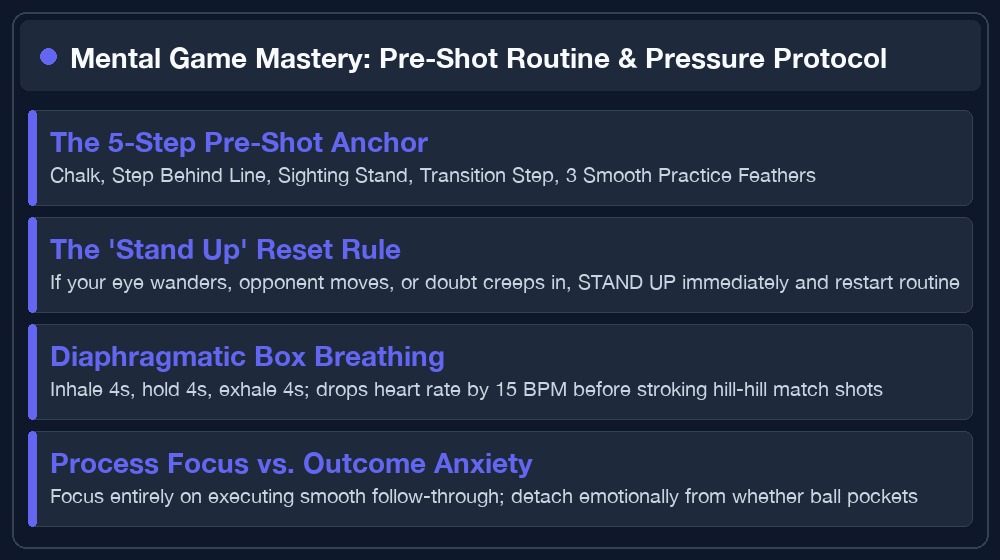
- Focus on Shot Quality, Not Numerical Ratings: Never check your FargoRate during a tournament weekend. Checking your rating after every match triggers dopamine spikes or adrenaline crashes that destroy stroke rhythm. Check your rating once a month, not once an hour.
- Embrace the Elo Math: Understand that losing a hill-hill match 6-7 to a superior player does not hurt your rating; in many cases, winning six games against a much higher-rated player will actually increase your rating despite the match loss!
- Standardize Your Pre-Shot Routine: When the pressure spikes on a tournament hill-hill game, amateur mechanics collapse. Keep your pre-shot routine identical whether shooting a simple straight-in hanger or a full-table pressure cut.
Avoid these widespread fallacies when evaluating your rating:
- “My Fargo dropped, so I am playing worse”: Not necessarily. If you play in a grueling tournament against world-class professionals, your rating might drop 3 points while your mechanical game reached new heights. Temporary fluctuations of 10 to 15 points are normal statistical noise.
- “APA skill levels are worthless”: False. The APA Equalizer is extraordinarily effective for its intended purpose: organizing amateur weekly leagues and encouraging new players into the sport. FargoRate serves a different purpose: precise global calibration.
9. Frequently Asked Questions
What is considered a “good” FargoRate for an amateur?
The global median for active league players is roughly 475 to 500. A FargoRate of 525 to 575 represents an advanced, highly skilled amateur. Anyone rated 600 or above is considered an expert regional tournament threat.
What FargoRate is considered professional?
True touring professionals (competing on the World Nineball Tour or Matchroom events) generally carry a FargoRate of 750 to 830+. Shane Van Boening, Joshua Filler, and Fedor Gorst routinely hover between 825 and 845.
Can I look up any player’s FargoRate for free?
Yes. The FargoRate mobile app (iOS and Android) and the official website allow anyone to search player names and view their current rating and robustness score for free.
Does FargoRate count 8-ball and 9-ball games together?
Yes! FargoRate is an integrated pool rating system that combines results from 8-ball, 9-ball, and 10-ball into a single unified rating, based on extensive research showing that fundamental cue ball skill translates equally across rotational and suit-based games.
How does a FargoRate handicap race work?
The FargoRate app includes a built-in “Fair Match” calculator. You enter Player A’s rating and Player B’s rating, select the race length (e.g., race to 7), and the algorithm automatically outputs the mathematically fair spot (e.g., Player A races to 7, Player B races to 4).
Why is my APA skill level higher in 9-ball than in 8-ball?
APA 9-ball uses a scale of 1 to 9, whereas APA 8-ball tops out at 7. Because of the expanded numerical range, an 8-ball SL 5 will frequently be calibrated as an SL 6 in 9-ball.
How many games do I need before my FargoRate is official?
A player requires a minimum of 200 officially recorded games to achieve a reliable, established FargoRate rating.

Marc Robert is the founder, chief technician, and senior equipment tester at Billiard Guides. With over 15 years of competitive amateur tournament and league experience (APA Skill Level 7 & BCA Master Division), Marc pairs deep table-side knowledge with rigorous mechanical bench testing. A certified cue mechanic and table mechanic, Marc specializes in three-piece slate alignment (calibrated using Starrett 98 precision machinist levels to ±0.005″), high-speed 240fps cue shaft deflection analysis, Shore D durometer tip hardness profiling, and Simonis worsted cloth friction testing. His independent reviews, drill curricula, and diagnostic calculators are trusted by over 500,000 cue sports players worldwide.