Watch any televised professional pool or snooker match, and you will notice a universal habit: before every single shot, the player rubs a small cube of chalk across the tip of their cue stick. But why is this tiny ritual so crucial? What does chalk actually do in pool? Simply put, cue chalk provides the vital friction required between the smooth leather cue tip and the polished, glassy surface of the billiard ball. Without chalk, applying rotational spin (“English”), draw, or follow would be mathematically impossible, and nearly every off-center shot would result in a disastrous miscue.
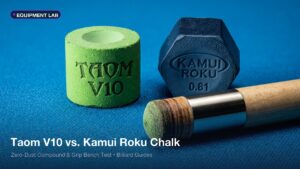
Zero-Dust Chalk Testing: See how Finland’s and Japan’s premier clean compounds compare in our bench test: Taom V10 vs. Kamui Roku.
⚡ The Physics of Chalk at a Glance
Table of Contents
The Science of Friction: Why Leather Needs Chalk
To understand why chalk is necessary, we must examine what happens at the microscopic level during cue ball impact:
The Microscopic Collision
A standard regulation billiard ball is crafted from ultra-smooth, compressed phenolic resin (such as Aramith) that has been machine-polished to a frictionless mirror sheen. Meanwhile, a cue tip is made of compressed animal leather. Over hundreds of cue impacts, the leather fibers become compressed, hardened, and “mushroomed,” developing a glazed, slick surface.
When dry, unchalked leather strikes polished phenolic resin at an angle, the coefficient of friction is far too low to grip the ball. Instead of transferring rotational kinetic energy, the leather slides off the curved surface of the sphere in less than 0.001 seconds (1 millisecond), producing the dreaded metallic “tick” of a miscue.
What is Cue Chalk Made Of? (Hint: It’s NOT Blackboard Chalk!)
One of the most persistent myths in cue sports is that pool chalk is made of the same calcium carbonate used on classroom blackboards or gymnastics hands. This is completely false.
| Component | Billiard Cue Chalk | Classroom / Gym Chalk |
|---|---|---|
| Primary Chemical Base | Crushed Silica & Alumina (Aluminum Oxide) | Calcium Carbonate or Magnesium Carbonate |
| Primary Purpose | Acts as an abrasive grit to grip the ball | Absorbs moisture and sweat from skin |
| Texture Under Microscope | Sharp, crystalline volcanic abrasive particles | Soft, powdery limestone sediment |
| Effect on Pool Cues | Creates micro-teeth that mechanically lock into resin | Acts like grease—causes instant, catastrophic miscues |
Modern billiard chalk was invented and patented in 1897 by professional billiards champion William A. Spinks and chemist William Hoskins. By combining powdered silica abrasive with binding agents and dyes, they revolutionized the sport by allowing players to strike the cue ball far from center without slipping.
How Chalk Prevents Miscues (Understanding the “Miscue Limit”)
In billiard physics, every ball has a geometric threshold known as the Miscue Limit:
The 1/2 Radius Principle
The radius of a standard pool ball is 1.125 inches (28.6 mm). You can safely hit the ball at dead center with zero chalk because the force vector points straight into the core of the ball.
However, as you move your cue tip outward to apply side spin (English), the contact angle becomes increasingly oblique. Once your tip strikes beyond half the ball’s radius (approximately 0.5 inches off-center), the normal contact force alone cannot prevent the tip from glancing off. The abrasive silica crystals in chalk provide the lateral shear resistance needed to anchor the leather during the 1/1,000th of a second of impact.
Traditional Chalk vs. High-Performance Modern Chalk
Over the last decade, chalk technology has evolved dramatically. Today, the billiard market is divided into two main categories:
1. High-Performance Clean Chalk (Taom & Kamui)
Engineered in Finland and Japan, modern synthetic chalks use proprietary organic compounds that eliminate dust, prevent “kicks” (static cling bad contacts), and do not mark up pool balls or table felt.
- Top Pro Pick: Taom Pyro Blue Chalk — The gold standard across the World 9-Ball Tour and Matchroom events. Produces virtually zero residue on the cue ball, ensuring clean, kick-free contact.
- Tournament Green Pick: Taom V10 Professional Chalk — Engineered for elite players seeking maximum grip with clean cloth properties.
- Maximum Grip Pick: Kamui Roku Hexagonal Chalk — Uses ultrafine ceramic particles for extreme spin retention on massé and jump shots.
2. Traditional American Chalk (Master & Predator)
The time-tested standard found in almost every commercial billiard room worldwide for over 80 years.
- The World Benchmark: Master Chalk (12-Pack Blue) — Made in Chicago by Tweeten Fibre Co. Offers great texture, dependable coverage, and unmatched value.
- Consistent Octagonal Pick: Predator 1080 Pure Billiard Chalk — Features an octagonal shape that prevents rolling off the table rail.
For an in-depth review and lab testing of all top brands, read our guide to the 10 Best Pool Cue Chalks.
The Proper Chalking Technique: Swipe vs. Drill Hole
How you apply chalk is just as important as what brand you use. Most casual players chalk incorrectly:
✅ The Correct Method: The Angled Swipe
Hold the chalk cube at a 45-degree angle. Gently brush or wipe the surface of the chalk across the crown of the cue tip while rotating the cue in your hand. Paint the tip evenly like an artist with a brush, paying special attention to the outer edges where English spin occurs.
❌ The Destructive Method: The “Drill” Technique
Jamming the tip into the center of the chalk cube and twisting it like a screwdriver is terrible for your equipment. It drills a deep hole in the chalk, misses the outer edges of the leather tip, and grinds abrasive chalk dust into the white ferrule, staining and weakening it.
Why Do Professionals Chalk Before Every Single Shot?
Watch champions like Shane Van Boening or Efren Reyes, and they chalk before virtually every stroke. There are two critical reasons for this:
- Insurance Against Miscues: A single impact blows approximately 80% to 90% of the chalk off the contact point of the leather. While you might safely hit a second shot near center ball, attempting a power draw or extreme side-spin shot with residual chalk is a massive, unnecessary gamble.
- The Pre-Shot Mental Routine: Chalking acts as a cognitive grounding mechanism. In professional sports psychology, repeating an identical physical ritual (like a tennis player bouncing the ball before serving or a golfer addressing the tee) calms heart rate, focuses spatial vision, and prepares the brain for stroke execution.
Frequently Asked Questions (FAQ)
Can you play pool without chalk?
You can hit the cue ball dead-center at low speeds without chalk. However, as soon as you attempt to hit with power, draw the ball backward, or apply left/right spin, the unchalked tip will slide off the ball, resulting in an immediate miscue.
Why is pool chalk usually blue?
Pool chalk was originally dyed green to match traditional green wool billiard cloth. However, when competitive tournaments shifted to blue tournament cloth (like Simonis Blue) for better television contrast in the 1970s, blue chalk became the international standard because chalk marks blend seamlessly into blue felt.
Does chalk go bad or dry out over time?
Yes. Chalk relies on a precise balance of moisture and binders. In arid climates or if left in a hot car, chalk can dry out, become crumbly, and fail to adhere to leather. Conversely, in high humidity, cheap chalk can absorb excess moisture and turn cakey. Keep your chalk stored in a climate-controlled cue case.
Why do some premium chalks cost $25 to $30 per piece?
High-end chalks like Taom Pyro use advanced dust-free organic formulas that do not shed powder onto the table or cue ball. This virtually eliminates “kicks” (unwanted ball hops or deflection caused by chalk dust getting trapped between colliding balls) and keeps expensive felt looking pristine for years.