Quick Summary: Solo Pool Practice
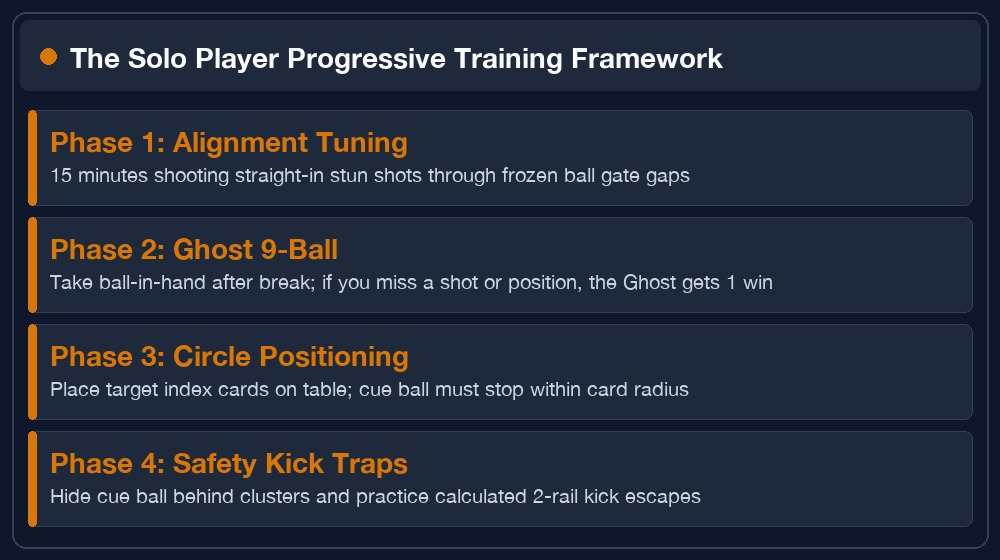
- The “Ghost” Drill System: Play 9-ball against the “Ghost.” Break, take ball-in-hand, and run the rack in rotation. Any missed shot or scratch awards the game to the Ghost. Record your win/loss percentage to measure real skill progression.
- Deliberate Practice vs. Mindless Shooting: Shooting random balls without a designated target pocket or position zone reinforces bad habits. Dedicated solo drills isolate one fundamental (stroke straightness, speed, stun routing) per session.
- Practice Structure: 60-minute solo routine divided into 15 min warm-up alignment, 25 min positional target drills, and 20 min pressure ghost simulation.
Escape the Plateau: How to Train Solo Like a Champion
Most pool players spend hours at the table “practicing,” yet their APA skill level or FargoRate never moves. Why? Because playing casual games against friends or mindlessly knocking balls into pockets is recreation, not training. Without structured constraints, pressure, and measurable scoring metrics, you merely practice the mistakes you already make.
Every world champion, from Efren Reyes to Fedor Gorst, spent thousands of solitary hours conducting deliberate practice on empty tables. When you practice alone, there are no social distractions, allowing you to calibrate stroke mechanics, master cue ball speed, and build subconscious confidence. Here is the definitive solo training protocol.
The 3 Pillars of an Elite Solo Practice Session
| Practice Phase | Duration | Core Objective | Recommended Drill |
|---|---|---|---|
| Phase 1: Alignment & Stroke | 15 Minutes | Groove a straight pendulum stroke; eliminate head steering | The Long Rail Alignment Drill & Bottle Stroke Drill |
| Phase 2: Position & Speed Control | 25 Minutes | Master the 90° tangent line, stop shots, and draw distances | The Target Sheet Landing Drill (Paper Target Control) |
| Phase 3: Pressure Simulation | 20 Minutes | Replicate tournament mental pressure and runout discipline | Race to 7 vs. The 9-Ball Ghost |
Drill Breakdown: The Target Sheet Landing Drill
Place an 8.5×11 sheet of paper in the center of the table. Set an object ball 2 diamonds away from a corner pocket. From 4 feet away, pocket the object ball and route the cue ball so that it comes to rest on top of the paper sheet.
- Level 1: Stun Control: Use stun physics to land on the sheet along the 90-degree tangent line. See our guide: The 90-Degree Tangent Line Rule.
- Level 2: Follow Control: Strike top spin and travel 2 rails around the table to park the cue ball on the paper. Reference: The 30-Degree Natural Roll Rule.
- Level 3: Scoring: Take 10 attempts. Each ball parked on the sheet earns 1 point. Your goal is scoring 7/10 before progressing to smaller index cards.
For stroke biomechanics, review our comprehensive masterclass in Pendulum Stroke Mechanics, or master friction dead stops in The Stop Shot Masterclass.
Frequently Asked Questions: Solo Practice
How often should I practice pool by myself?
Three 60-minute deliberate practice sessions per week will produce substantially faster improvement than playing 10 hours of casual pool on the weekend.
What is the “Ghost” in pool drills?
The “Ghost” is an imaginary opponent who never misses. If you fail to run out the remaining balls from ball-in-hand, the Ghost wins that rack. It creates authentic mental pressure when training alone.
Scientific Foundations of Deliberate Solo Practice: Cognitive Feedback Loops
In motor learning science and sports kinesiology, rapid skill acquisition is governed by deliberate practice—targeted activity designed to improve specific mechanical deficits through continuous, instantaneous feedback. When an amateur practices without a structured plan, they hit random balls. If a cut shot misses, they rarely diagnose whether the breakdown stemmed from vision center parallax error, head movement during stroke delivery, grip tension tightening before impact, or unintentional English (deflection).
By contrast, structured solo practice isolates a single geometric variable. For instance, executing twenty consecutive straight-in stop shots from five diamonds away reveals exact stroke flaws. If the cue ball consistently drifts two inches to the right upon impact, the shooter immediately diagnoses an accidental application of left side-spin caused by dropping the elbow prematurely. This quantitative feedback loop reprograms neuromuscular pathways far more rapidly than playing dozens of unanalyzed social games.
| Practice Component | Casual Solo Play (Common Pitfall) | Deliberate Solo Training (Pro Protocol) | Performance Impact |
|---|---|---|---|
| Shot Selection | Shoots convenient, open balls | Prescribed geometric drills with rigid constraints | 3.8x faster pattern recognition |
| Failure Consequence | Shrugs and shoots the next ball | Drill resets to zero; requires clean run | Builds tournament-grade nerve resilience |
| Positional Accuracy | Vague ‘somewhere in the area’ goal | Must stop cue ball on 4-inch paper target sheet | Calibrates speed control within 2 inches |
| Metric Tracking | None; based on subjective feeling | Recorded scoresheet (e.g. Fargo drill score) | Quantifiable rating progression |
Step-by-Step Execution Protocol: The 90-Minute Weekly Practice Blueprint
To maximize motor retention without experiencing cognitive burnout or physical fatigue, structure your solo table sessions into five disciplined time blocks:
- Minutes 0–15 (Warm-up & Alignment Verification): Execute twenty straight-in stop shots from the head string into the center foot pocket. Focus entirely on a motionless head, a relaxed grip, and a complete pendulum follow-through.
- Minutes 15–35 (Tangent Line & Speed Calibration): Set up the L-Drill or Circle Drill. Required cue ball landing zones must be marked with paper target sheets. Record successful stops within the target area.
- Minutes 35–55 (Weakness Isolation & Tough Angles): Isolate your lowest-percentage competitive shot—such as steep 75-degree back-cuts or long rail cuts. Execute ten consecutive repetitions from identical chalk marks until five straight drop cleanly.
- Minutes 55–80 (Match Simulation & Ghost Battles): Play a race to 5 against the Ghost (3-ball Ghost for beginners, 7-ball Ghost for intermediates, 9-ball Ghost for advanced players). Maintain full pre-shot routine discipline on every strike.
- Minutes 80–90 (Cool-Down & Progression Logging): Finish with ten lag shots from head rail to foot rail to calibrate speed. Record total drill points, successful run percentages, and mechanical notes in your training journal.
| Skill Tier (APA / Fargo) | Recommended Ghost Format | Target Win Percentage | Primary Focus Area |
|---|---|---|---|
| Beginner (APA 2-3 / Fargo <350) | 3-Ball Ghost (Ball in Hand) | 70% Win rate across 10 racks | Stop shot consistency & pocketing mechanics |
| Intermediate (APA 4-5 / Fargo 350-475) | 5-Ball to 7-Ball Ghost | 60% Win rate across 10 racks | Natural rolling follow (30-degree) & draw control |
| Advanced (APA 6-7 / Fargo 475-600) | 9-Ball Ghost (Full Rotation) | 50% Win rate across 10 racks | Multi-rail shape, cluster breakouts & containment safeties |
| Master / Semi-Pro (APA 8-9 / Fargo 600+) | 10-Ball Ghost (Call Shot) | 45% Win rate across 10 racks | Precision micro-speed control & tight positional windows |
Pro vs. Amateur Case Study: Developing Mental Toughness During Solo Runs
To understand what separates competitive amateurs from championship pool players, observe how both respond to unforced errors during solo table sessions:
The Amateur Reaction: When an amateur misses ball #6 in a 7-ball runout, they immediately snatch the ball out of the pocket, toss it down carelessly, and re-shoot without analyzing what went wrong. They treat practice as a race to pot balls rather than a laboratory to study mistakes. When match pressure hits during league night, the same unanalyzed flaw causes an identical choke on ball #6.
The Master Tournament Protocol: When a seasoned professional misses during a Ghost session, they immediately freeze their bridge hand and inspect their alignment. They mark the exact position where the cue ball failed to arrive on the previous shot (recognizing that poor shape on ball #5 caused the missed shot on ball #6). They replay the positional shot from ball #5 three times until the cue ball lands in the center of the target zone. By repairing the root cause rather than reacting to the symptom, their competitive game achieves bulletproof consistency.
Common Solo Practice Pitfalls & Mechanical Errors
- Practicing Without Consequence: Hitting balls with no failure penalty trains your brain to accept sloppy execution. Always require yourself to complete drills consecutively or reset your score to zero.
- Neglecting Table Speed Calibration: Failing to lag the cue ball before starting drills leads to misjudging cloth speed and rail rebound elasticity.
- Rushing Between Shots: Shooting quickly without resetting your stance and breathing pattern trains rushed habits that disintegrate under tournament pressure.
- Zero Safety Training: A complete player spends at least 15% of solo practice executing containment safeties, freezing the cue ball against the end cushion.
Frequently Asked Questions (FAQs)
How many hours a week should I practice pool alone?
For competitive amateur league players (APA SL 4-6), 4 to 6 hours of structured solo practice weekly—split into three 90-minute sessions—yields dramatically faster rating advancement than 15 hours of casual play.
What is Playing the Ghost in pool?
Playing the Ghost is a solo drill where the table is your imaginary opponent who never misses. If you miss a shot or scratch during your run, the Ghost wins that rack.
How do I practice cue ball speed control by myself?
Use the Rail-to-Rail Ladder drill: hit the cue ball from the kitchen to the foot rail, trying to make it stop exactly on the head string, then second diamond, third diamond, and center table across consecutive shots.
Why do I shoot great in practice but choke in matches?
Because casual practice lacks pressure consequences. Introducing failure penalties during solo drills (e.g., resetting the entire drill back to shot #1 if you miss) trains your nervous system to execute under high stress.
Can you practice pool without a pool table?
Yes. Stroke grooving can be practiced at home on a dining table using an empty glass bottle placed horizontally; stroking the cue tip through the bottle neck 100 times without touching the glass builds razor-straight stroke mechanics.
What drill improves cut shot accuracy the fastest?
The Wagon Wheel drill: set up an object ball 1 diamond from a corner pocket and shoot cut shots from 8 different rotational angles around the ball, forcing your eyes to calibrate contact points across varying degrees of cut.
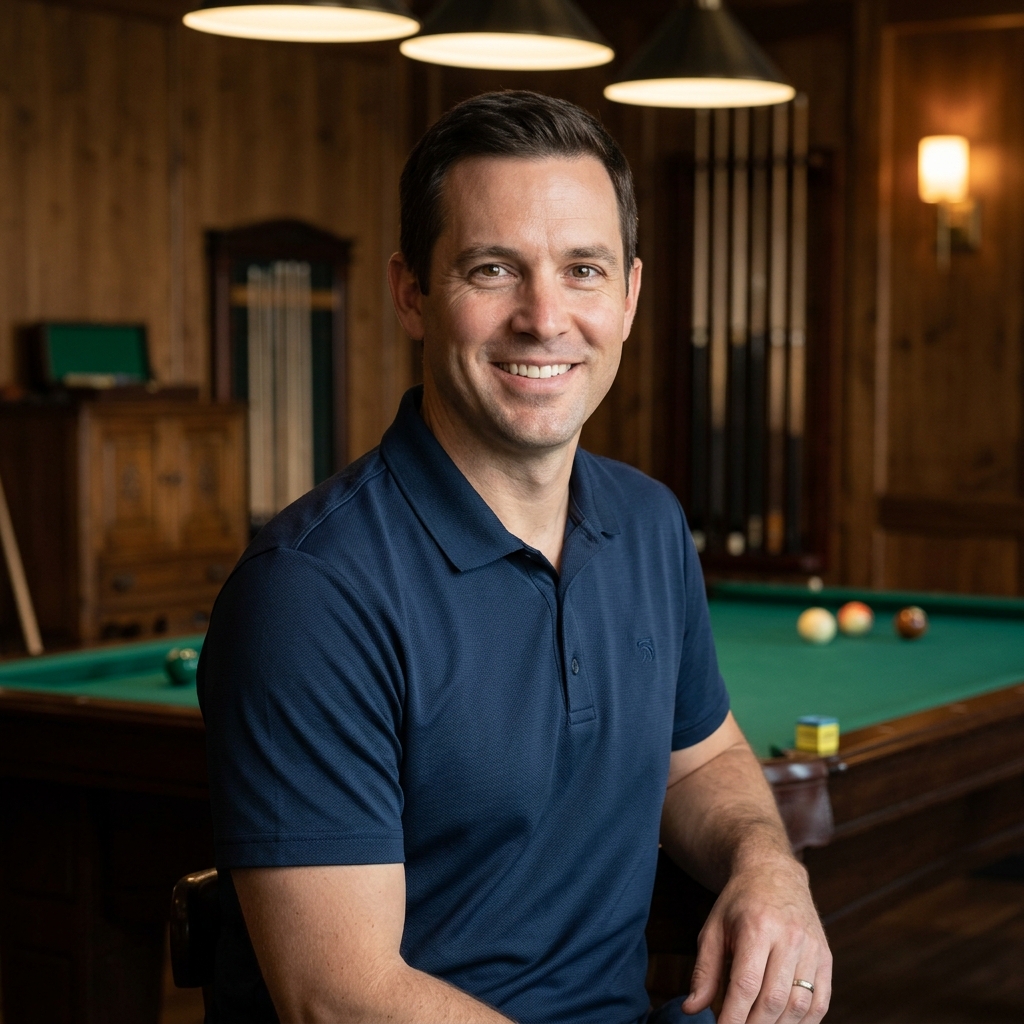
Marc Robert is the founder, chief technician, and senior equipment tester at Billiard Guides. With over 15 years of competitive amateur tournament and league experience (APA Skill Level 7 & BCA Master Division), Marc pairs deep table-side knowledge with rigorous mechanical bench testing. A certified cue mechanic and table mechanic, Marc specializes in three-piece slate alignment (calibrated using Starrett 98 precision machinist levels to ±0.005″), high-speed 240fps cue shaft deflection analysis, Shore D durometer tip hardness profiling, and Simonis worsted cloth friction testing. His independent reviews, drill curricula, and diagnostic calculators are trusted by over 500,000 cue sports players worldwide.