In the smoky lore of American pool halls, no game commands greater reverence, higher gambling stakes, or deeper intellectual respect than One Pocket. While 9-ball is a game of high-speed sprinting and rotational shotmaking, One Pocket is four-dimensional chess with cue sticks. Invented in the southern pool rooms of Oklahoma and Texas during the Great Depression, One Pocket strips away lucky rolls and chaotic clusters. Each player is assigned a single corner pocket at the foot of the table; any ball legally pocketed into your designated pocket counts as one point toward your target of eight, while any ball entering your opponent’s pocket awards them a point. But what happens when you scratch? How do scratch penalties and ball spotting work? What is the dreaded Three-Foul Rule? And how do masters wage defensive war when balls are frozen against the head rail? In this definitive 2,100+ word master guide, we break down official One Pocket rules, explain scratch point deficits, reveal advanced defensive trap strategies, and teach you how to master billiards’ most intellectual discipline.
Table of Contents
1. The Core Objective & Scoring Matrix: The Race to 8 Points
In One Pocket, fifteen object balls are racked randomly in a triangle on the foot spot. The fundamental scoring framework is deceptively simple:
| Table Action / Event | Shooter’s Assigned Pocket | Opponent’s Assigned Pocket | Neutral Pockets (Other 4 Pockets) |
|---|---|---|---|
| Ball Legally Pocketed | +1 Point (Shooter continues turn) | +1 Point for OPPONENT (Turn ends) | No points awarded; ball is spotted on foot spot |
| Scratch / Cue Ball Foul | -1 Point Penalty (Score drops by 1) | Opponent receives ball-in-hand in kitchen | Any pocketed ball on foul is spotted + penalty ball owed |
| Target to Win Game | First to 8 Points | First to 8 Points | N/A |
The Negative Score Dynamic: In One Pocket, players can have negative scores! If you scratch in the first inning before scoring a point, your score is -1. You must pocket nine balls to reach the winning threshold of eight points.
2. Official Scratch Penalties & “Owed Balls” Protocol
Scratches in One Pocket carry severe, compounding structural consequences:
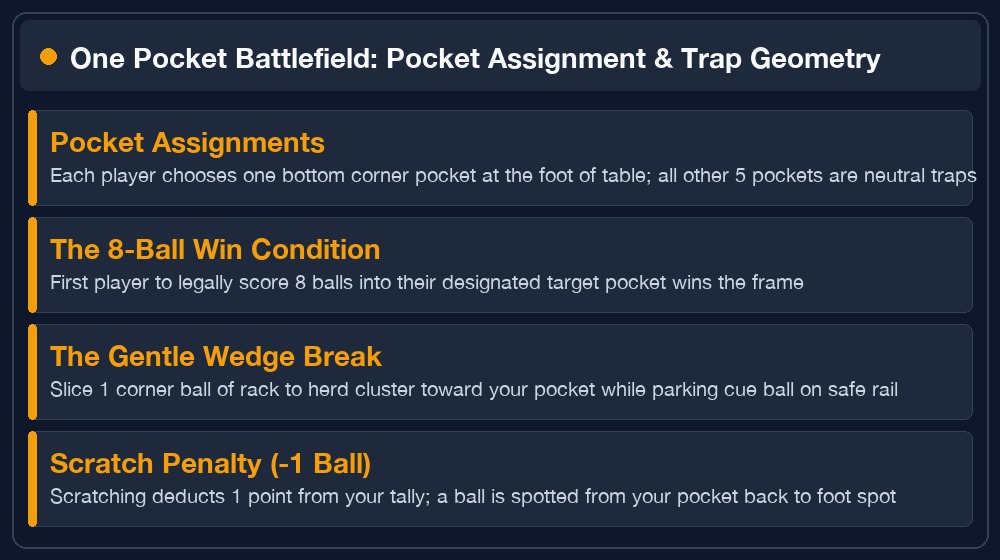
- The 1-Point Deduction: Whenever you scratch the cue ball into a pocket or drive it off the table, you are docked one point. If you currently have points in your tray, you must immediately take one of your pocketed balls and spot it on the foot spot.
- The “Owed Ball” (In the Hole): What happens if you scratch when you have zero points? You go “in the hole” (-1). You do not spot a ball immediately because you have none in your tray. Instead, the first ball you legally pocket on a subsequent inning must be spotted at the end of that inning to pay off your debt!
- Cue Ball in Hand in the Kitchen: Following any scratch, the incoming player accepts cue ball in hand behind the headstring (in the kitchen). They can shoot at any object ball located outside the kitchen, or kick off the far rail to strike a ball resting inside the kitchen.
3. Ball Spotting Rules & The Long String
Because balls pocketed into neutral pockets or spotted after scratches return to play, spotting accuracy is critical:
- The Foot Spot Priority: All spotted balls are placed directly on the foot spot.
- The Long String Alignment: If the foot spot is occupied by another ball, the spotted ball is placed directly behind it (toward the foot rail) in a straight line along the table’s longitudinal center axis, frozen flush against the blocking ball.
- End-of-Inning Spotting: In standard One Pocket rules, balls that drop into neutral pockets during a run remain in the pocket until the shooter’s inning concludes, at which point all neutral balls are retrieved and spotted simultaneously along the long string in numerical order.
4. The Infamous Three-Foul Rule in Championship One Pocket
To prevent malicious stalling and deliberate negative play, modern tournament regulations (such as the Derby City Classic One Pocket Championship) enforce the strict Three-Foul Rule:
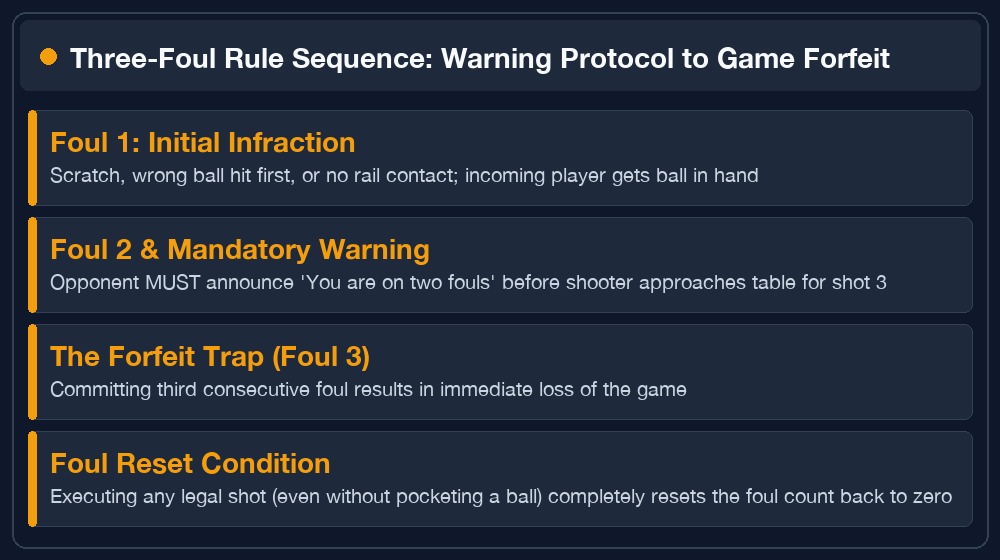
- The Rule: If a player commits three consecutive fouls or scratches in three consecutive turns at the table, they suffer an immediate LOSS OF GAME.
- Mandatory Official Warning: When a player commits their second consecutive foul, the referee or opponent must verbally declare: “You are on two fouls.” If the opponent fails to notify the player before their third shot, the penalty is voided and the player remains on two fouls.
- Tactical Use: Masters often use the Three-Foul Rule as a lethal weapon. When an opponent is trapped in a deep snooker, a master will refuse to let them escape, repeatedly putting them back into impossible traps until they concede or foul out.
5. Master Defense Strategies: The Art of the “Move”
In One Pocket, every turn at the table where you cannot safely pocket a ball is dedicated to executing a “Move”—a combination shot that advances your board position while starving your opponent:
- The Lag Safe to the Head Rail: Driving an object ball across the table toward your pocket’s side of the table while floating the cue ball to freeze flush against the head rail (9 feet away from danger). The opponent has zero direct shots and cannot attack.
- The Wedge (The Jaw Blocker): Tucking an object ball directly into the jaws of your opponent’s pocket so tightly that no other ball can enter. The opponent cannot shoot into their own pocket without knocking the wedge out!
- The “Take a Scratch” Gambit: Sometimes, giving up 1 point is the smartest play on the table. If your opponent has an open table with three balls hanging in their pocket jaws, an expert will deliberately roll the cue ball into a pocket or steer it off the table! Surrendering 1 point moves the cue ball to the kitchen, denying the opponent an easy 4-point runout.
6. The Opening Break Shot: The Corner-Ball Shave
Unlike the violent 20 MPH smash break of 8-ball or 9-ball, the opening break in One Pocket is a whisper-soft surgical procedure:
- Placement: The breaker places the cue ball in the kitchen, roughly 2 to 3 diamonds from either the left or right long rail.
- The Shave: The breaker strikes the second ball on the side of the rack with soft-medium speed, shaving the edge.
- The Dual Routing: The impact peels 2 to 3 object balls off the rack, banking them toward the breaker’s corner pocket side, while the cue ball rebounds off two rails and dies frozen against the head cushion. If executed properly, the incoming opponent has zero direct offensive shots.
7. Pro vs Amateur Case Study: Patience vs. Greed
In a legendary Derby City Classic match between Efren Reyes and a young power shotmaker:
- The Amateur Flaw: The young challenger had 6 points and saw a difficult, 8-foot bank shot into his pocket. He attacked the bank, missed by an inch. The ball rebounded across the table directly in front of Reyes’ pocket.
- The Master Punishment: Reyes stepped up, pocketed the gift ball, and smoothly ran out six consecutive banks and cut shots to win 8-6. Reyes never attempted a shot with less than 90% positional insurance; he simply waited for the amateur’s patience to break.
8. Legendary Masters & The Evolution of One Pocket Strategy
The strategic framework of modern One Pocket was forged by mid-20th-century pool hall legends whose tactical innovations revolutionized the sport:
- Ronnie “Fast Eddie” Allen: In the 1960s and 70s, Ronnie Allen transformed One Pocket from a slow, grinding containment game into an aggressive art form. Allen pioneered the “power one pocket” style, demonstrating that high-speed multi-rail banks and offensive caroms could blow open games while still leaving the cue ball safe.
- Efren “Bata” Reyes: Widely regarded as the greatest One Pocket player to ever live. Reyes dominated the Derby City Classic One Pocket division for decades through his superhuman mastery of kick-shot physics, diamond geometry, and three-rail safety escapes. Reyes proved that patience and defensive entrapment will consistently defeat raw firepower over a long race.
- The Modern Era (Scott Frost & Tony Chohan): Today’s elite players combine Reyes’ surgical positional containment with Allen’s aggressive bank pocketing, utilizing precision carbon-fiber low-deflection shafts to execute micro-fine rail cut safeties with millimeter accuracy.
9. The Anatomy of the Foot Rail Wedge Defense
When an opponent is trapped in a defensive cycle, masters frequently employ the Foot Rail Wedge. By gently clipping an object ball to roll it into the cluster near the foot spot while drawing the cue ball back into the opponent’s corner pocket pocket jaws, you freeze the opponent in total tactical paralysis. If they attempt to blast free, they risk pocketing a ball into your pocket. If they tap softly, you retain complete board control on your subsequent inning.
10. Frequently Asked Questions
What happens if I pocket an object ball in my pocket AND scratch?
The pocketed ball does not count as a point. The ball is spotted on the foot spot, you are docked a 1-point penalty (losing a point or going into the hole), and your opponent receives ball-in-hand in the kitchen.
Can I win One Pocket if my opponent scratches three times in a row?
Yes! Under the official Three-Foul Rule, three consecutive fouls by an opponent results in an immediate forfeit and win of the game for you, provided the mandatory two-foul warning was properly given.
What if I accidentally pocket a ball in my opponent’s pocket?
It counts as an immediate point for your opponent! Your turn ends, and your opponent keeps the point. This is why shooting near your opponent’s pocket is extraordinarily dangerous.
Can the cue ball be shot backward from the kitchen after a scratch?
No. When you receive ball-in-hand in the kitchen, the cue ball must cross the headstring before making contact with any object ball or rail.
What is a handicap “spot” in One Pocket gambling matches?
In gambling matches between players of differing skill, players spot balls. For example, in an “8 to 6” game, the master must reach 8 points, but the amateur only needs 6 points to win.
What happens if all 15 balls are on the table and neither player can shoot?
If both players agree that the table layout is completely stalemated and neither player wishes to alter position, the balls are re-racked and the original breaker breaks again.
How long does a typical game of One Pocket take?
Between experienced players, a single rack of One Pocket can last anywhere from 20 to 45 minutes, making it the most deliberate, strategic game in cue sports.

Marc Robert is the founder, chief technician, and senior equipment tester at Billiard Guides. With over 15 years of competitive amateur tournament and league experience (APA Skill Level 7 & BCA Master Division), Marc pairs deep table-side knowledge with rigorous mechanical bench testing. A certified cue mechanic and table mechanic, Marc specializes in three-piece slate alignment (calibrated using Starrett 98 precision machinist levels to ±0.005″), high-speed 240fps cue shaft deflection analysis, Shore D durometer tip hardness profiling, and Simonis worsted cloth friction testing. His independent reviews, drill curricula, and diagnostic calculators are trusted by over 500,000 cue sports players worldwide.