Amateur pool players obsess over spectacular, high-risk potting. They drill full-table bank shots, attempt razor-thin cuts, and blast through clusters hoping for miraculous rolls. Yet when you watch elite champions like Efren Reyes, Shane Van Boening, or Allison Fisher compete in high-stakes 8-ball, you witness a game governed by cold, calculating tactical warfare. In competitive 8-ball, pocketing balls when you do not have a guaranteed, high-percentage path to the 8-ball is tactical suicide. Every ball you pocket removes a potential blocker, opens the table for your opponent, and leaves you vulnerable to a counter-attack. The true master understands that the safety shot is an offensive weapon designed to extract ball-in-hand and win matches. In this definitive 2,100+ word tactical masterclass, we reveal the mathematical principles of 8-ball defense, break down 5 deadly safety traps that dismantle opponents, examine official foul rules, and teach you how to think three innings ahead of your competition.
Table of Contents
1. The Strategic Philosophy: When to Shoot vs. When to Safe
The fundamental dividing line between an APA Skill Level 4 and a Skill Level 7 is the Runout Probability Threshold. Before addressing any shot, an expert runs a cold calculation:
| Table Layout Condition | Amateur Decision Pattern | Master Tactical Decision | Statistical Win Probability Impact |
|---|---|---|---|
| One Problem Ball Clustered on Rail | Pockets 4 easy balls, then hopes to make a heroic breakout | Plays an immediate safety to break problem ball or snooker opponent | Increases win probability from 35% to 78% |
| Opponent Has 1 Ball Left + 8-Ball | Tries a 70% cut shot to keep shooting | Locks the cue ball behind an opponent ball or freezes it on rail | Prevents immediate opponent runout; forces ball-in-hand |
| Open Table, No Clear Pattern | Blasts an easy ball to claim a suit immediately | Plays a containment safe; leaves cue ball in awkward kitchen zone | Forces opponent to make the first mistake |
The Iron Rule of 8-Ball: Never run five balls just to leave yourself stuck on the sixth. If you cannot see a 90%+ probability runout pattern from your current shot all the way to the 8-ball, play a safety immediately while you still have object balls on the table to use as shields!
2. Official Legal Safety Requirements (WPA & APA Rule 3.7)
Before executing defensive traps, you must understand what constitutes a legal billiard shot. Under official WPA, BCA, and APA tournament regulations, a shot is legal if and only if:
- First Contact: The cue ball must make first contact with a legal object ball of your assigned suit (solids or stripes), or any legal ball on an open table.
- Cushion or Pocket Requirement: AFTER the cue ball contacts your legal object ball, at least one ball (either the cue ball, your object ball, or any other ball) must contact a cushion or drop into a pocket.
- The “Slow-Roll” Trap Warning: Simply rolling the cue ball gently into your ball without driving any ball to a rail afterward is a FOUL! This foul awards your opponent ball-in-hand anywhere on the table, instantly destroying your defense.
3. The 5 Deadly 8-Ball Safety Traps
Trap 1: The Full Snooker (The Cluster Shield)
The most devastating safety in cue sports. You contact your legal object ball softly, sending it gently toward a cushion while routing the cue ball to come to rest directly behind a tight cluster of your opponent’s balls. With your opponent’s own balls blocking all direct sightlines to their targets, they are forced into a blind multi-rail kick shot. A missed kick grants you universal ball-in-hand.
Trap 2: The Rail Freeze (The Friction Lock)
When you cannot completely hide the cue ball behind a blocker, freeze it directly against the cushion. A cue ball that is “welded” to the wood rail leaves the opponent zero clearance for their cue tip. They cannot strike downward without risk of scooping or miscuing, cannot impart draw or follow, and are forced into an awkward, inaccurate elevated bridge.
Trap 3: The Pocket Tie-Up (The Hostage Ball)
If your opponent has an easy hanging ball sitting directly in front of a pocket, do not let them enjoy it. Play a controlled combination or carom safety that rolls one of your balls directly in front of their pocket hanger, jamming the pocket jaws. Now, their easiest shot is tied up in a dead cluster, neutralizing their runout advantage.
Trap 4: The Maximum Distance Separation Safe
Physics dictates that pocketing difficulty scales exponentially with distance. When no hiding blocker exists, drive your object ball to one end of the table while sending the cue ball to the opposite corner rail (8 to 9 feet away). Leaving your opponent facing a 90-inch cut shot down the rail carries a massive failure rate for amateur players.
Trap 5: The “Two-Way” Shot (Offense with Insurance)
The hallmark of professional play. A two-way shot is an offensive pot attempt engineered so that if the ball misses, the cue ball naturally travels behind a cluster or into a locked rail position. If you make the ball, you continue your runout; if you miss, your opponent is left completely hooked!
4. Step-by-Step Execution: Speed Control & Tangent Lines
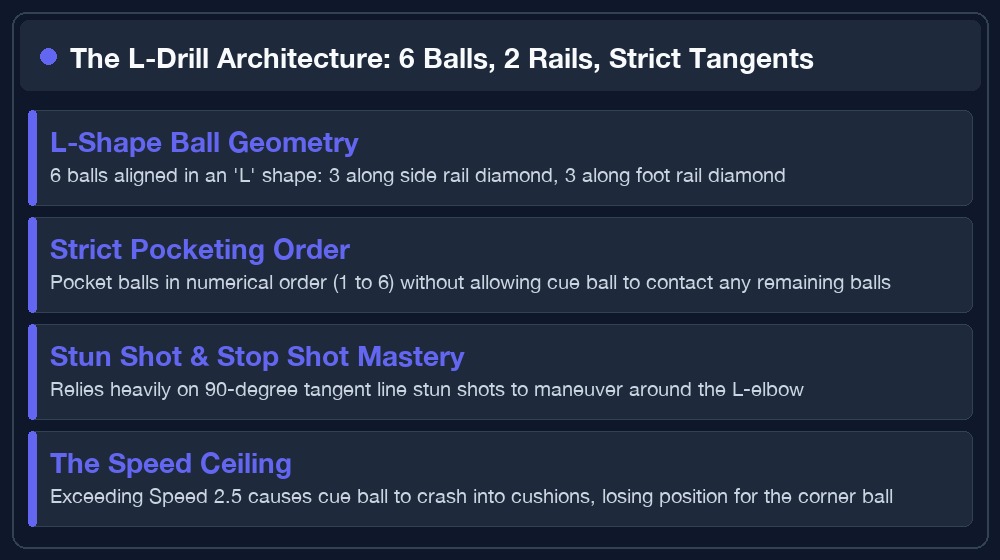
Executing precision safeties requires mastering the 90-Degree Tangent Line and speed control:
- Step 1: Stun Hit for Predictability: Striking the cue ball with sliding stun (preventing forward roll or backward draw at impact) forces the cue ball to travel along the exact 90-degree tangent line from the object ball path. This makes cue ball routing 100% mathematically predictable.
- Step 2: Calibrate Lag Speed: Elite safeties require “lag speed”—cue ball momentum that dies within 3 inches of the cushion. Practice stroking with a relaxed grip to avoid punching the ball with excess adrenaline.
- Step 3: Call “Safety” in Call-Shot Games: Under BCA/WPA tournament rules, if you intend to pocket your own ball while intentionally surrendering your turn (a safety pocket), you must verbally declare “Safety” to your opponent or referee before the shot.
5. Pro vs Amateur Tactical Case Study: The 8-Ball Endgame
Consider a tense tournament hill-hill game. Player A has one solid left (the 4-ball), but it is tied up against the 8-ball near the foot rail. Player B has five stripes scattered openly across the table.
- The Amateur Reaction: Player A attempts a wild bank shot on the 4-ball to break it free. The ball misses, scattering the cluster. Player B steps up to an open table and effortlessly runs all five stripes and the 8-ball to win the match.
- The Master Tactical Execution: Player A softly clips the 4-ball, driving it 6 inches while rolling the cue ball behind the cluster, pinning Player B on the head rail. Player B cannot see any stripes directly, scratches on a multi-rail kick, and hands Player A ball-in-hand to easily break the cluster and win.
6. Common Safety Mistakes That Backfire
Executing a bad safety is worse than missing a pot. Avoid these three deadly traps:
- The “Half-Safe” (The Graveyard Shot): Leaving the cue ball 4 feet away without a full hook. An opponent with good shotmaking skills will bury the cut and run out the table. A safety must be absolute: either completely hooked, frozen on a rail, or maximum distance.
- Failing to Drive a Ball to a Rail: The most heartbreaking foul in amateur pool. A player plays a gorgeous snooker but forgets the legal cushion rule, surrendering ball-in-hand.
- Selling Out the 8-Ball: Never play a safety that leaves the 8-ball in open pocket view if the opponent can legally make contact with it.
7. How to Escape When Your Opponent Safeties You
When you find yourself locked in a deadly safety trap, stay calm and follow this defensive protocol:
- Use the Diamond System: Mirror the angle from the cue ball to the target cushion using table rail diamonds to calculate exact single-rail and two-rail kick trajectories.
- Play a Counter-Safety Kick: Do not just try to nick your object ball. Kick into your ball with controlled speed to drive your ball toward a safe rail while returning the cue ball to an awkward position.
- Consider the Jump Shot (Where Legal): If local league rules allow specialized jump cues, elevate your cue stick to 45 degrees and legally hop over the blocking ball to make direct contact.
8. Tip Maintenance & Shaft Care for Stiff Short Cues
Because short pool cues feature a stiffer, more abrupt conical taper than standard pro-taper shafts, the impact shock transmitted to the cue tip is significantly higher. Without the 12-to-14-inch flexible flex zone of a tournament shaft, the tip absorbs direct kinetic rebound on every shot:
- Scuffing and Chalk Adhesion: Keep a nickel-radius tip scuffer in your accessory kit. Stiff short cues require frequent scuffing to ensure chalk grips the leather firmly. Miscues with a short cue often result in the cue tip glancing violently into the ball, scuffing the cloth.
- Preventing Tip Mushrooming: Due to higher direct compression forces, soft leather tips mushroom rapidly on short cues. We strongly recommend equipping your trouble cue with a medium-hard or hard layered tip (such as Kamui Brown Hard or Tiger Everest), which resists deformation and holds its dome shape over thousands of strikes.
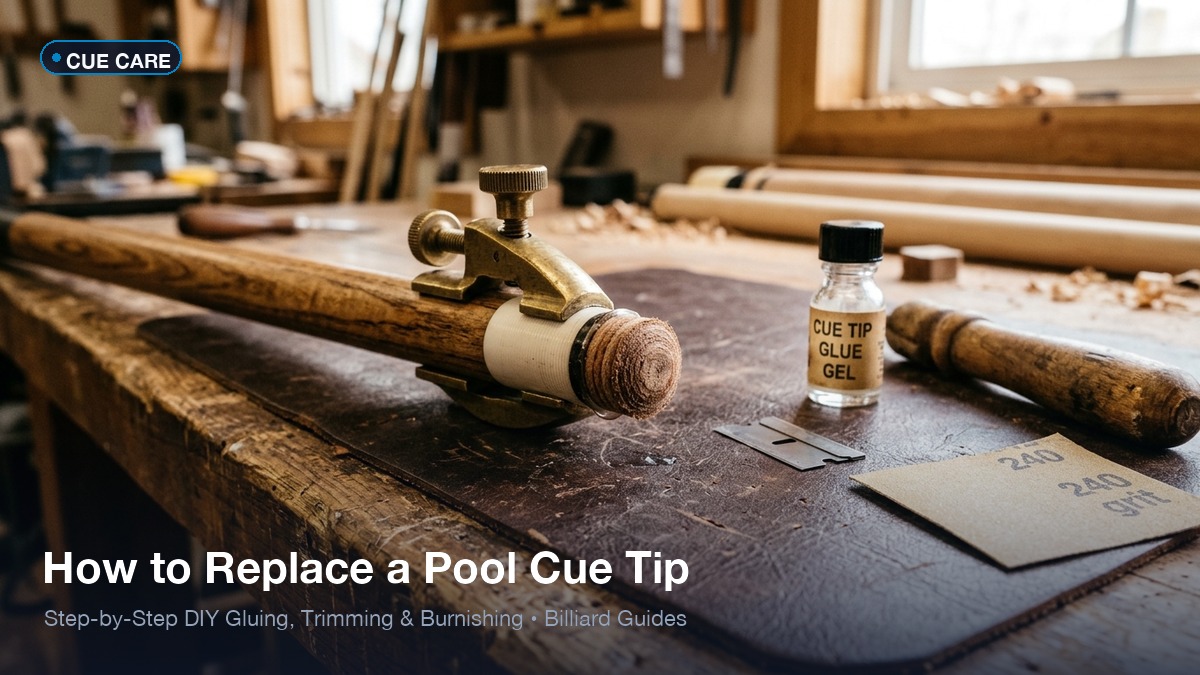
- Shaft Burnishing: Never use heavy sandpaper on maple trouble cue shafts. Use a leather burnishing pad or unprinted cardboard to buff the wood smooth, sealing the grain against basement humidity and chalk dust intrusion.
9. Real-World Case Study: Sinking the Match-Winning 8-Ball Around a Support Post
Consider a tense League Finals hill-hill game. The 8-ball sits 4 inches off the side pocket, but the cue ball rests frozen against the long rail directly aligned with a steel basement support pole. With a standard 58-inch cue, the shooter would have to elevate their cue butt at a comical 60-degree angle (“jacked-up banana shot”), risking an errant scoop foul or missed pot.
Instead, the player pulls a 48-inch Action Trouble Shooter from the wall rack. With 10 full inches of backswing clearance gained, the shooter drops into a completely level shooting stance, aligns their chin over the shaft, and strokes smoothly through center ball. The 8-ball drops dead center into the pocket, clinching the championship without touching the pole. This single shot illustrates why a trouble cue is the highest-ROI investment in any home billiard room.
10. Frequently Asked Questions
Can you legally play a safety in APA 8-ball?
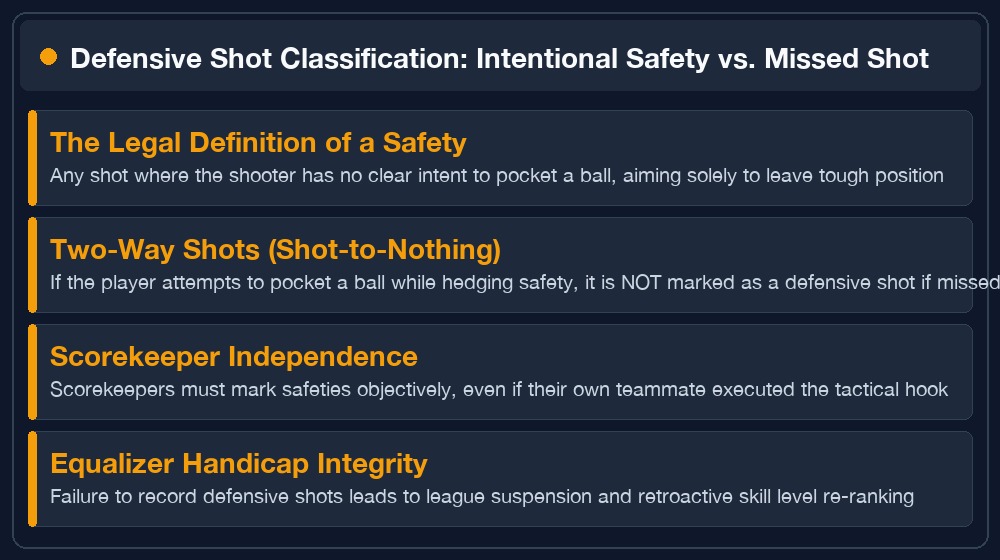
Yes, absolutely! Safeties are 100% legal in the APA. Furthermore, scorekeepers are required under APA bylaws to mark every deliberate defensive shot on the scoresheet to protect handicap accuracy.
Do I have to call “Safety” before shooting in 8-ball?
Under BCA and WPA call-shot rules, you only need to verbally declare “Safety” if you intend to pocket an object ball and surrender your turn. If you are not pocketing a ball, no verbal declaration is required, though good sportsmanship encourages clarity.
What happens if I accidentally pocket my ball while playing a safety?
Under BCA rules, if you did not declare “Safety” before shooting and your ball drops into an uncalled pocket, it is a foul-free miss: your ball stays down, your inning ends, and your opponent accepts the table as it lies.
Can you jump a cue ball over an opponent ball to escape a safe?
Under WPA, BCA, and CSI tournament rules, legal jump shots executed by elevating the cue stick and striking downward on the upper hemisphere of the ball are legal. However, scooping underneath the ball with the cue tip is an illegal foul.
What is a “Two-Way” shot?
A two-way shot is a shot designed so that if you pocket the target ball, you continue shooting, but if you miss, the cue ball’s path automatically snookers or isolates your opponent.
Can I hit my opponent’s ball first if I am completely snookered?
No. Striking an opponent’s ball first is an immediate foul that awards your opponent ball-in-hand anywhere on the table.
Is it unsportsmanlike to play safeties in bar pool?
While casual bar players sometimes complain about safeties (“dirty pool”), competitive billiards at all sanctioned levels views defensive play as an essential, sophisticated discipline of the sport.

Marc Robert is the founder, chief technician, and senior equipment tester at Billiard Guides. With over 15 years of competitive amateur tournament and league experience (APA Skill Level 7 & BCA Master Division), Marc pairs deep table-side knowledge with rigorous mechanical bench testing. A certified cue mechanic and table mechanic, Marc specializes in three-piece slate alignment (calibrated using Starrett 98 precision machinist levels to ±0.005″), high-speed 240fps cue shaft deflection analysis, Shore D durometer tip hardness profiling, and Simonis worsted cloth friction testing. His independent reviews, drill curricula, and diagnostic calculators are trusted by over 500,000 cue sports players worldwide.