Every basement game room designer and home pool table owner eventually faces the dreaded “Obstacle Shot.” You have dialed in your dream 8-foot slate table, installed brilliant tournament lighting, and laid down premium Simonis felt. But when the cue ball drifts toward the long rail, you address your shot only to hear a sickening thunk: your 58-inch cue stick butt has slammed into a drywall basement wall, a structural steel lally column, or a brick fireplace hearth. Moving the table isn’t an option, and knocking down a load-bearing wall is out of the question. Your salvation lies in specialized short pool cues (commonly known as “trouble cues”). But should you buy a 48-inch or a 52-inch cue? How much does reduced length and lighter weight impact your stroke balance, cue ball deflection, and shotmaking accuracy? Can a short cue actually produce tournament-grade spin and draw? In this definitive 2,100+ word buyer’s guide and technical review, we put 48-inch and 52-inch trouble cues through rigorous deflection and balance testing, explain room obstacle clearance math, and review the top models on the market today.
Table of Contents
1. 48-Inch vs. 52-Inch Trouble Cues: Head-to-Head Comparison Matrix
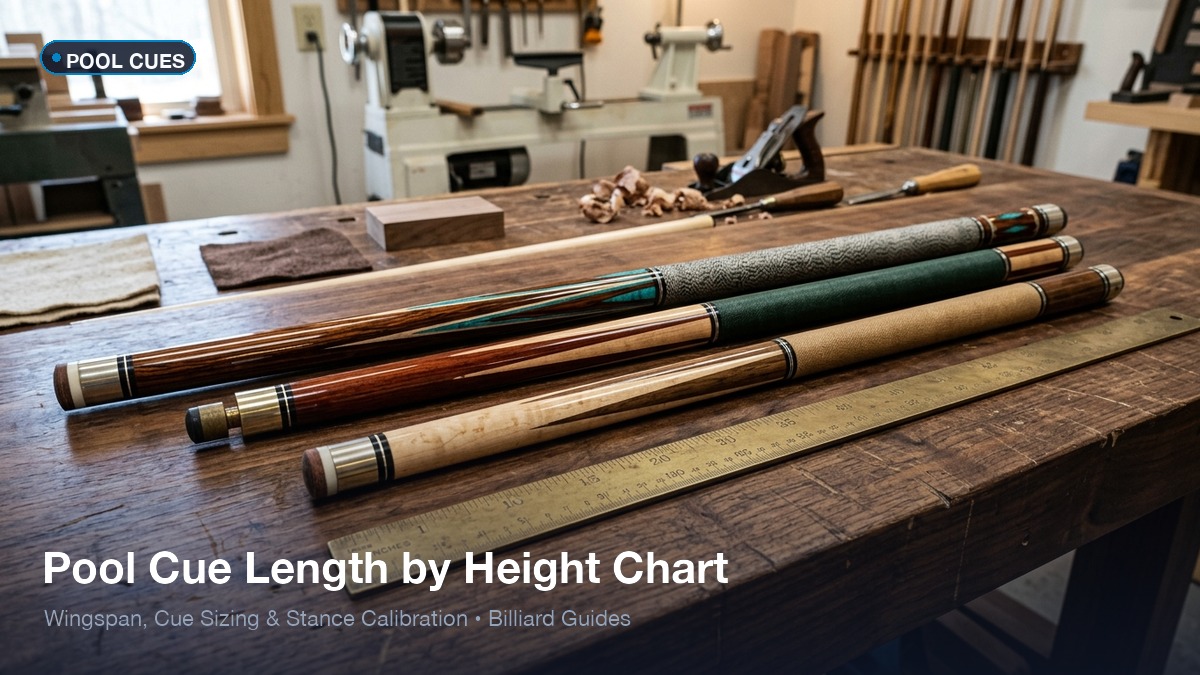
Short cues are not simply scaled-down toys; high-end trouble cues are precision instruments engineered with balanced weight bolts and tapered Canadian maple shafts. Here is how 48-inch and 52-inch models compare:
| Performance Metric | 48-Inch Short Cue (Trouble Cue) | 52-Inch Mid-Length Cue | Standard 58-Inch Two-Piece Cue |
|---|---|---|---|
| Wall Clearance Gained | +10 Inches of backswing freedom | +6 Inches of backswing freedom | Baseline (Requires 5′ clearance) |
| Typical Total Weight | 14 – 16 oz (Lightweight feel) | 16 – 18 oz (Near-standard feel) | 18 – 20 oz (Traditional weight) |
| Stroke Pendulum Naturalness | Requires shortened bridge & wrist snap | 90% identical to full 58” pendulum stroke | 100% natural anatomical stroke |
| Tip Diameter | 12.5mm – 13mm Hard Leather | 12.5mm – 13mm Medium Leather | 11.75mm – 13mm Multi-Layer |
| Best Room Obstacle Match | Severe bottlenecks, support columns < 4 ft | Minor wall pinches, 4’3” to 4’8” clearance | Unobstructed 5-foot perimeter |
2. The Physics of Short Cues: Balance Point, Mass & Cue Ball Squirt
When you shorten a cue stick from 58 inches down to 48 or 52 inches, fundamental physical properties shift:
- Forward Balance Point Migration: On a standard 58-inch cue, the balance point sits roughly 18 to 19 inches forward from the butt cap. On a cheap 48-inch cue, cutting 10 inches off the butt shifts the balance point awkwardly forward toward the joint, making the cue feel “nose-heavy.” High-end trouble cues (such as Action Trouble Shooter or McDermott Shorties) incorporate heavy butt weight bolts to pull the center of gravity back into the player’s rear hand.
- Mass and Kinetic Energy Transfer: Because a 48-inch cue weighs only 14 to 15 ounces compared to an 19-ounce tournament cue, you must generate slightly higher cue acceleration to achieve the same cue ball speed. Trying to “muscle” the shot with shoulder tension ruins accuracy; focus on a smooth, fluid stroke with wrist snap.
- Shorter Taper and Low Deflection: Shorter cues naturally feature a stiffer shaft taper. This stiffness minimizes shaft vibration on impact, resulting in surprisingly low cue ball deflection on center-ball and rolling stun shots.
3. Clearance Math: How Much Space Do You Actually Gain?
Let’s calculate the real-world clearance math in a cramped basement room:
Standard 58” Cue Deficiency = 58” cue + 4” backswing = 62” needed (-14” deficit → Unplayable!)
52” Cue Fit = 52” cue + 4” backswing = 56” needed (-8” deficit → Still cramped!)
48” Cue Fit = 48” cue + 3” backswing = 51” needed (±3” manageable with slight angle)
The Takeaway: If your room bottleneck leaves you with less than 4 feet 4 inches of clearance from the cushion nose, a 52-inch cue will still hit the wall. You must step down to a 48-inch (or 42-inch) trouble cue to guarantee complete stroke freedom.

4. Stroke Mechanics Adjustments for Shooting with a Short Cue
Do not attempt to shoot with a 48-inch cue the exact same way you address a 58-inch cue. Follow these three mechanical adjustments:
- Shorten Your Bridge Distance: On a standard cue, your bridge hand sits 8 to 10 inches from the cue ball. On a 48-inch cue, choke up and set your bridge hand 5 to 6 inches from the ball. This keeps your grip hand over the balanced center of the butt section.
- Compact Your Backswing: Do not pull back a massive 8-inch backswing. Limit your backswing to a controlled 3 to 4 inches, relying on clean forward acceleration and pure center-ball contact.
- Stay Down and Resist Scooping: Because the cue is light, novice players tend to “steer” or scoop upward at impact. Keep your bridge hand locked firmly into the felt and maintain a level cue stick trajectory through the finish.
5. Top Short Cues on the Market: Hands-On Reviews
Here are the premier trouble cues evaluated across build quality, balance, and tip performance:
- Action Trouble Shooter (Best Overall Value): Specifically engineered for room obstacles. Features an internal weighted butt system that delivers an authentic 18-ounce feel even in 48-inch and 42-inch lengths. Fitted with a quality 13mm layered leather tip.
- McDermott Lucky Short Cue (Best Craftsmanship): Built by McDermott with high-grade hard rock maple and a premium Irish linen wrap. The 52-inch model feels virtually indistinguishable from a full-size cue, making it the top choice for tight rooms with minor bottlenecks.
- Players E-2300 Trouble Cue (Best Budget Option): Solid one-piece or two-piece maple construction with a high-gloss finish. Lightweight (14-15 oz) and extremely durable for family recreation rooms.
6. Can Children and Junior Players Use Trouble Cues?
Short cues are not just for tight basements; they are the ultimate training cues for young junior players:
- Anatomical Proportions: Handing a 58-inch, 19-ounce cue to an 8-year-old child forces them to hike the cue over their shoulder, creating bad elbow-dropping habits that last a lifetime.
- The Correct Youth Size: Children under 4’6” tall thrive with a 42-inch or 48-inch cue weighing 12 to 14 ounces. It allows them to maintain a proper level pendulum stroke and parallel stance.
7. Common Mistakes When Buying Short Cues
Avoid these three widespread consumer errors:
- Buying Cheap Screw-On Plastic Tips: Inexpensive department store short cues come with terrible hard plastic screw-on tips that miscue constantly and can scuff the cue ball. Always insist on a genuine glued leather tip (water-buffalo, Le Pro, or layered leather).
- Buying Only One Length: If your room has a support post on one side and a short wall on the other, buying a two-cue package (one 48-inch and one 52-inch) covers every possible obstacle scenario.
- Sawing Off an Old Cue at Home: Homeowners often attempt to create a trouble cue by cutting 10 inches off an old warped bar cue with a handsaw. This ruins the balance, leaves a ragged splintered butt, and results in a cue that shoots terribly. Invest in a properly counterbalanced factory short cue.
8. Legendary Masters & The Evolution of One Pocket Strategy
The strategic framework of modern One Pocket was forged by mid-20th-century pool hall legends whose tactical innovations revolutionized the sport:
- Ronnie “Fast Eddie” Allen: In the 1960s and 70s, Ronnie Allen transformed One Pocket from a slow, grinding containment game into an aggressive art form. Allen pioneered the “power one pocket” style, demonstrating that high-speed multi-rail banks and offensive caroms could blow open games while still leaving the cue ball safe.
- Efren “Bata” Reyes: Widely regarded as the greatest One Pocket player to ever live. Reyes dominated the Derby City Classic One Pocket division for decades through his superhuman mastery of kick-shot physics, diamond geometry, and three-rail safety escapes. Reyes proved that patience and defensive entrapment will consistently defeat raw firepower over a long race.
- The Modern Era (Scott Frost & Tony Chohan): Today’s elite players combine Reyes’ surgical positional containment with Allen’s aggressive bank pocketing, utilizing precision carbon-fiber low-deflection shafts to execute micro-fine rail cut safeties with millimeter accuracy.
9. The Anatomy of the Foot Rail Wedge Defense
When an opponent is trapped in a defensive cycle, masters frequently employ the Foot Rail Wedge. By gently clipping an object ball to roll it into the cluster near the foot spot while drawing the cue ball back into the opponent’s corner pocket pocket jaws, you freeze the opponent in total tactical paralysis. If they attempt to blast free, they risk pocketing a ball into your pocket. If they tap softly, you retain complete board control on your subsequent inning.
10. Frequently Asked Questions
What is the shortest legal pool cue in tournament play?
Under official WPA and BCA tournament rules, a cue stick must measure a minimum of 40 inches (101.6 cm) in length. Standard 48-inch and 52-inch trouble cues are 100% legal for tournament competition.
Can you draw the cue ball with a 48-inch cue?
Yes. Because draw is generated by tip contact beneath center ball and clean cue acceleration rather than raw stick weight, a skilled player can effortlessly draw the cue ball full-table with a 48-inch cue.
Are 1-piece short cues better than 2-piece short cues?
One-piece short cues offer exceptional solid hit feel and durability. However, two-piece short cues (with standard 5/16×18 or quick-release joints) are much easier to transport in a cue case to league matches.
How much clearance do I gain with a 48-inch cue?
A 48-inch cue gives you exactly 10 inches of additional wall clearance compared to a standard 58-inch cue, transforming an unplayable rail shot into a comfortable, natural stroke.
What weight should a short cue be?
High-end short cues feature internal weight bolts that bring total weight to 16 to 18 ounces, providing enough mass to prevent deflection while remaining maneuverable.
Can I use a jump cue as a trouble cue in tight spaces?
While a jump cue butt is short (roughly 40-45 inches total), jump cues are equipped with ultra-hard phenolic tips designed to bounce balls, making them terrible for delicate cut shots. Always use a dedicated trouble cue with a soft or medium leather tip.
What is a “banana shot”?
A banana shot (or elevated rail shot) is an awkward shot where a player jacks up the cue butt at 45 degrees to avoid hitting a wall. Using a short cue eliminates the need for banana shots, allowing you to stroke completely level.

Marc Robert is the founder, chief technician, and senior equipment tester at Billiard Guides. With over 15 years of competitive amateur tournament and league experience (APA Skill Level 7 & BCA Master Division), Marc pairs deep table-side knowledge with rigorous mechanical bench testing. A certified cue mechanic and table mechanic, Marc specializes in three-piece slate alignment (calibrated using Starrett 98 precision machinist levels to ±0.005″), high-speed 240fps cue shaft deflection analysis, Shore D durometer tip hardness profiling, and Simonis worsted cloth friction testing. His independent reviews, drill curricula, and diagnostic calculators are trusted by over 500,000 cue sports players worldwide.