Quick Verdict: Mezz vs. Predator
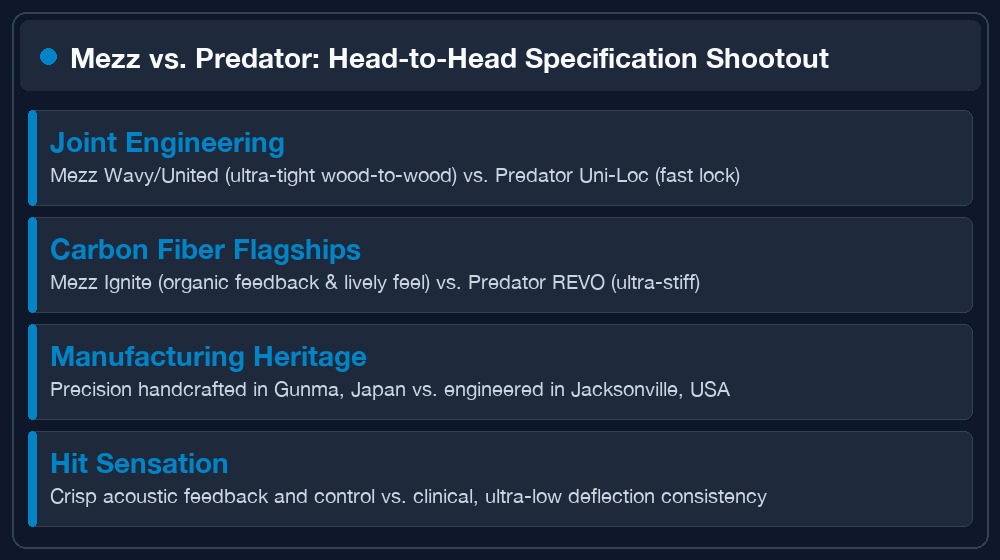
- Mezz (Miki Co., Japan – Best Craftsmanship & Feel): Tightest wood joinery tolerances in the industry. The United and Wavy 2 joints create an unmatched solid hit with surgical feedback. The Ignite carbon shaft is widely considered the truest hitting carbon shaft ever built.
- Predator (American Innovation & Market Ubiquity): The pioneer of low-deflection technology. The REVO carbon shaft and Uni-Loc quick-release joint offer universal accessory availability, exceptional warranty service, and the lowest end-mass deflection recorded on robotic testing.
- The Decision: Choose Mezz for handcrafted Japanese woodworking, firm acoustic hit feel, and heirloom build quality. Choose Predator for modular flexibility, Uni-Loc ecosystem, and proven tournament pedigree.
The Heavyweight Showdown: Mezz vs Predator
When professional pool players step onto the TV table at the Mosconi Cup or World 9-Ball Championship, the majority are holding either a Predator or a Mezz cue stick. Both brands have redefined low-deflection cue sports engineering, but they approach cue making from radically different philosophies.
Predator, founded in Jacksonville, Florida, revolutionized the sport by treating the cue as an aerodynamic, low-mass physics problem. Mezz, manufactured by the Miki family in Gunma, Japan since 1960, views cue making as an art of microscopic woodworking precision combined with aerospace composite integration. In this comprehensive comparison, we test shafts, joint mechanics, butt construction, and real-world resale value.
Direct Technical Specification Comparison
| Engineering Metric | Mezz Cues (Japan) | Predator Cues (USA) |
|---|---|---|
| Flagship Carbon Shaft | Mezz Ignite (12.2mm) | Predator REVO (11.8mm / 12.4mm / 12.9mm) |
| Proprietary Joint System | Wavy 2 / United Joint (Wood-to-Wood Tight Lock) | Uni-Loc Quick Release / Radial Pin |
| Hit Sensation | Solid, crisp, woody resonance with minimal ring | Damped, uniform, ultra-soft deflection response |
| Stock Factory Tip | Kamui Original (S/M) or Zan Plus | Predator Victory Medium |
| Manufacturing Base | Handcrafted in Gunma, Japan | Designed in USA; Engineered in Asia/USA |
Joint Pin Physics: Wavy 2 vs Uni-Loc Quick Release
One of the biggest distinctions between these two giants is their joint architecture. The Predator Uni-Loc pin connects with just a few turns, making assembly rapid. However, some purists feel it lacks the deep vibrational transfer of traditional wood-to-wood threads.
Conversely, the Mezz Wavy 2 joint uses a precision-machined stainless steel pin with special wooden female threads cut inside the shaft. The fit is so tight that it feels virtually identical to a continuous one-piece cue. To see pin specifications, consult our Pool Cue Joint Types Guide.
For more intermediate brand comparisons, read our shootout between Lucasi vs. McDermott Pool Cues or explore composite shaft physics in Carbon Fiber vs. Wood Shafts.
Frequently Asked Questions: Mezz vs Predator
Is the Mezz Ignite shaft better than the Predator REVO?
Both are top-tier. The REVO has slightly lower end-mass deflection on extreme cut shots, but the Ignite features a custom Japanese composite dampener that provides superior tactile sound and feel.
Why are Mezz cues harder to buy in the US?
Mezz limits production runs at their Japanese workshop to preserve strict quality control standards. Authorized dealer batches often sell out within hours of restocking.

Marc Robert is the founder and lead equipment tester at Billiard Guides. With over 15 years of competitive amateur league play (APA & BCA) and extensive hands-on experience in slate table leveling, cloth refelting, and cue repair, Marc conducts independent bench tests on cues, cloth, and billiards gear to help players make informed decisions.