Is your pool table feeling sluggish, showing white friction burn rings, or bunching around the rails? Replacing your cloth is the single highest-impact upgrade you can make to restore tournament-grade speed, true ball roll, and sharp bank angles. While professional table technicians typically charge between $400 and $850 for labor alone, recovering a pool table yourself is a completely achievable weekend DIY project—provided you follow the exact mechanical sequence for leveling, slate seam sealing, and tension stretching.
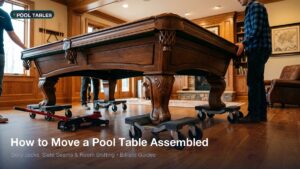
Refelting or Moving Your Table to a New Spot?
While your table is dismantled for refelting, it is the best time to verify cue clearance around walls and support posts. Use our interactive calculator to test your exact room clearance.
⚡ Project Overview at a Glance
Table of Contents
The Master Mechanic Toolkit: Everything You Need
Having the correct specialized tools within arm’s reach prevents costly mistakes, such as gouging slate joints or unevenly stretching worsted fabric. Below is the exact inventory professional table mechanics carry:
| Tool / Material | Function in Installation | Mechanic Recommendation |
|---|---|---|
| Heavy-Duty Staple Gun | Fastens cloth to wood slate liner and under rails | Arrow T50 Heavy-Duty Stapler (1/4″ or 5/16″ staples) |
| Tack & Staple Puller | Pries out hundreds of old staples without damaging wood backing | Bates Heavy-Duty Tack & Staple Puller Pliers |
| Slate Seam Beeswax | Fills slate joints and screw holes to create a seamless glass-flat plane | Mary Tylor 100% Pure Natural Beeswax |
| Spray Adhesive (Unframed) | Bonds cloth to vertical slate edge on commercial/unframed tables | 3M Super 77 Multipurpose Spray Adhesive |
| Socket Wrench Set | Unbolts rail hardware from underneath the slate bed | Standard 9/16″ and 1/2″ deep socket wrench |
| Razor Utility Knife | Precision cloth trimming and featherstrip relief cuts | Standard box cutter with fresh, sharp heavy-duty blades |
| Propane Torch or Heat Gun | Melts beeswax evenly into slate gaps | Handheld plumber’s propane torch or variable heat gun |
| 6-Inch Flexible Putty Knife | Scrapes excess cooled beeswax flush with slate surface | Stiff-flex drywall taping or putty knife (burr-free) |
Choosing the Right Felt: Worsted (Speed Cloth) vs. Woolen
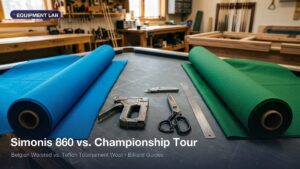
Before purchasing your cloth, understand that pool table cloth is divided into two distinct categories: Worsted cloth (such as Simonis) and Woolen blend (such as Championship Invitational). Selecting the wrong cloth for your environment leads to premature wear or disappointing play speeds.
1. Worsted Cloth (Speed Cloth) — Tournament & Enthusiast Standard
Worsted cloth is combed before spinning so that all fibers run in parallel, eliminating fuzz and nap. The result is a smooth, weave-visible fabric that plays significantly faster, produces true English reaction, and resists ball burn spots.
- Top Pick: Iwan Simonis 860 Worsted Cloth — The gold standard used in worldwide professional tournaments. Composed of 90% wool and 10% nylon for extreme durability.
- Play Characteristics: Zero directional nap, maximum cue ball speed, high resistance to humidity fluctuations.
- Installation Nuance: Requires an aggressive, tight stretch (approximately 1% to 1.5% elastic elongation) to perform properly.
2. Woolen Blend — Casual, Family & Budget Play
Traditional woolen cloth is thicker, contains directional nap (velvety fuzz), and plays slower. It offers excellent ball control for beginners and casual family game rooms, and many models feature Teflon coatings that repel spills.
- Top Pick: Championship Invitational 21oz Teflon Felt — Infused with DuPont Teflon to prevent liquid spills from penetrating the slate.
- Complete DIY Kit Pick: Accuplay 20 oz Pre-Cut Pool Table Felt Kit — Comes pre-cut into bed cloth plus 6 individual rail strips for beginner-friendly installation.
- Full Table & Cushion Rebuild: Podoy 8ft Replacement Kit with K66 Rubber Bumpers — Ideal if your rubber rail cushions have hardened or deadened over time.
For an in-depth breakdown of speed ratings, nap care, and durability testing, read our full guide to the 10 Best Pool Table Felts.
Step 1: Systematic Table Disassembly & Rail Labeling
Disassembling a pool table requires methodical care. Rushing through rail removal can strip frame bolts or damage delicate drop pockets.
- Label Every Rail Section: Before removing a single screw, take blue painter’s tape and mark each rail: Head, Foot, Left Head, Left Foot, Right Head, Right Foot. While rails may appear interchangeable, their bolt holes and cushion angles are factory-matched to specific positions on the frame.
- Remove the Pocket Liners: If your table has leather or plastic drop pockets, crawl underneath and locate the pocket mounting brackets. Remove the screws or upholstery tacks securing each pocket to the slate backing and carefully slide the pocket cups down and out.
- Unbolt the Rails: Standard 3-piece slate tables have 3 to 4 heavy bolts per rail underneath the table bed. Using your 9/16″ or 1/2″ socket wrench, remove all rail bolts and washers. Keep hardware organized in labeled magnetic trays.
- Lift Rails Clear: With the help of an assistant, lift the side and end rails straight up. Avoid dragging rails across the slate, as protruding bolt heads can score deep grooves in the stone. Store the rails on clean moving blankets away from the work zone.
Step 2: Stripping the Old Felt & Deep-Cleaning the Slate
Once the bare slate bed is exposed, you must completely remove the worn cloth and prepare the slate surface.
Check whether your slate has a wooden backing glued underneath its outer perimeter (Framed Slate) or is solid stone right to the edge (Unframed Slate). Framed slates accept staples; unframed slates (often commercial bar boxes) require adhesive bonding. Never hammer staples directly into bare slate stone—it will chip and crack the slate edge!
- Removing Staples on Framed Tables: Use your Bates staple puller pliers to remove all staples securing the old bed cloth to the wood frame. Pry staples out completely; any broken staple legs left protruding will puncture your brand-new cloth during tensioning.
- Removing Glued Felt on Unframed Tables: Slowly peel the old felt back from the edge. Use mineral spirits or denatured alcohol and a scraper to dissolve hardened contact cement residue along the slate perimeter until the stone feels smooth to the touch.
- Vacuuming the Slate Bed: Vacuum the entire stone bed thoroughly using a soft brush attachment. Even a single grain of sand or dried staple fragment trapped beneath new cloth will create a noticeable bump that deflects rolling billiard balls.
Step 3: Sealing Slate Seams & Leveling the Joints
A multi-piece slate table relies on two or more hairline seams. Over years of play and humidity shifts, these joints settle out of alignment, causing balls to drift off course. Sealing and leveling these seams is the defining mark of a professional table installation.
Method 1: 100% Pure Beeswax (Mechanic Standard)
Beeswax is the industry-standard joint sealant. It cools rapidly, expands with ambient temperature changes without cracking, and can be melted cleanly if the table ever needs future disassembly.
- Light your handheld propane torch on low flame.
- Hold a block of pure yellow beeswax against the flame, allowing molten wax to drip generously along the slate seams and into countersunk screw holes.
- Pass the flame gently over the bead of wax to ensure it flows deep into the hairline joint.
- Let the wax cool for 5 minutes until fully solid.
- Using a clean 6-inch flexible putty knife held at a 45-degree angle, scrape the excess wax flush with the slate. Scrape until your fingernail slides over the seam without feeling the slightest lip.
Why You Should Avoid Plaster or Silicone
Amateur installers often attempt to use plaster of Paris, Bondo, or silicone caulk. Here is why mechanics avoid them:
- Plaster of Paris: Highly brittle. Table vibration from heavy breaks causes it to crack and turn to dust beneath the felt within months.
- Silicone Caulk: Never cures hard enough. It acts like a rubber sponge under ball weight, dampening roll speed.
- Auto Bondo: Cures rock-hard, but chips the slate edges during subsequent recoveries.
Step 4: Installing the Bed Cloth — The Stapling Method (Framed Slate)
Stapling into the wood frame offers maximum control over tension and weave alignment. Follow the numbered sequence below to prevent ripples, puckers, and ball-tracking errors.
The Compass Tension Stretch Pattern
Always install cloth with the smooth playing face up (for Simonis, the printed label side faces UP). For woolen cloths, ensure the directional nap brushes smoothly from the head of the table toward the foot spot.
- Anchor the Head Rail: Unroll the cloth across the table, centering it with equal overhang on all sides. Begin at the center of the head rail. Place 3 staples into the wood liner 1 inch apart. Working outward from the center toward each corner, pull the cloth snug (not overstretched) and place staples every 2 to 3 inches until the head end is fully secured.
- The Lengthwise Master Stretch (Foot Rail): Walk to the opposite foot rail end. Grab the cloth at the dead center and pull firmly along the table’s length. While maintaining strong tension, place 3 anchor staples into the wood liner. Work outward toward the foot corners, pulling diagonally and straight, driving staples every 2 to 3 inches. You should see all lengthwise ripples vanish.
- Lateral Stretch on the First Side: Move to the center of one long side rail. Pull the cloth outward firmly and drive 3 anchor staples directly opposite the center pocket. Work from the center outward toward the corner pockets, pulling at a slight 45-degree angle toward the corners.
- Lateral Master Stretch on the Second Side: Move to the remaining long side. This is your final tensioning pass. Pull with firm, uniform force across the entire width of the table. Staple from the center outward to the corners every 2 inches. Tap the surface with your fingertips—the cloth should sound tight and firm like a snare drum without any wave distortion in the weave.
Finishing the Pocket Openings
Once the bed cloth is secured around the perimeter, you must relieve and secure the pocket openings:
- Corner Pockets: Make 3 clean relief cuts into the cloth hanging over the corner pocket drop zone. Pull each tab down through the pocket throat, wrap it tightly under the bottom edge of the slate frame, and drive 3 staples securely into the wood liner.
- Side Pockets: Make 2 vertical relief cuts in the pocket drop. Pull the center tab down and under the slate frame, staple it firmly, and wrap the lateral flaps around the pocket contours. Trim excess cloth leaving 1/2 inch of margin past the staples.
Step 5: Installing the Bed Cloth — The Gluing Method (Unframed Slate)
For commercial coin-operated bar tables (such as Valley tables) lacking wooden frame borders, the bed cloth must be glued directly to the stone edge using heavy-duty contact adhesive.
- Protect the Playing Field: Lay cardboard or painter’s plastic across the top of the slate, leaving only the outer 1.5 inches of slate perimeter exposed. This prevents adhesive mist from settling onto your playing surface.
- Apply Adhesive: Shake your can of 3M Super 77 spray adhesive thoroughly. Spray an even coat along the vertical edge and bottom underside rim of the head rail. Simultaneously spray the matching underside overhang of the cloth.
- Wait for Tackiness: Allow the adhesive to dry for 60 to 90 seconds until it feels tacky but does not transfer liquid to your finger.
- Press & Set Head End: Press the cloth firmly against the vertical slate edge and wrap it under to the bottom rim, smoothing it out with your palm to eliminate air pockets.
- Stretch & Bond Remaining Sides: In the exact same sequence as the stapling method (Foot end first, then Long Sides), apply adhesive, wait for tack, pull firmly to tension, and press into place. Hold each bonded section for 30 seconds to guarantee full contact bond.
Step 6: Recovering the Rails & Featherstrips
Recovering the 6 rails requires precision craftsmanship. If the rail cloth is loose or the featherstrip is improperly seated, bank shots will play spongy and cushions will lose rebound speed.
Anatomy of a Pool Table Rail
Every pool table rail features a triangular rubber cushion (K66 profile on standard tables) glued to the face of a wooden rail. Running along the top rear edge of the cushion is a precision groove holding a wooden or rubber wedge known as the featherstrip. The featherstrip locks the cloth in place without staples.
The Rail Refelting Process:
- Extract the Featherstrip: Take a small flathead screwdriver or tack lifter. Gently pry the featherstrip up starting from the center of the rail. Work outward toward the ends. Caution: Wooden featherstrips are brittle—never bend them sharply or they will snap.
- Remove Old Rail Cloth: Strip the old cloth and pull all staples from the bottom and rear of the wooden rail.
- Position the New Rail Strip: Lay a fresh strip of rail cloth face down on your workbench. Place the rail upside down on the cloth, ensuring equal overhang at both ends.
- Seat the Featherstrip: Push the cloth into the rail groove. Center the featherstrip over the groove and press it in by hand. Place a scrap wooden block over the featherstrip and tap it gently with a hammer until it sits 1/32″ below flush with the top of the rail wood. Trim excess cloth along the groove with a fresh razor blade.
- The 45-Degree Cushion Nose Wrap: Flip the rail right-side up. Pull the cloth tightly over the triangular rubber cushion nose, wrapping it around to the bottom wooden surface. Pull at a 45-degree angle toward each pocket end.
- Staple Underneath: Place staples every 1.5 inches along the bottom of the wooden rail, keeping consistent tension so no ripples form along the rubber edge.
- Miter the Pocket Facings: At the pocket ends, fold the cloth cleanly around the rubber facings like wrapping a gift box. Staple the folds securely to the wooden backing. Ensure no thick folds sit directly in the ball trajectory where balls strike the cushion facings.
- Clear Bolt Holes: Feel along the bottom of the rail to locate the bolt holes. Make a small “X” cut over each hole with your razor blade so the rail bolts can pass through cleanly during reassembly.
Step 7: Table Reassembly, Cushion Alignment & Final Leveling
With all 6 rails recovered and the bed cloth tight, you are ready for final reassembly:
- Position Rails in Matched Order: Place each rail back onto its corresponding position according to your painter’s tape markings. Thread all rail bolts through from underneath by hand to prevent cross-threading into the slate frame inserts.
- Check Pocket Openings & Cushion Alignment: Before tightening bolts, align the corners where the side and end rails meet. The cushion noses should form a clean, continuous boundary with correct pocket opening dimensions (typically 4.5″ to 4.75″ for corner pockets, and 5.0″ to 5.25″ for side pockets).
- Torque the Rail Bolts: Using your socket wrench, tighten the bolts firmly in an alternating pattern starting from the center bolts outward. Do not overtighten with an impact gun—excessive torque can crack the slate backing or distort rail alignment.
- Reinstall Pocket Liners: Screw the drop pocket brackets securely back into place underneath the castings.
- Check Precision Leveling: Place a 12-inch or 24-inch machinist level in the center of the table and along all four rail tracks. If adjustments are needed, place thin hardwood shims beneath the table legs or adjust the threaded metal feet.
Step 8: Post-Installation Care & Breaking In Your Felt
Brand-new billiard cloth requires a brief break-in period to reach optimal tournament performance:
Mechanic Rules for New Felt:
- Proper Brushing Technique: For woolen cloths, always brush in one direction—from the head string toward the foot rail. Never scrub back and forth in circles, as this disrupts the directional nap. For worsted cloth, use a specialized horsehair billiard brush to sweep chalk dust toward the pockets.
- Avoid Hard Power Breaks on Day One: During the first 10 to 15 hours of play, avoid high-velocity break shots without a break cloth or racking template. Powerful breaking pushes the cue ball downward into the slate, causing white friction burn marks on fresh fibers.
- Cover When Not in Use: UV light from windows and ambient airborne moisture degrade cloth tension over time. Protect your investment with a fitted, waterproof heavy-duty pool table cover.
Frequently Asked Questions (Mechanic FAQ)
How long does pool table felt typically last?
For residential home tables played 4 to 8 hours per week, high-grade worsted cloth like Simonis 860 typically lasts 5 to 10 years before needing replacement. Standard woolen cloths in family game rooms last 3 to 5 years. In commercial pool halls or bars, felt is typically replaced every 6 to 12 months due to heavy daily wear and spill damage.
Can you refelt a pool table without taking the rails off?
No. It is physically impossible to refelt a pool table properly without removing the rails. The bed cloth must be stretched under extreme tension and anchored to the perimeter of the slate frame underneath where the rails bolt down. Additionally, the rails themselves must be individually stripped and recovered.
How tight should pool table felt be?
Worsted cloth (Simonis) is engineered to stretch approximately 1% to 1.5% of its length and width. When properly stretched, it should be as tight as a drum head with zero slack, ripples, or bunched fabric when pinched between your fingers. Woolen cloth should be pulled snug to remove all wrinkles, but not overstretched, which can distort the directional weave.
Can I reuse my old pool table felt if I move the table?
If the existing cloth was stapled and carefully removed with a specialized tack lifter without tearing the edges, it can sometimes be reinstalled. However, cloth that was previously trimmed close to the staples rarely has sufficient overhang to grip and restretch properly. If your felt is more than 3 years old, mechanics always recommend installing fresh cloth while the table is disassembled.
How do I know what size felt to order?
Pool table cloth is sold according to the overall table size: 7-foot, 8-foot, 8-foot oversize (Pro 8), or 9-foot. Always order cloth labeled for your table size or one size larger; pre-cut kits include excess margin for both the bed and rails that you trim away during installation.