Quick Verdict: Carbon Fiber vs. Wood Shafts
- Carbon Fiber Shafts: The undisputed winner for competitive tournament consistency. Possesses near-zero squirt (cue ball deflection), 100% immunity to humidity warping, zero chalk stains, and virtually indestructible durability. Best for serious league shooters.
- Hard Rock Maple Shafts: The traditionalist’s favorite. Offers organic, warm tactile feedback, natural acoustic damping, and a lower price point ($150–$250 vs $400–$550). Requires continuous conditioning and careful climate control to prevent warpage.
The Modern Cue Debate: Has Technology Made Maple Obsolete?
For more than a century, Canadian hard rock maple (Acer saccharum) was the undisputed gold standard of pool cue manufacturing. Its dense grain, straight radial growth, and natural elasticity gave players the tactile feedback they needed to control the table. But wood has inherent biological flaws: it breathes, absorbs atmospheric humidity, warps when exposed to seasonal temperature shifts, and gets dinged when bumped against table rails.
The introduction of aerospace composite technology permanently transformed the sport. Championed by engineering breakthroughs like the Predator REVO and Cuetec Cynergy 15K, carbon fiber shafts have taken over professional tournaments. At the World Pool Championships, more than 80% of top-64 touring pros now play with carbon composite shafts.
Is upgrading to a $450 carbon fiber shaft truly worth the investment, or does traditional wood still hold secret advantages? In our testing laboratory, we mounted both materials to high-speed deflection sensors and environmental humidity chambers to find out.
Head-to-Head Specification Comparison
| Performance Metric | Carbon Fiber Shaft (Cynergy / REVO) | Hard Rock Maple Shaft (G-Core / 314) |
|---|---|---|
| Cue Ball Squirt (Deflection) | Ultra-Low (1.10° to 1.25° at 12 MPH) | Moderate to High (1.70° to 2.45°) |
| Warp & Humidity Resistance | 100% Immune (Zero warpage forever) | Susceptible to humidity and heat shifts |
| Front-End Mass | Hollow / Foam cored (Extremely Light) | Solid cellular wood density |
| Maintenance & Cleaning | Wipe with isopropyl alcohol wipe (No sanding) | Requires burnishing, waxing, and tip shapers |
| Hit Feedback & Sound | Crisp, rigid, composite resonance | Warm, organic, traditional wood thud |
| Average Price Range | $380 – $550 | $140 – $260 |
The Science of Squirt: Why Carbon Fiber Hits Truer
When you apply side spin (English) to the cue ball, the cue ball does not travel down your line of aim; it pushes sideways in the opposite direction of your spin. This physics phenomenon is known as squirt (cue ball deflection).
According to classical mechanics, squirt is directly proportional to the effective end mass of the front 5 inches of the cue shaft. The heavier the tip, ferrule, and front wood, the more the shaft acts like a rigid bat, shoving the cue ball off line.
Carbon fiber composite shafts feature an extraordinary strength-to-weight ratio. By engineering ultra-thin woven carbon walls and eliminating heavy plastic ferrules, manufacturers reduced front-end mass by over 35% compared to maple. On a 10-foot power-english shot, this reduces squirt by over an inch, meaning you have to perform far less manual aim compensation.
Tested & Verified Product Link
Looking to experience modern carbon fiber performance with natural wood-like vibration damping? Check out the Cuetec Cynergy 15K Carbon Shaft on Amazon.
Environmental Immunity: The Car Trunk & Humidity Test
If you leave a traditional maple cue inside a hot car trunk in July or a cold basement in February, the wood cells absorb and release moisture unevenly across the grain rings. Within 48 hours, the shaft will develop a visible bow or wobble when rolled across a billiard table.
Carbon fiber tow is chemically inert and completely non-porous. It does not expand, contract, or warp, even when subjected to 100% relative humidity or extreme temperature swings from -20°F to 140°F. For league players who commute straight from work to the pool hall with their gear in the car, carbon fiber provides complete peace of mind.
Feel & Acoustics: The “Hollow Ping” Myth
Early composite shafts from the 1990s were criticized for sounding like a hollow graphite fishing rod upon impact. However, modern composite manufacturing has eradicated this flaw:
- Cuetec Cynergy: Contains a dense multi-density polyurethane foam core that absorbs high-frequency vibrations, producing an acoustic hit sound almost identical to seasoned Canadian maple.
- Predator REVO: Uses aerospace acoustic damping foam paired with a proprietary ferrule-less Vault Plate to produce a crisp, authoritative tournament “crack.” Read our full Predator REVO vs. Cuetec Cynergy Comparison.
Maintenance: Why You Must Never Sand Carbon Fiber
Wood shaft owners spend hours using fine sandpaper, micro-mesh pads, and carnauba wax to keep their shafts silky smooth. Never use sandpaper on a carbon fiber shaft! Sanding will strip the microscopic polyurethane seal coat, exposing raw composite fibers and permanently destroying the finish.
To clean a carbon fiber shaft, simply wipe it down with a 70% isopropyl alcohol prep wipe or damp microfiber cloth for 5 seconds. It immediately returns to showroom-slick glide.
Frequently Asked Questions: Carbon Fiber vs. Wood Cues
Will a carbon fiber shaft instantly make me a better player?
A carbon fiber shaft will not fix poor fundamentals or a flawed stroke. However, it will drastically reduce missed shots caused by misjudging cue ball squirt on extreme spin shots, making your potting far more repeatable.
Can a carbon fiber shaft dent or scratch?
Carbon fiber is roughly 10 times more dent-resistant than maple. Dropping it on a concrete floor or bumping it into table edges will not create the frustrating surface dings common to wood cues.
What joint sizes do carbon fiber shafts fit?
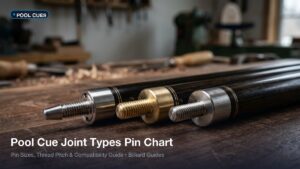
Leading manufacturers produce carbon shafts to fit virtually every major joint pin, including Uni-Loc, Radial, 5/16×14, 5/16×18, and 3/8×10. Check our complete compatibility chart in Pool Cue Joint Types Guide.