Few moments in cue sports match the sudden, electric shock of pocketing the black 8-ball on the opening break shot. As fifteen tightly packed object balls explode across the table cloth, the black ball catches a deflection, tracks toward an open corner or side pocket, and drops out of sight before the remaining cluster has even come to rest. The entire pool hall stops to look. But as the cue ball slows to a halt, the celebration is almost immediately interrupted by shouting from across the slate: Did the breaker just win the game instantly? Or do they have to spot the 8-ball and shoot again? What happens if the cue ball also scratched? In casual barrooms and sanctioned tournament arenas alike, this single shot generates more heated arguments and broken cues than almost any other table event. The answer depends entirely on which rulebook governs your table: the American Poolplayers Association (APA), the Billiard Congress of America (BCA) / World Pool-Billiard Association (WPA), or traditional tavern bar rules. In this definitive 2,100+ word master guide, we break down every sanctioning body’s rulebook, examine the physics of the 8-ball break, and settle every table dispute once and for all.
Quick Answer: What Happens If You Make the 8-Ball on the Break?
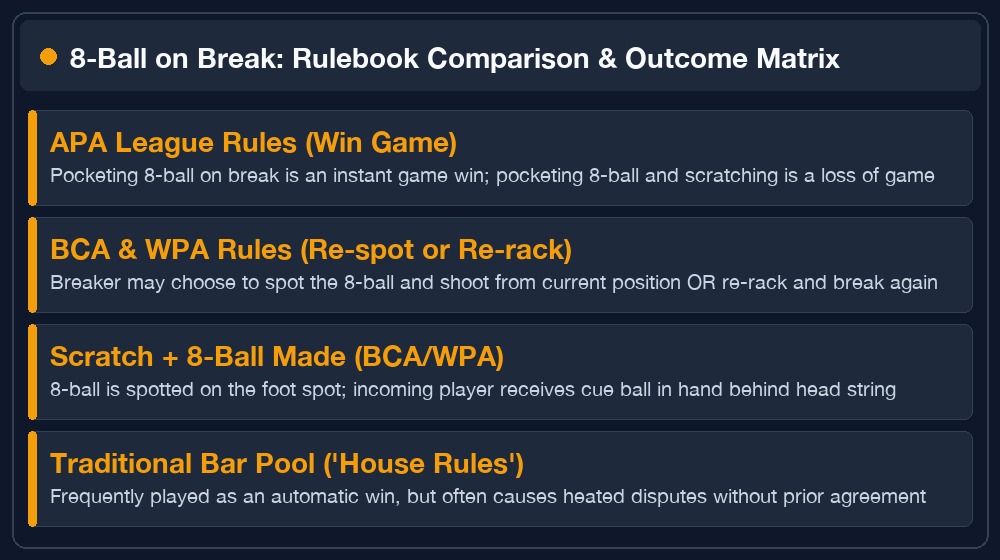
- APA Rules: Pocketing the 8-ball on a legal break is an instant win! (Earns the coveted APA ‘8-on-the-break’ patch).
- BCA / WPA Rules: It is NOT an automatic win. The breaker may choose to respot the 8-ball on the foot spot and shoot from current position, or re-rack and break again.
- Scratch + 8-Ball Pocketed: In APA, it is an automatic loss of game. In BCA/WPA, it is NOT a loss—the incoming player chooses to respot the 8-ball with ball in hand behind the line or re-rack.
Table of Contents
1. 8-Ball Pocketed on the Break: Sanctioning Body Rule Matrix
The rules governing the 8-ball on the break represent one of the deepest philosophical divides in cue sports. Some organizations view it as an exhilarating instant triumph, while others consider it a random stroke of luck that should not decide a competitive match. Here is how every major governing body rules on the shot:
| Sanctioning Organization | 8-Ball Made (Legal Break, No Scratch) | 8-Ball Made AND Cue Ball Scratches | Special Patch or Award |
|---|---|---|---|
| APA (American Poolplayers Assoc.) | INSTANT WIN (Rack ends immediately) | INSTANT LOSS OF GAME | Official “8-on-the-Break” Patch & Pin |
| BCA / WPA World Rules | NOT A WIN. Spot 8-Ball OR Re-Rack | NOT A LOSS. Spot 8-Ball + Kitchen Ball-in-Hand OR Re-Rack | None (Treated as non-decisive event) |
| CSI / USA Pool League | NOT A WIN. Spot 8-Ball OR Re-Rack | NOT A LOSS. Opponent spots 8-ball + Kitchen BIH | None |
| Valley / VNEA League | INSTANT WIN | INSTANT LOSS OF GAME | VNEA Recognition Pin |
| Traditional Bar / House Rules | INSTANT WIN (Almost universally) | INSTANT LOSS OF GAME | Free beer from opponent |
2. APA League Rules: The 8-on-the-Break Instant Win and Patch
In the American Poolplayers Association (APA), making the 8-ball on the break is celebrated as the crowning highlight of amateur league night:
- Instant Rack Victory: Under Section 3 of the APA Official Team Manual, pocketing the 8-ball on a legal opening break shot results in an immediate, uncontested win of that game. The rack ends instantly, zero innings are recorded, and the breaker marks the win on their scoresheet.
- The Prestigious Patch: The breaker earns the famous commemorative cloth patch and lapel pin designated as “8-on-the-Break.” Players proudly sew these onto their team vests and cue cases.
- Legal Break Requirement: To qualify for the win, the break must be legal. If the breaker fails to drive four balls to cushions or fails to make a legal hit, the shot is voided.
3. BCA and WPA World Rules: Spotting the 8-Ball or Re-Racking
The Billiard Congress of America (BCA) and the World Pool-Billiard Association (WPA) approach the 8-ball on the break with a radically different philosophy. Professional tournament purists believe a championship match should never be decided by a random kinetic deflection on the break. Consequently, under WPA World Standardized Rule 3.3(b):
- It Is NOT an Automatic Win: Pocketing the 8-ball does not end the match or award a game point to the breaker.
- The Breaker’s Two Legal Options:
- Option 1: Spot the 8-Ball: The 8-ball is retrieved from the pocket and spotted on the foot spot. The breaker accepts the table as it lies and continues shooting, with the table completely open.
- Option 2: Re-Rack and Break Again: The breaker may elect to gather all fifteen balls, re-rack them in the triangle, and deliver a fresh break shot.
- Why Most Players Choose to Spot: If the break left a wide-open table with multiple easy shots, skilled players almost always choose to spot the 8-ball and continue their runout rather than gamble on a re-break.
4. The Fatal Scratch: What Happens If the 8-Ball AND Cue Ball Pocket?
This is where table disputes explode into bitter shouting matches. What happens when the 8-ball drops into one pocket, but the cue ball simultaneously scratches into another? Here is the definitive legal truth:
| Governing Body | Official Ruling on 8-Ball + Scratch | Incoming Player Options |
|---|---|---|
| APA League Rules | AUTOMATIC LOSS OF GAME | Incoming player wins the rack; match proceeds to next game. |
| BCA / WPA World Rules | NOT A LOSS OF GAME | Incoming player may spot the 8-ball with ball-in-hand in kitchen, OR demand a re-rack and take over the break. |
| Tavern / Bar House Rules | AUTOMATIC LOSS OF GAME | Breaker surrenders the table and buys the incoming player a drink. |
The Massive Contrast: Notice how diametrically opposed these rules are. If you play in a BCA tournament and scratch while making the 8-ball, an opponent who yells “I win!” is completely mistaken. Under BCA Rule 3.3, you do not lose the game!
5. Traditional Bar / Tavern Rules: Regional House Variations
In American neighborhood bars, the rule is virtually universal: Making the 8-ball on the break is an instant win, and scratching while making the 8-ball is an instant loss. However, bar pool players must be aware of quirky regional variations:
- The “Coin-Op Problem”: In coin-operated tables without a ball return trap door, when the 8-ball drops into a pocket, it is locked inside the machine. Because retrieving the 8-ball requires spending another round of quarters, coin-op bar culture naturally evolved to treat pocketing the 8-ball as an instant game over.
- Called Pocket Break Rules: In some old-school tavern leagues, making the 8-ball on the break is only an instant win if the breaker specifically pointed at a pocket before breaking and yelled “8-ball in that corner!” If it goes into an uncalled pocket, some house rules force a loss or a re-rack.
6. The Physics of the 8-Ball Break: How and Why Does the 8-Ball Move?
Under official racking rules, the 8-ball is positioned dead in the center of the triangle rack (the second ball of the third row). How can a ball buried in the center of fourteen other balls fly into a pocket?
- Kinetic Energy Propagation: When the cue ball hits the head ball (apex), the impact waves travel outward through the wings in an inverted V-shape. The two balls directly in front of the 8-ball pinch it from both sides.
- The “Squeeze Out” Effect: If the rack is tightly packed with zero gaps, the 8-ball is squeezed backward and sideways between the second-row balls. If the break stroke strikes slightly off-center (even by 1 millimeter), the kinetic pressure squeezes the 8-ball out toward the long rail, sending it on a direct line toward the side pocket.
- The Second-Ball Break: Players who deliberately aim to pocket the 8-ball on the break frequently use the “second-ball break” (striking the second ball of the rack rather than the apex ball from the side rail). This drives the cue ball across the face of the rack, kicking the 8-ball across the table into the opposite side pocket.
7. Tactical Execution: Racking Tightness and Apex Ball Energy Transfer
Whether you want to pocket the 8-ball on the break or avoid accidental break scratches, racking quality dictates everything:
- Ensure Zero Gaps Behind the Apex: If there is even a 0.5-millimeter gap between the apex ball and the two balls behind it, kinetic energy is dissipated into thin air. The break will sound hollow, the cluster will not disperse, and the 8-ball will barely roll two feet.
- Use a Template Rack (Magic Rack): Precision template racks hold all fifteen balls in microscopic contact. With a template rack, energy transfer is maximized, drastically increasing ball spread and side-pocket action on the 8-ball.
- Control the Squat: Focus on keeping your cue level and striking 1/4 tip below center ball. A clean stun break parks the cue ball dead center, completely eliminating the risk of scratching while the 8-ball is in flight.
8. Common Rule Disputes and Table Protocol
To avoid ugly barroom brawls or league penalties, observe these three universal tournament protocols:
- Protocol 1: Agree on Governing Rules Before Flipping Coins: Never assume your opponent plays by your house rules. Before the opening lag or coin toss, ask one simple question: “Are we playing APA, BCA, or straight bar rules on the 8-ball break?” Thirty seconds of clarity prevents thirty minutes of bitter argument.
- Protocol 2: Never Touch the Table Until All Balls Stop Moving: If the 8-ball drops, do not immediately rush the table or reach into the pocket. If the cue ball is still rolling and accidentally drifts into a corner pocket three seconds later, your premature celebration will turn into a devastating loss of game.
- Protocol 3: Let the Referee or Opponent Inspect the Spot: Under BCA rules, when the 8-ball is spotted, it must be placed directly on the foot spot. If another ball occupies the foot spot, the 8-ball must be placed directly behind it along the long string line.

9. Frequently Asked Questions
Is making the 8-ball on the break a win in professional pool?
No. In premier professional tournaments governed by the World Pool-Billiard Association (WPA) or Matchroom Pool, pocketing the 8-ball on the break is never an instant win. The 8-ball is simply spotted, or the rack is re-racked.
What happens if the 8-ball flies off the table onto the floor on the break?
Under APA rules, driving the 8-ball off the table on the break is an immediate loss of game. Under BCA/WPA rules, it is a break foul: the 8-ball is spotted, and the incoming player receives ball-in-hand behind the headstring.
Can you win an APA national championship with an 8-on-the-break?
Yes! In the APA National Team Championships in Las Vegas, if a player pockets the 8-ball on a legal break without scratching in the deciding hill-hill match, their team immediately wins the national title.
Why do bar pool tables treat the 8-ball break as a win?
Bar tables are coin-operated. Once the 8-ball drops, the mechanical trap locks it inside the cabinet. Because retrieving the ball would require paying more money, tavern house rules universally evolved to end the game immediately.
Can you intentionally aim for the 8-ball on the break?
Yes. Many players use the “second-ball break” technique from the side rail, which specifically directs kinetic energy into the second row to drive the 8-ball toward the opposite side pocket.
What happens if the 8-ball is pocketed and an object ball flies off the table?
Driving an object ball off the table is a foul. In the APA, because a foul occurred on the break, pocketing the 8-ball while fouling results in a loss of game. In the BCA, the 8-ball is spotted, and the incoming player receives ball-in-hand behind the headstring.
What if the 8-ball goes in on the break during a 9-ball game?
In 9-ball, the 8-ball is just another numbered object ball. It stays down in the pocket, and play continues with the 9-ball as the money ball.
Master Cue Ball Position & Run More Racks
Stop getting trapped by difficult angles. Download our free 10-page 30-Day Cue Ball Control Practice Workbook complete with 30 daily table drills, tangent line physics, and printable scorecards.

Marc Robert is the founder, chief technician, and senior equipment tester at Billiard Guides. With over 15 years of competitive amateur tournament and league experience (APA Skill Level 7 & BCA Master Division), Marc pairs deep table-side knowledge with rigorous mechanical bench testing. A certified cue mechanic and table mechanic, Marc specializes in three-piece slate alignment (calibrated using Starrett 98 precision machinist levels to ±0.005″), high-speed 240fps cue shaft deflection analysis, Shore D durometer tip hardness profiling, and Simonis worsted cloth friction testing. His independent reviews, drill curricula, and diagnostic calculators are trusted by over 500,000 cue sports players worldwide.