Quick Summary: Pool Cue Tenon Repair
- What Is a Tenon: The tenon is the turned wooden post at the tip end (or joint end) of the shaft over which the ferrule (or joint collar) is press-fitted and glued.
- Tenon Failure Signs: A cracked ferrule, rattling hit vibrations, or a tip that snaps off taking wood with it indicates a shattered or sheared wooden tenon.
- The Professional Fix: Chucking the shaft into a precision cue lathe, boring out the damaged wood, inserting a threaded hard maple or phenolic core dowel, and turning a fresh tenon to factory tolerances.
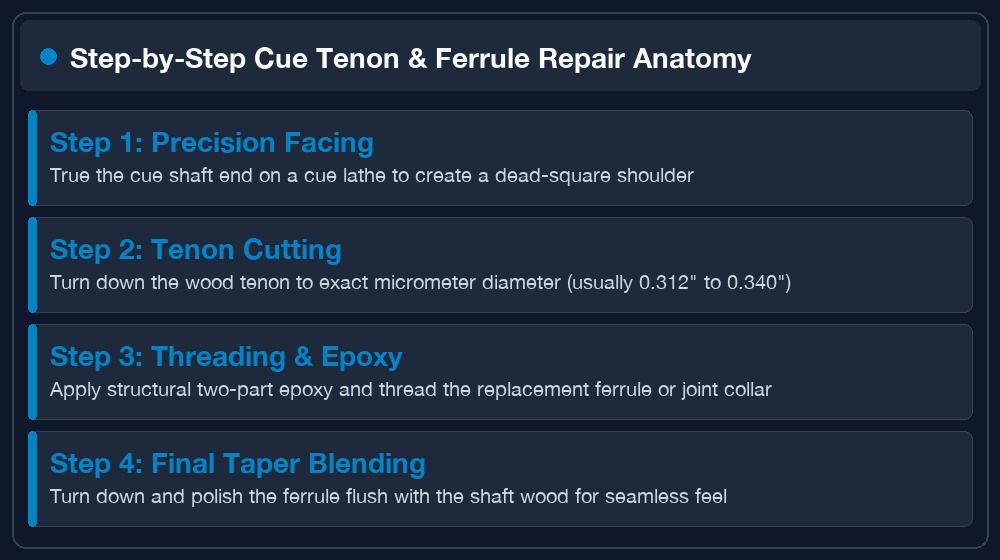
The Anatomy of Cue Failure: The Tenon
When you strike a break shot at 25 MPH, hundreds of pounds of instantaneous compressive shock surge through your tip, ferrule, and the slender wooden post underneath. This post is the tenon. If a ferrule develops a hairline stress crack and goes unnoticed, subsequent impacts will shear or crush the tenon beneath it, causing the cue to rattle with a sickening hollow vibration on every hit.
Many players assume a broken tenon means the shaft is garbage. However, experienced cue makers can perform a tenon graft repair that restores full structural integrity, often making the joint stronger than original factory spec. In this repair guide, our lathe technicians explain how tenons fail, how they are replaced on a lathe, and how to prevent ferrule cracking.
Tenon Repair Protocol: Precision Lathe Steps
| Repair Stage | Lathe Procedure | Tolerances Required | Adhesive / Material |
|---|---|---|---|
| 1. Facing & Coring | Face off damaged tenon; bore 5/16″ hole 1.5 inches deep into shaft center. | Concentricity within 0.001″ TIR | High-speed carbide boring bar |
| 2. Dowel Grafting | Threaded kiln-dried rock maple dowel inserted with structural epoxy. | Full depth lock; zero air pockets | West System 105 / 206 Slow-Cure Epoxy |
| 3. Tenon Turning | Turn new grafted wood down to exact ferrule internal diameter (typically 0.312″). | Light press-fit (0.0005″ interference) | Dial calipers / micrometers |
| 4. Ferrule Installation | Press new Aegis, Juma, or Ivorine ferrule onto tenon with cyanoacrylate. | Flush mating to shaft shoulder | Liquid CA adhesive |
Wood Tenon vs Threaded Phenolic Tenon
While traditional shafts use natural maple wood tenons, modern cue makers often upgrade to threaded phenolic tenons during repair. Phenolic resin is impervious to moisture, withstands extreme break velocities, and eliminates future tenon cracking forever.
For more joint technical specifications, view our Pool Cue Joint Types Guide, or compare composite shafts in Carbon Fiber vs. Wood Shafts.
Frequently Asked Questions: Tenon Repairs
How much does a pool cue tenon repair cost?
A professional tenon replacement and ferrule installation performed on a cue lathe typically costs between $45 and $75, making it far cheaper than purchasing a new $250+ shaft.
Can you fix a tenon at home without a lathe?
No. Hand-filing a tenon will result in an eccentric, off-center post, causing the ferrule to sit crooked and causing severe cue ball steering and miss-hits.

Marc Robert is the founder and lead equipment tester at Billiard Guides. With over 15 years of competitive amateur league play (APA & BCA) and extensive hands-on experience in slate table leveling, cloth refelting, and cue repair, Marc conducts independent bench tests on cues, cloth, and billiards gear to help players make informed decisions.