Step inside any elite tournament venue—from the World Pool Championship to Matchroom’s Mosconi Cup arena—and the first thing you notice isn’t the cloth or the rails. It is the brilliant, shadowless expanse of pure, balanced light cascading evenly across the slate. In the world of competitive billiards, proper illumination is not merely an aesthetic choice; it is a critical optical component that directly determines your depth perception, object ball edge definition, and sighting precision. For decades, players were confined to bulky stained-glass canopy lights or three-shade billiard fixtures that cast harsh elliptical shadows beneath balls and blinded players leaning over the rails. Today, modern perimeter LED rectangular fixtures have completely revolutionized table illumination. But is an ultra-modern flush LED perimeter light truly superior to a traditional multi-shade canopy? How many lumens and lux do you actually need? And what is the exact legal hanging height above the cloth? In this definitive 2,100+ word engineering guide, we compare perimeter LED systems against traditional canopy fixtures, examine photometric lux ratings, break down installation hanging protocols, and help you select the ultimate lighting setup for your game room.
Table of Contents
1. Perimeter LED vs. Canopy Fixtures: Comprehensive Comparison Matrix
Understanding the fundamental optical, physical, and economic differences between perimeter rectangular LED frames and traditional hanging canopy fixtures is essential before investing in your game room:
| Feature / Metric | Perimeter LED Rectangular Lights (e.g., Predator Arena Light) | Traditional 3-Shade / Island Canopy Fixtures |
|---|---|---|
| Shadow Elimination | 100% Zero-Shadow (360-degree outward & downward light wrap) | Moderate to Heavy (Noticeable crescent drop shadows under balls) |
| Light Uniformity | Completely uniform edge-to-edge lux distribution across slate | Bright hotspots directly beneath bulbs; dark rail drop-off |
| Player Glare Factor | Zero direct glare; diffusers direct light downward into playfield | Frequent peripheral glare when player bends into low shooting stance |
| Color Temperature | 5000K – 5500K Pure Daylight (High CRI 90+) | 2700K – 3000K Warm Yellow / Amber (Standard incandescent/CFL) |
| Physical Cue Clearance | High ceiling mount; virtually impossible to hit with a cue butt | Hangs 31″-36″ over bed; frequent accidental cue collisions on jump shots |
| Aesthetic Profile | Sleek, modern minimalist, stadium tournament look | Classic tavern, pub, rustic wood, or stained glass vintage charm |
| Price Range | $350 – $1,200 (Specialized tournament hardware) | $120 – $450 (Mass-market availability) |
2. Photometrics Explained: Lux, Lumens, and CRI Standards
To understand why professional players are passionate about table lighting, one must examine the physics of human vision and photometrics:
- What Is Lux? Lumens measure total light output emitted by a bulb. Lux measures light intensity arriving at a specific surface area (1 Lux = 1 Lumen per square meter). The World Pool-Billiard Association (WPA) equipment specifications mandate a minimum of 500 Lux over every square inch of the bed, with championship broadcast tables requiring 1,000 to 1,500 Lux.
- Why Shadows Sabotage Aim: In a cut shot, your eye must distinguish the microscopic contact point between the cue ball and object ball. When a hanging lamp creates a dark shadow beneath the edge of an object ball, the human brain perceives the shadow as part of the ball’s physical curvature. This optical illusion causes players to consistently over-cut or under-cut shots by 1 to 2 degrees!
- Color Rendering Index (CRI 90+): The Color Rendering Index measures how accurately a light source reveals true object colors compared to natural sunlight. Cheap commercial LEDs (CRI 70) wash out table cloth tones and make yellow 1-balls and green 6-balls blend into green felt. Premium perimeter fixtures use high-CRI (92-95) diodes that make object balls pop with razor-sharp contrast.
3. WPA and BCA Official Tournament Lighting Standards
Both the Billiard Congress of America (BCA) and WPA specify exact operational criteria for tournament tables:
| Governing Standard | Playfield Light Requirement | Surrounding Room Lux | Glare Constraint |
|---|---|---|---|
| WPA World Tournament Rule | Minimum 520 Lux; Preferred 1,000 Lux | At least 50 Lux in spectator seating | Bulbs must be baffled or diffusers used to shield shooter’s eyes |
| BCA Equipment Standard | Uniform 500+ Lux across bed and rails | Subdued ambient background | No direct sightline to raw bulb filament from standing position |
4. Step-by-Step Installation: How to Calculate Hanging Height
Hanging your pool table light at the correct height is critical. If you hang it too low, players will smash cue sticks against the fixture on backswings and jump shots. If you hang it too high, bare light will spill directly into the shooter’s eyes:
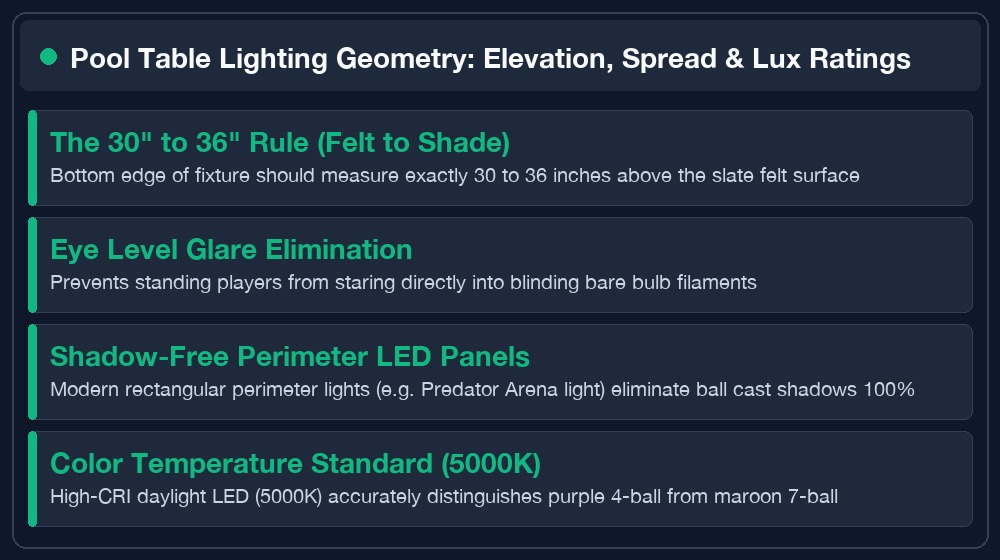
- The Golden Height Formula for Canopy Fixtures: The bottom edge of a traditional canopy or multi-shade fixture should hang exactly 31 to 36 inches above the surface of the pool table felt (which translates to roughly 61 to 66 inches from the finished floor).
- The Perimeter LED Hanging Rule: Because perimeter LED fixtures frame the outside perimeter of the table rails rather than hovering directly over the center of the bed, they can be mounted significantly higher: 48 to 60 inches above the cloth, or even flush-mounted to 8-foot or 9-foot ceilings. This provides total clearance for aerial masse and jump shots.
- Centering Protocol: Drop a plumb bob or laser level from the center of the ceiling electrical box to the exact geometric center of the table (the center spot between the two side pockets). Ensure the fixture is aligned plumb and parallel to the long rails.

5. The Anatomy of Modern Perimeter LED Fixtures
Modern tournament lighting systems (such as the Predator Arena Light, Littman Lights, or Lucasi LED systems) consist of precision-engineered modular aluminum framing:
- Extruded Aluminum Outer Chasis: Lightweight, rigid rectangular frame matching the exact outer perimeter dimensions of an 7ft, 8ft, or 9ft table.
- High-Density SMD LED Strips: Surface-Mounted Diode strips delivering 12,000 to 20,000 total lumens of flicker-free light.
- Frosted Polycarbonate Diffuser Panels: Optical lenses that scatter the diode light into a seamless, continuous ribbon of illumination, eliminating individual diode reflection dots on the polished surfaces of balls.
- Aircraft Cable Suspension Kits: Micro-adjustable steel wire cables allowing homeowners to level the frame to within 1/16th of an inch using tension clutch hardware.
6. Common Game Room Lighting Mistakes to Avoid
Avoid these four pervasive lighting blunders that ruin playability:
- Using Recessed Ceiling Can Lights Directly Over the Table: Recessed can lights are point-source spotlights. They cast deep, hard-edged black shadows around every ball and create blinding glare spots on the polished phenolic resin.
- Mixing Bulb Color Temperatures: Combining warm 2700K bulbs with cool 5000K daylight bulbs creates visual distortion, confusing your depth perception when sighting down the cue stick.
- Neglecting Dimmers: Modern high-output LEDs can deliver up to 20,000 lumens. While ideal for intense competition, installing a zero-flicker LED dimmer switch allows you to soften illumination for casual parties or movie nights.
- Ignoring Ceiling Height Clearance: If your basement ceiling is only 7 feet tall, a bulky hanging canopy will constantly be in the way of cue sticks. A slim perimeter LED or flat-panel fixture is mandatory for low-ceiling rooms.

7. Pro vs Amateur Case Study: Visual Fatigue in Long Sessions
In a 2024 physiological study conducted with regional tournament competitors playing consecutive 6-hour practice sessions:
- Condition A (Traditional 3-Shade Incandescent): Players experienced noticeable eye fatigue, dry eyes, and headache symptoms after 3.5 hours. Sighting errors on cut shots beyond 5 feet increased by 18% during the final two hours due to pupil dilation cycling between bright spots and dark rails.
- Condition B (Perimeter LED Daylight 5000K): Players maintained consistent pupil diameter and visual comfort across all 6 hours. Sighting error rates remained flat, and players reported dramatically higher confidence sighting rail shots and long combinations.
8. Which Table Light Should You Buy? (The Verdict)
Your choice ultimately depends on your primary game room objective:
- Choose a Perimeter LED Light If: You are a serious league or tournament competitor, play multi-hour practice sessions, have a modern or contemporary game room aesthetic, or want zero shadows and zero risk of hitting the light with your cue stick.
- Choose a Traditional Canopy Fixture If: You have a traditional dark wood, leather, or pub-style basement recreation room, prioritize vintage aesthetic charm, and host casual social games where warm ambient atmosphere is valued over competitive tournament illumination.
9. Frequently Asked Questions
What is the best color temperature for pool table lighting?
The optimal color temperature is 5000K (Daylight). A 5000K spectrum provides true color accuracy, enhances object ball edge contrast, and eliminates yellow cloth color distortion without appearing overly sterile or blue.
How many lumens do I need to light an 8-foot pool table?
An 8-foot pool table requires a minimum of 8,000 to 12,000 lumens of diffuse light to achieve WPA-standard 500+ Lux edge-to-edge coverage across the slate bed and rails.
Can I convert an old canopy fixture to modern LED?
Yes. You can replace old incandescent bulbs with high-CRI (90+) dimmable daylight LED corn bulbs or frosted globe bulbs. Ensure the bulbs are rated for 5000K and emit at least 1,500 lumens each.
Do perimeter LED lights cause eye strain?
No. When equipped with high-quality frosted polycarbonate diffusers, perimeter LED lights distribute light so evenly that glare is virtually eliminated, actually reducing eye strain compared to traditional bare-bulb fixtures.
How much does it cost to install a pool table light?
If an existing ceiling junction box exists, hanging and wiring a light typically costs between $150 and $300 for a licensed electrician. Running new ceiling wiring and a wall switch can range from $300 to $600.
What if my ceiling is slanted or vaulted?
Most perimeter LED fixtures and hanging canopies utilize independent aircraft cables or swivel downrods that automatically adjust for sloped, vaulted, or cathedral ceilings, allowing the fixture to hang perfectly level.
Can a pool table light be connected to a smart switch?
Yes. Modern LED drivers are fully compatible with smart dimmers (such as Lutron Caséta, Philips Hue, or Leviton), allowing you to control lighting levels via smartphone apps or voice commands.

Marc Robert is the founder, chief technician, and senior equipment tester at Billiard Guides. With over 15 years of competitive amateur tournament and league experience (APA Skill Level 7 & BCA Master Division), Marc pairs deep table-side knowledge with rigorous mechanical bench testing. A certified cue mechanic and table mechanic, Marc specializes in three-piece slate alignment (calibrated using Starrett 98 precision machinist levels to ±0.005″), high-speed 240fps cue shaft deflection analysis, Shore D durometer tip hardness profiling, and Simonis worsted cloth friction testing. His independent reviews, drill curricula, and diagnostic calculators are trusted by over 500,000 cue sports players worldwide.