Simonis worsted wool cloth is universally acknowledged as the undisputed gold standard of billiard fabrics, adorning championship tables worldwide from Matchroom Arena tournaments to discerning private billiard lounges. Unlike traditional napped woolen felts that rely on fluffy, directional fibers, Simonis cloth (such as Simonis 860 and 760) is woven from ultra-fine combed worsted wool and high-tensile nylon. This tight, thread-bare weave delivers razor-sharp ball speed, true geometric roll, and exceptional burn resistance. However, maintaining this pristine speed requires strict, specialized cleaning protocols. Cleaning worsted cloth like standard fuzzy felt—using aggressive upright vacuums, harsh household detergents, or saturated damp towels—destroys the delicate fiber weave, stretches the tensioned bed cloth, induces localized pilling, and permanently alters ball roll dynamics. In this definitive care guide, we break down worsted wool micro-fiber mechanics, provide a daily and monthly maintenance regimen, review vacuum specifications, test specialized spot-cleaning compounds, and explain how to prevent chalk burn spots.
Table of Contents
1. Worsted Wool vs. Traditional Napped Felt: Why Cleaning Methods Differ
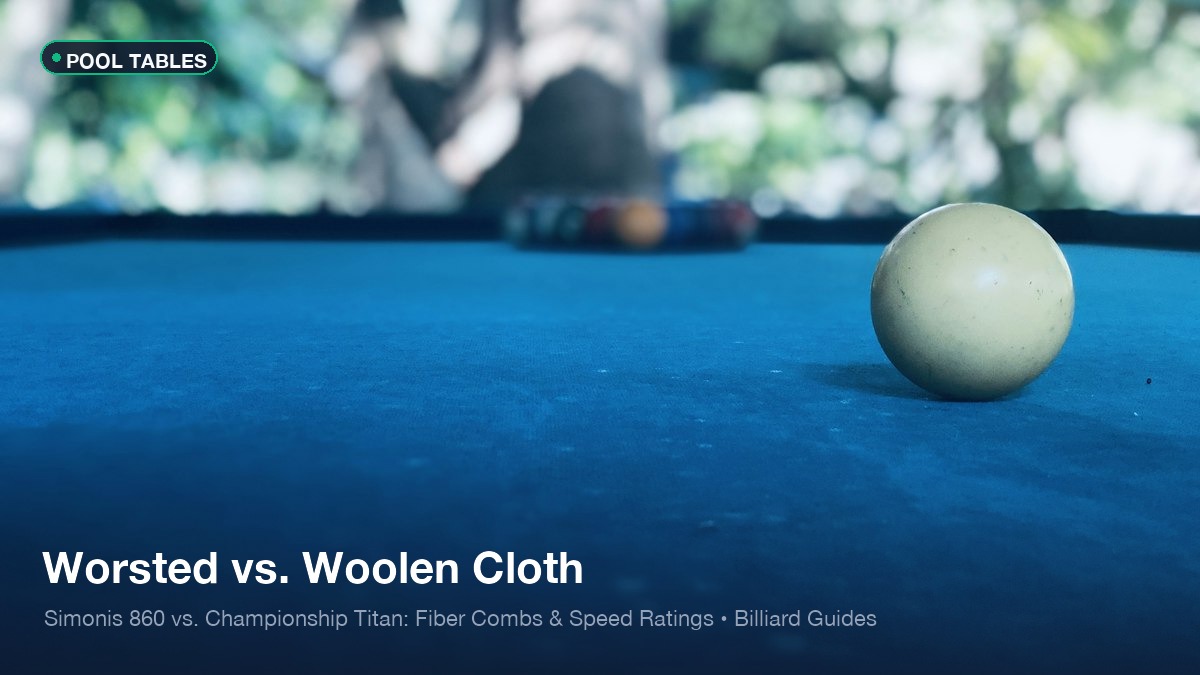
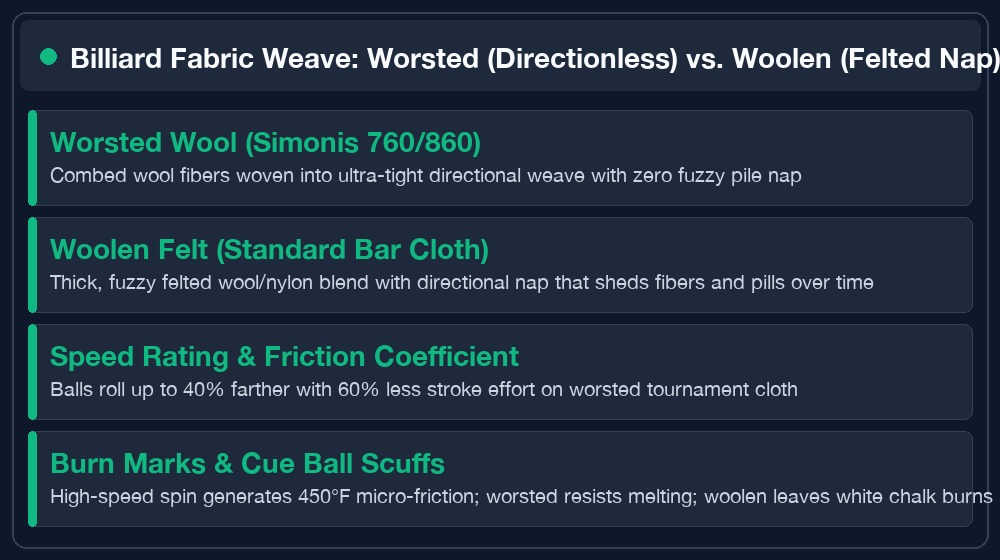
To clean Simonis cloth effectively without destroying its playing characteristics, one must appreciate how worsted fabric differs fundamentally from traditional woolen felt:
Traditional woolen cloth (often called “recreational felt”) is manufactured by pressing short, loose wool fibers into a dense, fuzzy nap, similar to a heavy winter coat. Cleaning woolen felt requires vigorous brushing in a single direction (from the head rail toward the foot rail) to comb the directional nap flat.
In stark contrast, Simonis worsted wool undergoes an intensive combing process that aligns only the longest, strongest wool fibers, which are then tightly spun into fine threads and flat-woven under extreme tension. Simonis has zero directional nap; it is completely smooth and flat. Therefore, traditional aggressive nap-brushing can actually snag the cross-woven threads and cause premature pilling. Instead, Simonis maintenance focuses on extracting microscopic silica chalk dust from deep within the thread matrix without disturbing the weave tension.
Because worsted wool does not shed lint or develop directional friction ridges, ball roll speed across Simonis cloth is virtually frictionless. However, when abrasive chalk particles become embedded within the tight thread interstices, they act like micro-abrasives against the phenolic resin surface of billiard balls, dulling ball gloss and slowing roll velocity by up to 25% over time.
| Fabric Characteristic | Simonis Worsted Wool (860/760) | Standard Napped Woolen Felt |
|---|---|---|
| Weave Structure | Combed, flat-woven worsted yarn (90% wool / 10% nylon) | Short, random carded wool fibers with directional fuzz nap |
| Surface Nap Direction | Non-directional (Zero nap, perfectly flat) | Directional (Must be brushed head-to-foot only) |
| Ball Speed Rating | Very Fast (Low friction coefficient) | Slow to Medium (Fuzzy fibers create high drag) |
| Recommended Vacuum Tool | Brushless suction head or Simonis X-1 tool | Soft horsehair vacuum attachment |
| Susceptibility to Pilling | Extremely low (Unless brushed with stiff bristles) | High (Fibers shed continually as lint) |
2. The Simonis X-1 Tool vs. Vacuuming vs. Brushing: Method Comparison
Maintaining clean Simonis cloth can be achieved through three primary methods, each with specific advantages and operational rules:
| Cleaning Methodology | Chalk Extraction Depth | Risk of Cloth Damage | Best Frequency |
|---|---|---|---|
| Simonis X-1 Tool | High (Electrostatically traps micro-dust) | Zero risk (Engineered exclusively for worsted cloth) | After every playing session (Daily) |
| Canister Vacuum (Brushless) | Maximum (Deep slate extraction) | Low (If suction is modulated; never use rotating beater bars) | Twice monthly |
| Horsehair Table Brush | Surface only (Pushes dust toward pockets) | Moderate (Can grind chalk deeper into fibers) | Weekly (For clearing rail crevices only) |
| Damp Microfiber Towel | Moderate (Lifts static surface haze) | High if wet (Water rings, fiber swelling) | Monthly (Wring until virtually bone dry) |
3. Step-by-Step Maintenance Protocol: Daily, Weekly, and Monthly
To preserve tournament speed and achieve 10+ years of life from your Simonis cloth investment, follow this tiered care protocol:
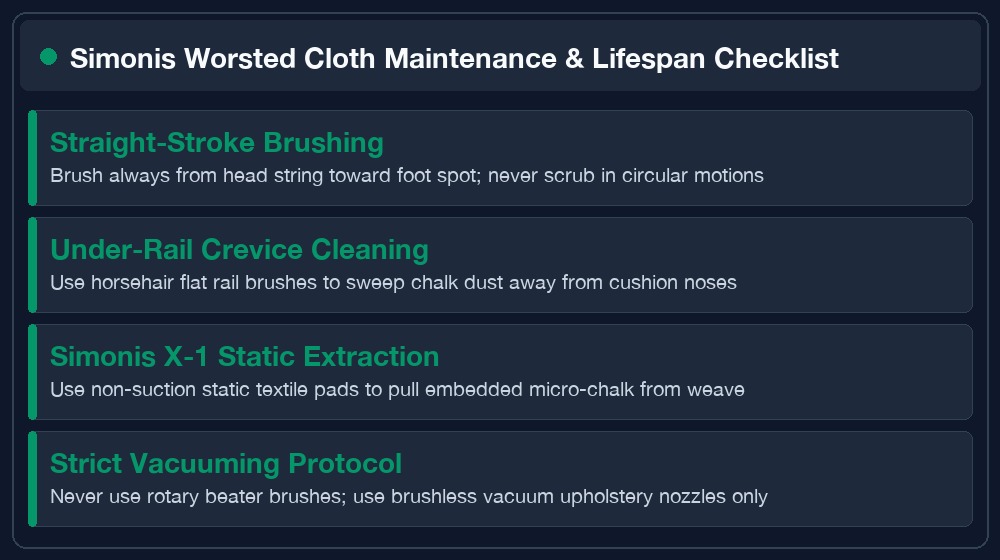
- Post-Match Routine (Daily / Every Session): Run the Simonis X-1 tool across the entire table bed in smooth, overlapping strokes. Move forward and backward across the width, then vacuum or slap the X-1 pad clean over a trash bin. If you do not own an X-1, sweep a clean, dry plush microfiber towel lightly across the bed.
- Under-Rail Sweeping (Weekly): Use a fine, dual-length horsehair brush to gently sweep accumulated chalk dust out from beneath the cushion nose overhangs. Sweep the dust along the rail channel straight into the nearest pocket opening, where it can be lifted out.
- Deep Canister Extraction (Twice Monthly): Use a canister vacuum fitted with a smooth, brushless upholstery attachment. Turn suction power down to medium. Glide the nozzle gently across the cloth in straight overlapping lines. Crucial Rule: Never press down aggressively or allow a motorized roller brush (beater bar) to touch the table, as rotating nylon bristles stretch worsted cloth and shred wool fibers.
- Microfiber Haze Wipe (Monthly): Lightly mist a clean microfiber towel with distilled warm water, then wring it out until it is barely damp to the touch (not a single droplet should squeeze out). Wipe the cloth lightly in broad strokes to neutralize static electricity and lift clinging chalk haze. Let the table air-dry for 30 minutes before covering.
4. Treating Spills and Stubborn Stains: The Emergency Protocol
If a beverage or liquid spills on your Simonis cloth, immediate action prevents permanent staining. Follow this emergency triage protocol:
- Step 1: Blot Immediately (Never Rub): Drop a thick stack of dry white paper towels or an ultra-absorbent microfiber towel directly onto the spill puddle. Press straight down with your hands to draw liquid upward by capillary action. Never rub or scrub in a circular motion, as rubbing drives liquid through the cloth into the underlying slate backing.
- Step 2: Dilute with Cold Distilled Water: Lightly dampen a clean white cotton cloth with cold distilled water. Blot the area repeatedly to dilute remaining sugars or dyes. Hot water must never be used on wool, as heat permanently binds organic proteins to wool fibers.
- Step 3: Specialized Wool Detergent: For stubborn stains (soda, beer, or coffee), mix 1 drop of gentle pH-neutral wool wash (such as Woolite) into 8 ounces of cold distilled water. Dab the solution onto the stain with a cotton swab, let sit for 2 minutes, then blot dry with clean paper towels.
- Step 4: Accelerated Air Drying: Place an electric fan or hairdryer set strictly to cool air only 18 inches above the treated spot to dry the cloth rapidly and prevent water ring halos.
5. The Truth About White Cue Ball “Burn Marks”
Many table owners mistake white spots on their cloth for chalk stains and try desperately to scrub them out. These small white blemishes are actually friction burn spots. When a cue ball accelerates from a dead stop to 20+ mph in a fraction of a millisecond during a power stroke, instant sliding friction generates momentary flash temperatures exceeding 480°F (250°C) at the microscopic point of contact.
This instantaneous heat literally scorches the polyester or resin coating of cheap balls and scorches the surface wool fibers. While Simonis cloth is remarkably burn-resistant, friction marks cannot be washed out because the fibers have undergone thermal alteration. To prevent burn spots, upgrade to premium phenolic resin balls (such as Aramith Tournament or Centennial balls), which dissipate impact friction cleanly without scorching the cloth.
6. Pro vs. Amateur Maintenance Case Study
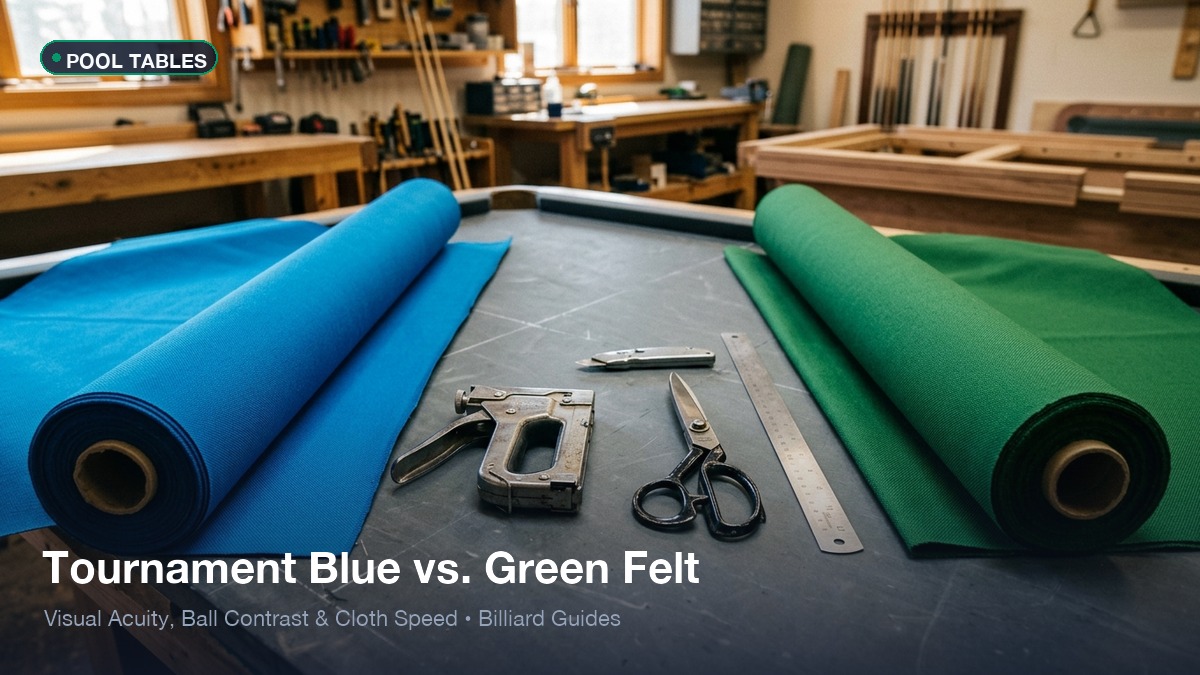
Our technical team monitored two high-end commercial clubs outfitted with new Simonis 860 Tournament Blue cloth over a 12-month period. Club A followed amateur maintenance: staff used traditional upright household vacuums with spinning roller brushes twice a week and scrubbed the table vigorously with stiff nylon brushes.
Club B utilized our professional protocol: tables were cleaned daily using Simonis X-1 static tools, vacuumed twice monthly using brushless canister attachments at low suction, and players were supplied with low-residue chalk (Taom V10). After 12 months, cloth in Club A exhibited severe fiber fuzzing, visible weave stretching around the foot string, and lost 22% of its original rolling speed. In Club B, the Simonis cloth remained tight as a drum skin, showed zero fiber fuzzing, and retained 97% of factory ball velocity. Proper cleaning protocol directly doubles cloth lifespan!
7. Chalk Management: Prevention Is Half the Battle
The single greatest threat to worsted wool longevity is abrasive chalk dust. Traditional blue cue chalk contains pulverized silica, alumina, and abrasive binders that act like liquid sandpaper against wool fibers every time a ball rolls over a chalk deposit. Follow these chalk rules:
- Chalk Away from the Table: Never chalk your cue stick directly over the playing surface. Step back 12 inches from the rail when chalking to prevent loose dust from cascading onto the cloth.
- Never Place Chalk Face-Down: Placing chalk cube face-down on the wooden rail caps or pocket shields deposits a circular ring of abrasive dust that transfers to players’ hands and clothes. Always place chalk cubes face-up.
- Switch to Clean Modern Compounds: Modern round chalks (such as Taom V10 or Kamui Roku) utilize micro-particle binders that leave virtually zero residue on balls or cloth, drastically reducing your cleaning workload.
8. Frequently Asked Questions (FAQs)
Can you vacuum Simonis pool table cloth?
Yes, but you must strictly use a brushless canister vacuum attachment. Never use an upright vacuum with a rotating beater bar or motorized roller brush, as spinning nylon bristles will stretch the tensioned cloth and shred the worsted wool weave.
What is the Simonis X-1 tool and how does it work?
The Simonis X-1 is a specialized, non-electric maintenance tool designed by Iwan Simonis. It uses a high-tech micro-fiber pad that generates static electricity and capillary action when slid across the table, drawing chalk dust out of the fabric weave without pulling on the cloth fibers.
How do you remove white spots from Simonis pool table cloth?
Small white spots are usually friction burns caused by instantaneous heat generated during high-speed cue ball acceleration, not chalk marks. They cannot be washed out because the fibers have been thermally altered. Using premium phenolic balls (like Aramith) minimizes friction burns.
Can you use a damp cloth to wipe Simonis felt?
Only if the microfiber towel is lightly misted with distilled water and wrung out until it is virtually bone dry. Excessive moisture causes wool fibers to swell, creates water stains, and can warp the wooden featherstrips securing the cloth.
How often should Simonis pool table cloth be cleaned?
For home tables, clean with a Simonis X-1 tool or dry microfiber towel after every playing session. Brush the rail crevices weekly, and perform a gentle brushless vacuuming twice a month to extract deep chalk dust.
Why shouldn’t you use a standard pool table brush on Simonis cloth?
Standard coarse brushes with stiff bristles are designed for fluffy, napped woolen cloth. On worsted wool, stiff bristles can catch and pull the tight cross-woven threads, creating fuzz and pilling that permanently ruins ball speed.
Can you iron Simonis pool table cloth?
Yes, professional tournament technicians occasionally iron Simonis cloth to remove atmospheric humidity and maximize speed. However, you must use a specialized thermostatic billiard iron set between 100°C and 120°C (212°F–248°F), moving continuously without pausing to avoid scorching the wool.
What is the difference between Simonis 860 and Simonis 760 cloth?
Simonis 860 is the worldwide standard for pool, woven with 90% wool and 10% nylon at approximately 410 g/m2, delivering optimal control and speed. Simonis 760 is slightly faster, featuring 70% wool and 30% nylon at 355 g/m2, making it popular for high-speed 9-ball and commercial bar boxes.

Marc Robert is the founder, chief technician, and senior equipment tester at Billiard Guides. With over 15 years of competitive amateur tournament and league experience (APA Skill Level 7 & BCA Master Division), Marc pairs deep table-side knowledge with rigorous mechanical bench testing. A certified cue mechanic and table mechanic, Marc specializes in three-piece slate alignment (calibrated using Starrett 98 precision machinist levels to ±0.005″), high-speed 240fps cue shaft deflection analysis, Shore D durometer tip hardness profiling, and Simonis worsted cloth friction testing. His independent reviews, drill curricula, and diagnostic calculators are trusted by over 500,000 cue sports players worldwide.