Whether purchasing a vintage Brunswick Gold Crown from an estate sale, moving a 7-foot Valley coin-operated bar box into a walk-out basement, or wondering if your second-story apartment floor joists can handle an 8.5-foot Olhausen, one critical engineering question dictates every logistical decision: How much does a slate pool table weigh? Unlike lightweight department store tables made of particle board or honeycomb MDF that weigh a modest 150 to 250 pounds, an authentic slate billiard table is an unyielding architectural monolith of quarried rock, dense kiln-dried hardwood framing, and cast-iron brackets. Assembled, these precision instruments weigh between 700 and 1,300+ pounds. In this definitive 2,100+ word engineering guide, we break down exact weights for 7ft, 8ft, and 9ft tables, analyze slate slab thickness, calculate floor load distribution in pounds per square foot (PSF), and explain how to safely transport these massive instruments without cracking the stone or damaging your home.
Table of Contents
1. Pool Table Weight Chart by Size and Slate Thickness
The total weight of a slate pool table depends on three major physical variables: the playfield dimensions, the thickness of the slate slabs, and the density of the cabinet construction (solid hardwood vs. engineered lumber). Here are the industry-standard weight specifications across standard table sizes:
| Table Size & Category | Slate Thickness | Weight of Slate Only | Frame & Rails Weight | Total Assembled Weight |
|---|---|---|---|---|
| 7-Foot Bar Box (Valley / Dynamo) | 3/4” or 7/8” (1-Piece Slate) | 400 – 450 lbs | 250 – 300 lbs | 650 – 750 lbs |
| 8-Foot Home Table (Brunswick / Olhausen) | 1” Matched 3-Piece Slate | 450 – 525 lbs (150-175 lbs/slab) | 300 – 350 lbs | 750 – 875 lbs |
| 8.5-Foot “Pro 8” Table | 1” Matched 3-Piece Slate | 500 – 575 lbs (170-190 lbs/slab) | 350 – 400 lbs | 850 – 975 lbs |
| 9-Foot Tournament (Diamond Pro-Am) | 1” or 1-1/4” 3-Piece Slate | 600 – 700 lbs (200-230 lbs/slab) | 450 – 550 lbs | 1,050 – 1,250 lbs |
| 12-Foot Championship Snooker Table | 1-3/4” or 2” 5-Piece Slate | 1,400 – 1,700 lbs | 800 – 1,100 lbs | 2,200 – 2,800 lbs |
2. 1-Piece vs. 3-Piece Slate Weight & Transport Dynamics
The configuration of the slate slabs dictates how the table must be moved, navigated through doorways, and leveled on site:
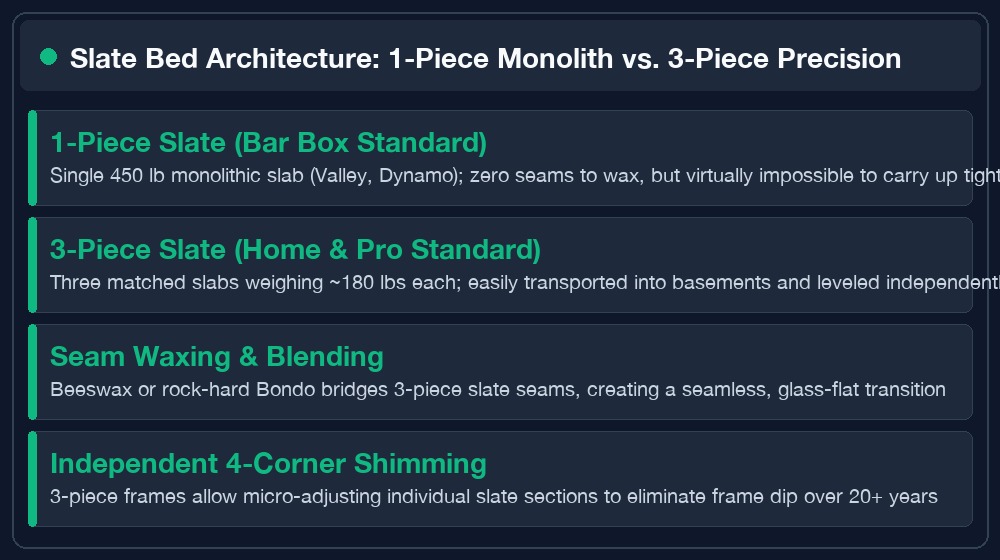
- 1-Piece Slate Tables (400 to 450 lbs single slab): Common in 7-foot commercial coin-operated bar tables (Valley, Dynamo). A single continuous sheet of slate provides indestructible durability in rough bar environments because there are no seams that can misalign when rowdy patrons lean on the table. However, moving a 450-pound single sheet of rock around tight stairwell corners is dangerous and requires 3 to 4 strong movers with specialized dollies.
- 3-Piece Slate Tables (150 to 230 lbs per slab): Standard in all 8ft, 8.5ft, and 9ft residential and tournament tables (Brunswick, Diamond, Olhausen). The slate bed is precision-milled as a single slab at the quarry, sliced into three matched sections, and numbered. Each section can be carried safely by two people. Once placed on the leveled frame, mechanics screw the slabs down and join the seams using melted beeswax or petroleum resin.
3. Breakdown of Structural Components: Slate, Cabinet, Rails, and Legs
Where does all that weight actually come from? Let’s dissect an 850-pound 8-foot hardwood residential table into its core components:
- The Slate Slabs (500 lbs / 60% of total): Quarried sedimentary rock composed of quartz, mica, and chlorite. Its high density gives it acoustic deadness and complete resistance to warping.
- The Wooden Cabinet & Cross Beams (180 lbs / 21% of total): Massive kiln-dried solid oak, maple, or tulipwood beams engineered to support the dead weight of the slate without sagging over decades of use.
- The Cushion Rails & Aprons (80 lbs / 9% of total): Hardwood top rails fitted with dense K-66 gum rubber cushions, cast metal corner castings, and heavy leather drop pockets.
- The Legs & Leveling Hardware (90 lbs / 10% of total): Solid turned wood or trestle-style pedestal legs equipped with heavy steel threaded leveling bolts and internal mounting plates.

4. Floor Load Engineering: Can Your Second Story or Apartment Hold a Slate Table?
One of the most persistent homeowner anxieties is whether an 850-pound pool table will cause second-story floor joists to sag or collapse. The structural engineering numbers provide immediate reassurance:
| Structural Metric | Standard Residential Code | 8-Foot Slate Table Load | Safety Factor Margin |
|---|---|---|---|
| Uniform Live Load (PSF) | 30 – 40 lbs / sq. ft. (IRC Code) | 18 – 22 lbs / sq. ft. across table footprint | Well below maximum residential rating |
| Point Load per Leg | Typical subfloor rating: 200-300 lbs point load | 210 – 225 lbs per leg (4-leg table) | Safe; use furniture cups on hardwood |
| Comparative Everyday Load | Waterbed / Refrigerator / Bathtub | Equivalent to four adult men standing in a cluster | Completely structurally sound |
Structural Recommendation: Modern residential homes built to International Residential Code (IRC) standards can easily support an 8ft or 9ft slate table on an upper floor. However, to minimize micro-vibrations, position the table perpendicular to the underlying floor joists and as close to load-bearing exterior walls as possible.

5. The Weight Difference Between Brazilian, Italian, and Chinese Slate
Not all billiard slate is mined from the same geological strata:
- Italian Slate (Liguria Region): The historical gold standard for billiard playfields. Italian slate is a fine-grained, soft-cleaving slate that is exceptionally flat and slightly lighter in density than other varieties. A 1-inch 8ft set weighs approximately 450 pounds.
- Brazilian Slate (Minas Gerais): Modern premium standard used by manufacturers like Olhausen and Brunswick. Brazilian slate is harder, denser, and less prone to chipping during drilling. A 1-inch set weighs roughly 480 to 520 pounds.
- Chinese Slate (Jiujiang Region): Widely used in modern production tables including Diamond Pro-Am tables. Chinese slate is extremely hard and heavy, with high quartz content. A 1-inch 8ft set can weigh upwards of 525 to 550 pounds.
6. Step-by-Step Disassembly and Safe Moving Protocol
NEVER attempt to move an assembled slate pool table in one piece! Doing so will buckle the frame, shear off leg mounting bolts, and crack the slate around screw holes. Always follow this disassembly sequence:
- Step 1: Remove Pocket Castings & Rails: Unbolt the rail bolts from beneath the cabinet apron. Lift the rails off in connected pairs or individually, being careful not to tear the rubber cushions.
- Step 2: Unfasten the Slate Bed Cloth: Carefully pull out the staples or unglue the felt along the wooden backing perimeter. Roll the cloth around a tube to prevent creases.
- Step 3: Remove Slate Screws & Scrape Seams: Back out the heavy countersunk screws holding each slab to the frame. Use a razor scraper or torch to melt out the beeswax seam filler.
- Step 4: Lift and Transport Slabs Vertically: With two workers per slab, lift the slate onto its long edge. Never carry slate flat! Slate has immense compressive strength but poor tensile strength; carrying a slab flat over a bump can snap it in half under its own weight.
- Step 5: Disassemble Frame & Legs: Unbolt the cabinet cross-braces and remove the legs from the frame box.
7. Heavy Table Pitfalls: Avoiding Structural Cracking and Pinched Nerves
Moving a 1,000-pound object presents genuine physical hazards:
- The Doorway Pinch: Slabs are 30 to 50 inches wide. Navigating narrow basement doorways or 90-degree stair turns requires pre-measuring clearance. Wear heavy leather grip gloves to avoid crushing fingers against door frames.
- Dropping the Corner: The corners of slate slabs are brittle. If a mover drops a corner onto concrete, the rock will shatter off in a chunk. Always rest slabs on folded moving blankets or rubber mats.
- Inadequate Vehicle Support: If hauling slate in a pickup truck or trailer, lay the slabs flat on a rigid, completely flat plywood bed, padded with moving quilts. Stacking slabs unevenly across wheel wells will crack them the first time you hit a pothole.
8. Leveling and Seam-Filling Protocol After Moving a Heavy Table
Once the table is reassembled in its new location, achieving a tournament-grade flat playfield requires precise leveling:
- Frame Leveling: Place a precision machinist level on the wooden frame. Adjust the leg levelers or insert wooden shims until the frame is completely plumb in both axes.
- Slate Shimming: Place the three slate slabs on the frame. Use brass or hardwood shims beneath the slate to eliminate any lip or height variance between slabs.
- Waxing the Seams: Heat a propane torch or electric wax iron and melt pure beeswax into the joints and screw countersinks. Once cool, scrape the wax flush with a flexible putty knife until your hand cannot detect any seam transition.

9. Frequently Asked Questions
Can two people move a slate pool table?
Two strong people can move a disassembled 3-piece slate pool table, as each individual slab weighs between 150 and 200 pounds. However, moving a 1-piece slate table (450 lbs) requires a minimum of 3 to 4 experienced movers.
How thick is standard pool table slate?
The tournament standard established by the Billiard Congress of America (BCA) is 1 inch thick matched slate. Economical home tables often feature 3/4-inch or 7/8-inch slate, while commercial snooker tables use 1-1/2 to 2-inch slate.
Can a wood-bed or Slatetron table compare to real slate?
No. Wood composite, particle board, or MDF tables warp under humidity, sag under their own weight, and produce slow, unpredictable ball roll. Authentic slate provides eternal flatness and tournament speed.
Will a pool table damage hardwood floors?
Because an assembled table exerts 200+ pounds of concentrated pressure on each leg, the leg bottoms can leave permanent indentations on hardwood. Always use heavy rubber-backed hardwood caster cups or thick carpet discs under the feet.
How much does it cost to hire professional pool table movers?
Professional pool table movers typically charge between $350 and $650 for a local move, which includes complete disassembly, transport, reassembly, precision leveling, and seam waxing.
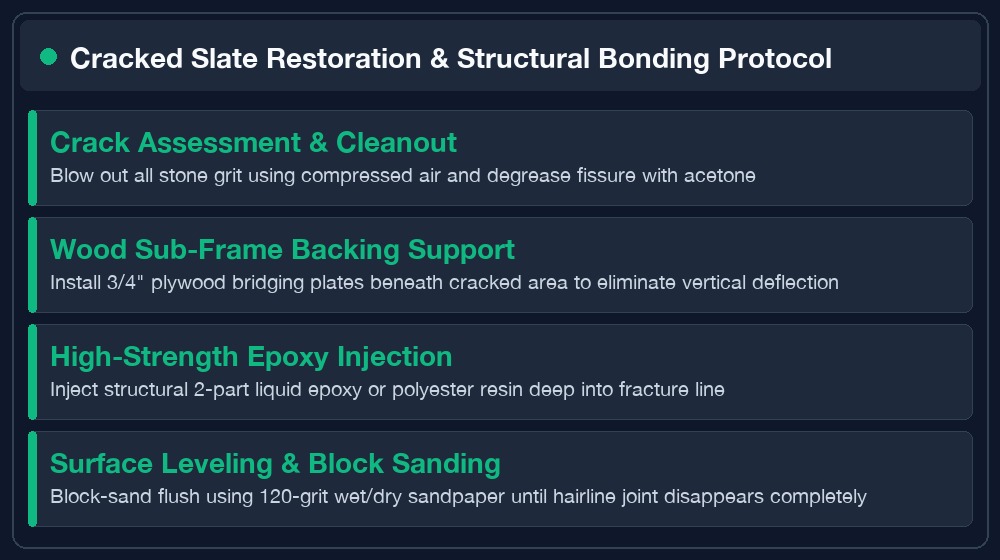
What happens if a slate slab cracks during a move?
Clean fractures can often be professionally repaired using high-strength two-part epoxy resin and re-milling. However, if a corner shatters into fragments, replacing the matched 3-piece set is usually required.
Can I lift a pool table by its rails to reposition it slightly?
Never lift a pool table by the rails! Lifting by the rails can rip the wooden aprons off the frame and break the wax seal between the slate slabs, completely ruining the table’s level.
How do I know if my used pool table is 1-piece or 3-piece slate before taking it apart?
Look underneath the table cabinet with a flashlight. If you see two wooden cross-support beams running across the width with screw holes aligned directly above them, it is a 3-piece slate table. If the bottom is open or has a single central support, it is 1-piece slate.

Marc Robert is the founder, chief technician, and senior equipment tester at Billiard Guides. With over 15 years of competitive amateur tournament and league experience (APA Skill Level 7 & BCA Master Division), Marc pairs deep table-side knowledge with rigorous mechanical bench testing. A certified cue mechanic and table mechanic, Marc specializes in three-piece slate alignment (calibrated using Starrett 98 precision machinist levels to ±0.005″), high-speed 240fps cue shaft deflection analysis, Shore D durometer tip hardness profiling, and Simonis worsted cloth friction testing. His independent reviews, drill curricula, and diagnostic calculators are trusted by over 500,000 cue sports players worldwide.