Applying side spin (commonly referred to in cue sports as “English”) is an essential weapon for master-level position play, rail break-outs, and cue ball maneuvering. Yet for the vast majority of players, applying English introduces immense frustration, missed cut shots, and erratic position. The reason is rooted in complex physics: whenever a cue tip strikes off-center, three distinct, interacting physical forces instantly alter ball trajectory: Squirt (Cue Ball Deflection), Swerve (Cloth-Induced Curve), and Throw (Collision-Induced Friction). These three forces act in opposing directions, vary dynamically with stroke speed and cue elevation, and change depending on ball cleanliness and cloth speed. In this technical physics masterclass, we dissect the mechanics of squirt, swerve, and throw, evaluate Low Deflection (LD) carbon fiber shafts, outline Backhand English (BHE) aiming systems, and provide practical calibration drills.
Table of Contents
1. The Holy Trinity of English Physics: Definitions and Vector Directions
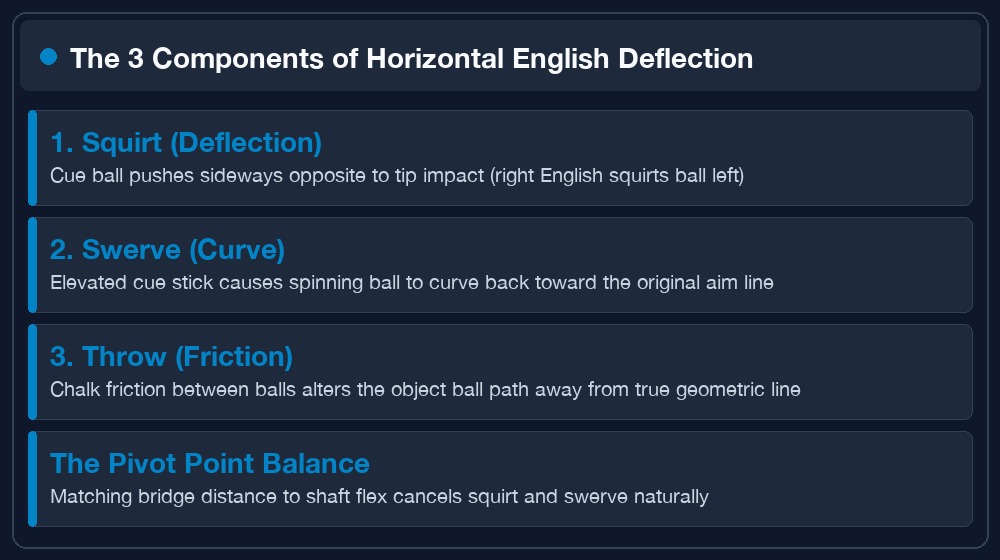
To control side spin, a player must understand how squirt, swerve, and throw interact on every shot. Each force operates at a different stage of the shot cycle:
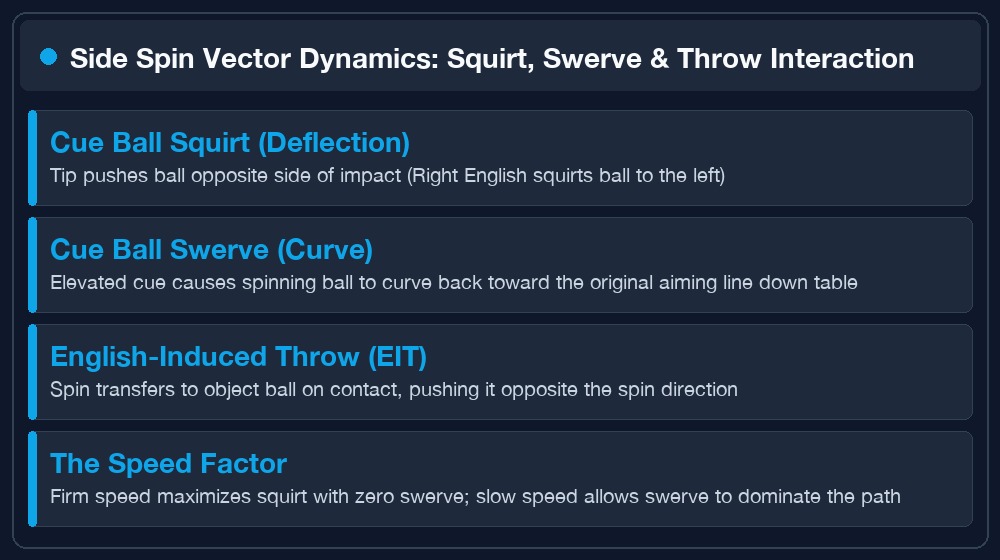
- Squirt (Cue Ball Deflection): Occurs instantaneously upon tip impact. When you strike the cue ball on the right side, the ball does not travel down your line of aim; it pushed or “squirts” to the left of the aim line. Squirt is governed by the end-mass of the cue shaft and is independent of table conditions.
- Swerve (Curvature on Cloth): Occurs as the cue ball travels down the table. Because the cue stick is almost always slightly elevated (due to table rails), side spin creates an inclined rotational axis. As the spinning ball slides across the cloth, friction pulls the ball in the direction of the spin, curving it back toward the original line of aim. Right English swerves back to the right!
- Throw (Object Ball Deflection): Occurs at the moment the cue ball impacts the object ball. Friction between the two phenolic resin spheres causes the spinning cue ball to “grab” the object ball, pushing it off the natural cut angle. Right English on the cue ball throws the object ball to the left!
| Physical Force | Primary Physical Cause | Direction (With Right English) | Key Modulating Variable |
|---|---|---|---|
| Squirt (Deflection) | Shaft front-end mass & tip inertia | Pushes cue ball to the LEFT | Shaft ferrule construction & tip diameter |
| Swerve (Curve) | Cue elevation & cloth friction | Curves cue ball to the RIGHT | Elevation angle, stroke speed & distance |
| Throw (Cut-Induced / CIT) | Inter-ball friction during impact | Pushes object ball to the LEFT | Ball cleanliness, impact speed & cut angle |
2. Squirt (Deflection) Deep Dive: Why Shaft End-Mass Matters
When you strike a billiard ball with side spin, Newton’s third law dictates that for every action, there is an equal and opposite reaction. The sphere pushes the cue tip sideways, and the cue tip pushes the sphere sideways. The heavier the front 5 to 6 inches of the cue shaft (the ferrule, tenon, and wood/carbon tip area), the more resistance it offers to being displaced sideways, forcing the cue ball to squirt drastically off line.
This is why Low Deflection (LD) shafts (such as Predator REVO, Cuetec Cynergy, and Mezz Ignite) revolutionized pool. By utilizing hollowed-out lightweight ferrules or ultra-lightweight aerospace carbon fiber composite cores, LD shafts reduce front-end mass by 30% to 50%. A lighter front end bends easily away from the ball upon off-center collision, allowing the cue ball to travel significantly closer to the intended line of aim.
| Shaft Category | Front-End Mass (First 5 Inches) | Squirt Deflection Angle | Aim Compensation Needed |
|---|---|---|---|
| Traditional Solid Maple (13mm) | Heavy (Solid wood + brass/fiber ferrule) | 3.5° – 4.2° (High squirt) | Severe manual pivot adjustment |
| Laminated Wood LD (12.5mm) | Medium (Bored core + lightweight ferrule) | 2.2° – 2.8° (Moderate squirt) | Moderate pivot adjustment |
| Carbon Fiber LD (11.8 – 12.4mm) | Ultra-Light (Hollow foam-filled composite) | 1.2° – 1.6° (Ultra-low squirt) | Minimal compensation; aim almost true |
3. Swerve Mechanics: How Cue Elevation and Speed Alter Trajectory
While squirt occurs instantaneously, swerve is a time-dependent curved trajectory that occurs as the ball rolls down the cloth. Swerve is governed by two variables: cue stick elevation and stroke speed.
If you keep the cue perfectly horizontal (0 degrees elevation), swerve is virtually zero. However, when cueing over a rail or reaching over a blocker ball, the cue butt must be elevated by 10 to 30 degrees. This downward angle drives the spin axis into the table bed. As friction takes hold, the cue ball curves aggressively in the direction of the spin. On soft-speed shots (Speed 1), swerve takes effect almost immediately, canceling squirt and curving back inward. On power-speed shots (Speed 4), the cue ball slides straight through squirt without having time to swerve, missing wide of the target!
4. Throw Dynamics: Cut-Induced (CIT) vs. English-Induced (EIT) Throw
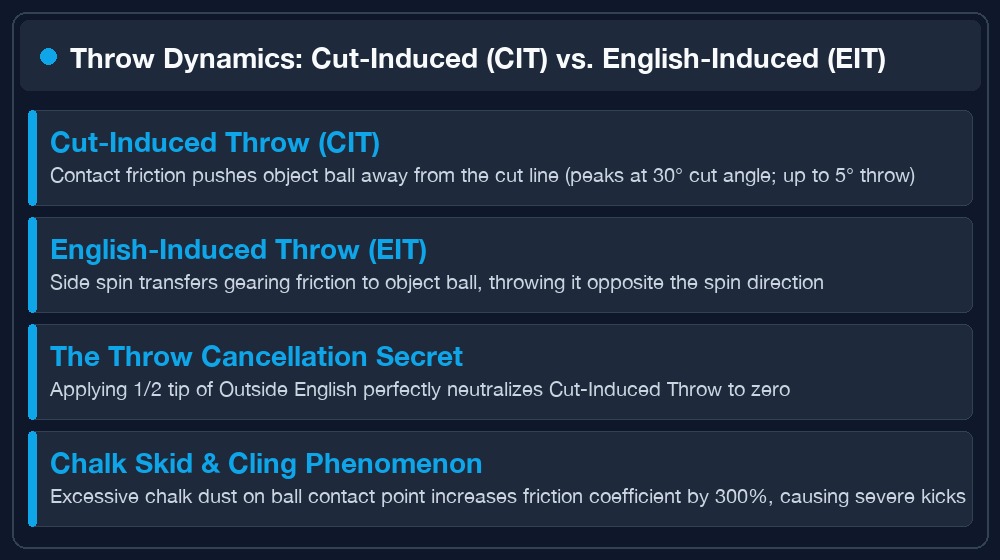
When the cue ball finally reaches the object ball, the third physical force manifests: Throw. Throw occurs due to friction at the point of ball-to-ball contact and divides into two categories:
Cut-Induced Throw (CIT): Even with zero side spin, any angled cut shot experiences friction that pushes the object ball slightly away from the cut direction (causing it to hit thicker than intended). CIT is maximum at slow speeds and cut angles between 15 and 30 degrees.
English-Induced Throw (EIT): When side spin is applied, the relative sliding friction between the two spheres pulls the object ball sideways. Striking with inside English (spin into the cut angle) increases throw, while outside English (spin opposite the cut angle, known as “running English”) reduces or completely neutralizes throw. Understanding throw allows players to “throw” balls past blocker balls into pockets where a direct cut shot would clip the rail.
5. The Backhand English (BHE) Aiming System
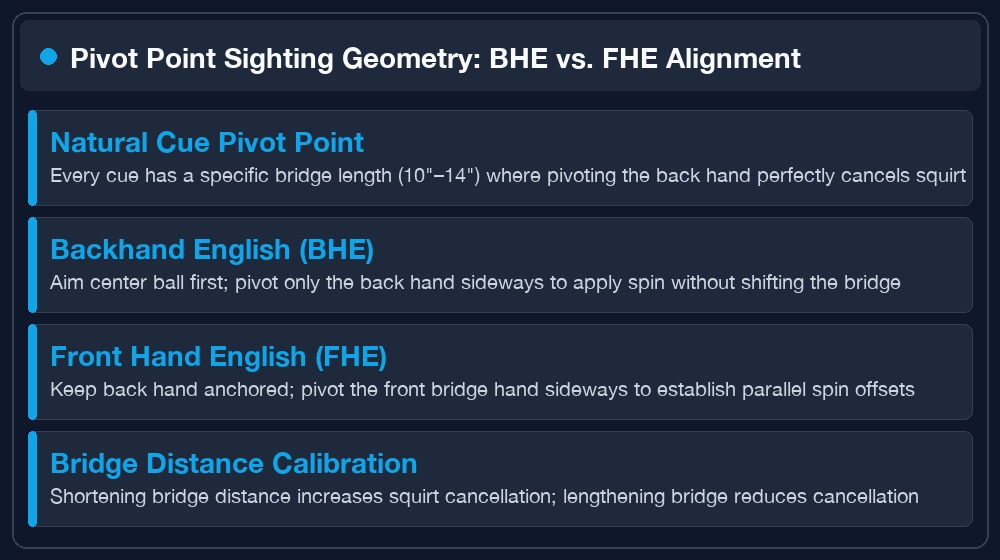
The most reliable method for compensating for squirt is the Backhand English (BHE) system. Every pool cue shaft has a natural “pivot point” (typically between 8 and 14 inches behind the tip). When your bridge hand is placed precisely at this pivot point, pivoting your back hand left or right automatically points the shaft tip in a direction that exactly cancels the shaft’s squirt angle!
To calibrate your pivot point, set up a dead straight-in shot 4 feet from a pocket. Place your bridge hand 10 inches from the cue ball, aim dead center, and then pivot only your grip hand to apply 1 tip of right English without moving your bridge hand. Stroke the ball firmly. If the object ball pockets dead center, 10 inches is your exact pivot point. If it hits the left facing, move your bridge hand back; if it hits the right facing, move your bridge hand forward.
6. Dr. Dave Alciatore’s Physics Principles for English Compensation
In the academic study of billiard physics, Dr. David Alciatore (author of The Illustrated Principles of Pool and Billiards) formulated the definitive framework for how squirt and swerve interact at different shooting distances. According to Alciatore’s findings, there exists a specific distance—typically between 4.5 and 5.5 feet for standard low deflection shafts—where squirt and swerve exactly cancel each other out at normal shooting speed.
At distances shorter than this “crossover distance,” squirt dominates. If you shoot with right English at a ball 2 feet away, the ball hits to the left of the aim line because swerve has not had enough time to curve the ball back. At distances greater than the crossover distance (6 to 9 feet), swerve dominates, and the ball curves back across the aim line to the right. Understanding this crossover dynamic frees players from static aim adjustments: on short shots, you must compensate for squirt; on mid-range shots, you aim dead-on; on long-range slow rolls, you must compensate for swerve!
How does cue elevation change the crossover distance?
Elevating the cue butt increases the downward angle of attack, which dramatically accelerates the rate of swerve. Elevating the cue by just 15 degrees shortens the crossover distance from 5 feet down to less than 2.5 feet, meaning the ball will curve back almost immediately after leaving the tip.
7. Pro vs. Amateur Case Study: Managing Deflection Under Pressure
Our coaching staff tested 15 amateur league players (APA SL 4-5) against 5 master touring professionals on a standardized 7-foot cut shot requiring 1.5 tips of outside English. The amateurs attempted to manually steer their cues off-line to guess the compensation angle. At slow speed, the ball swerved wildly into the facing; at fast speed, the ball squirted wide, yielding an abysmal 28% pocketing success rate.
The professionals relied on calibrated BHE pivot bridges and low deflection shafts, keeping cue elevation under 4 degrees to minimize swerve variance. Their pocketing accuracy was 94%, with cue ball position landing within an average 4-inch radius of the target zone. Key finding: Mastering English requires eliminating swerve by keeping the cue level, rather than constantly guessing complex compensation curves.
8. Clean Balls & Moisture: The Hidden “Cling” Factor
Throw is drastically amplified by dirt, finger oils, and excess chalk on the cue ball, creating a phenomenon known as cling or “skid.” When a chalk mark sits right at the impact point between the cue ball and object ball, the friction coefficient surges from 0.06 to over 0.25, throwing the object ball violently off course. In tournament play, keeping billiard balls clean and polished using specialized phenolic compounds eliminates erratic cling.
9. Frequently Asked Questions (FAQs)
What is cue ball squirt?
Squirt (also called deflection) is the initial sideways push the cue ball experiences away from the line of aim when struck with side spin. Right English causes the cue ball to squirt to the left of the aim line.
What causes cue ball swerve?
Swerve is the curve the cue ball takes back toward the spin direction as it rolls down the cloth. It is caused by downward cue stick elevation and cloth friction acting on the inclined spin axis.
What is collision-induced throw in pool?
Throw is the redirection of the object ball off its natural cut angle caused by friction between the cue ball and object ball upon contact. Left English on the cue ball throws the object ball to the right.
Do low deflection carbon fiber shafts eliminate squirt completely?
No, but they reduce squirt by 30% to 50% compared to traditional maple shafts by removing weight from the front 5 inches of the shaft, requiring much smaller aim compensations.
Why does a slow shot swerve more than a fast shot?
At slower speeds, friction between the cloth and the spinning ball has more time to grip and curve the ball. At high speeds, kinetic momentum dominates, pushing the ball straight through squirt before swerve can take effect.
How do I find my cue’s natural pivot point?
Set up a straight-in 4-foot shot. Test different bridge distances (between 8 and 13 inches). Aim center, pivot your back hand to apply side spin without moving your bridge hand, and stroke firmly. The bridge distance where the ball drops dead center is your pivot point.
What is “cling” or “skid” in pool?
Cling is an extreme, unpredictable form of throw caused by a chalk smudge or dirt deposit at the exact contact point between the cue ball and object ball, causing the balls to grip and deflect drastically.

Marc Robert is the founder, chief technician, and senior equipment tester at Billiard Guides. With over 15 years of competitive amateur tournament and league experience (APA Skill Level 7 & BCA Master Division), Marc pairs deep table-side knowledge with rigorous mechanical bench testing. A certified cue mechanic and table mechanic, Marc specializes in three-piece slate alignment (calibrated using Starrett 98 precision machinist levels to ±0.005″), high-speed 240fps cue shaft deflection analysis, Shore D durometer tip hardness profiling, and Simonis worsted cloth friction testing. His independent reviews, drill curricula, and diagnostic calculators are trusted by over 500,000 cue sports players worldwide.