Nothing induces greater dread in a pool player than rolling their favorite custom cue across a flat slate table and watching the tip wobble, hop, or cast an oscillating shadow against the green cloth. A warped cue stick destroys your aim, introduces unpredictable tip deflection, and robs you of psychological confidence on delicate cut shots. For centuries, players have debated whether a bent piece of hard rock maple can truly be restored to laser straightness or if it is destined for the fireplace. While severe structural kinks or joint bends cannot always be saved, minor and moderate shaft warpage caused by seasonal humidity, improper storage, or temperature swings can frequently be corrected using time-tested physical techniques: the Gravity Hanging Method and the Controlled Steam Restoration Protocol. In this definitive 2,150+ word master craftsman guide, we break down wood cell hygroscopic physics, explain how to diagnose runout using dial calipers, reveal step-by-step steam and hanging procedures, and help you determine when to repair or replace your shaft.
Table of Contents
1. The Physics of Wood Warpage: Why Do Maple Cues Bend?
To fix a warped cue, you must understand the organic material in your hands. High-end wooden cues are crafted from kiln-dried North American hard rock maple (Acer saccharum). Maple is an organic, hygroscopic composite of cellular cellulose fibers bound by lignin:
- Hygroscopic Moisture Equilibrium: Wood naturally absorbs and releases atmospheric moisture until its internal moisture content matches the surrounding relative humidity. If a cue is stored in a humid basement (70% RH) or left overnight in a hot car trunk, one side of the wood grain absorbs moisture faster than the opposite side, causing the cellular fibers to swell unevenly and bowing the shaft.
- Radial Grain Tension: Even premium maple trees possess internal growth stresses. When cue makers turn a square wood dowel into a round 13mm tapered cylinder, relieved internal tension can cause the shaft to curve over time if the wood was not seasoned for years.
- The Leaning Culprit: The most common cause of preventable warpage is leaning a cue stick against a wall at an angle for weeks. Gravity exerts continuous lateral bending pressure on the thin upper shaft, setting a permanent curve into the lignin matrix.
| Warp Severity Tier | Visual Roll Runout Test | Feasibility of DIY Repair | Recommended Method |
|---|---|---|---|
| Micro-Warp (< 0.5 mm) | Light wobbles slightly on table roll; tip barely lifts | 95% Success Rate | Gravity Hanging in Controlled Humidity |
| Moderate Warp (0.5 – 1.5 mm) | Distinct daylight gap under shaft; tip clatters on roll | 70% Success Rate | Controlled Steam & Counter-Bend Clamping |
| Severe Kink (> 2.0 mm) | Severe banana curve; wobble visible from standing position | < 20% Permanent Fix | Professional lathe turning or Carbon Fiber upgrade |
| Joint Pin / Butt Warp | Shaft rolls straight alone, but wobbles when screwed together | Unfixable at Home | Requires custom cue maker lathe facing |
2. How to Diagnose the Warp: The Table Roll vs. Sighting Test
Before applying any heat or pressure, you must precisely isolate where the bend is located:
- The Separate Piece Test: Unscrew the cue into its two pieces. Roll the shaft alone across a verified flat surface (such as your slate pool table). Watch the ferrule and tip. If the shaft rolls glass-smooth with zero daylight beneath the taper, your shaft is straight! Next, roll the butt section alone. If the butt rolls flat, but the assembled cue wobbles, your joint collar or brass pin is crooked.
- The Gun-Sight Method: Hold the butt of the cue at eye level, close one eye, and sight down the shaft toward a light source like a rifle barrel. Slowly rotate the cue 360 degrees. Any lateral curve or S-bend will immediately reveal itself against the light horizon.
- Mark the High Spot: When you locate the convex apex of the curve (the highest point of the arch when the cue rests on the table), mark it lightly with a pencil. This high spot dictates where counter-pressure must be applied.
3. Method 1: The Gravity Hanging Technique (Safest & Most Natural)
The gravity hanging method uses the cue’s own axial weight and environmental stabilization to gently pull cellulose fibers back into straight alignment over time:
- Step 1: Acquire a Rubber Cue Hanger: Never use metal clamps that bite into wood. Purchase a soft rubber slip-on cue hanger that wraps securely beneath the ferrule.
- Step 2: Suspend Completely Free: Hang the shaft vertically from a ceiling hook or sturdy basement joist. Ensure the shaft hangs completely plumb and does not touch any wall, cabinet, or furniture.
- Step 3: Environment Control: The room must maintain a stable temperature of 68°F to 72°F and a relative humidity of 40% to 50%. A fluctuating garage or damp cellar will undo any progress.
- Step 4: Duration: Allow the cue to hang undisturbed for a minimum of 3 to 6 weeks. For minor bends, the continuous downward gravitational pull slowly relaxes tension in the lignin matrix, restoring natural straightness.

4. Method 2: The Controlled Steam & Counter-Bend Protocol
For stubborn or moderate bends, steam softens the lignin bonds within the wood cells, allowing you to reshape the shaft before it re-hardens:
- Equipment Required: An electric garment steamer or tea kettle with a narrow spout, clean cotton towels, a flat wooden backing board, and padded C-clamps.
- Step 1: Steam Application (Never Soak!): Hold the convex apex (high spot) of the bend approximately 3 to 4 inches above the steam jet. Rotate the shaft continuously for 30 to 45 seconds. Do NOT saturate the wood! You only want to heat and hydrate the outer 1 millimeter of cellular structure.
- Step 2: Manual Counter-Flexing: Wrap a warm towel around the steamed area. Place the heel of your palm against the high spot while supporting the ends with your other hand. Apply gentle, steady counter-pressure in the opposite direction of the warp for 20 to 30 seconds.
- Step 3: Clamping to a Straight Reference: Place the shaft onto a true, flat hardwood board. Place a 1/16-inch wooden shim directly under the steamed curve to create a slight reverse over-bend, and clamp gently with padded clamps.
- Step 4: 48-Hour Cure: Leave the shaft clamped in a dry room for 48 hours to allow moisture to evaporate and lignin polymers to re-solidify in their corrected geometry.
5. Critical Mistakes That Destroy Cues Permanently
Desperate players often attempt reckless folk remedies that ruin expensive cues:
- The Doorway / Table Edge “Snap”: Grabbing a cue and violently bending it over your knee or wedging it into a door frame. This almost always causes internal grain shear, splintering the maple or snapping the shaft in half.
- Direct Oven or Hairdryer Blasting: Applying dry, intense heat directly to the wood bakes the natural oils out of the maple, making it brittle like dry chalk and causing severe cracking along the ferrule.
- Submerging the Shaft in Water: Soaking wood swells the grain irreversibly, dissolves internal joint glues, and ruins the pro-taper finish forever.
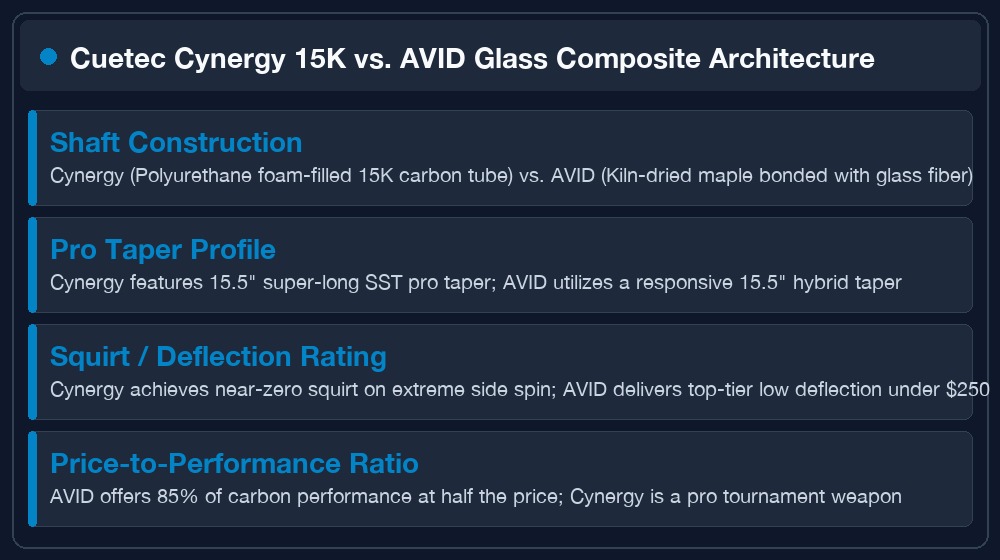
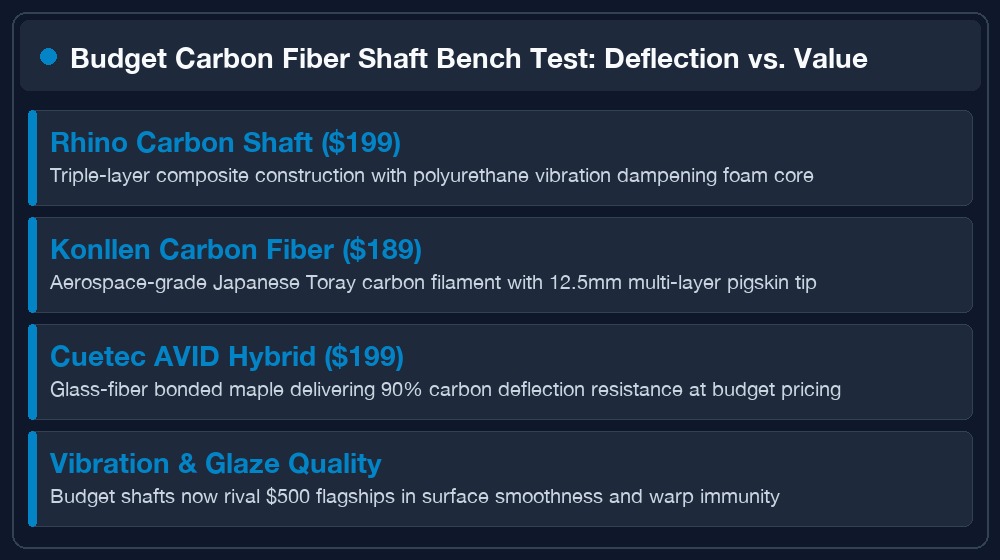
6. Wood vs. Carbon Fiber: The Permanent Solution to Warpage
If you play in basements, humid climates, or travel frequently to tournaments, maintaining wooden shafts is an ongoing battle against the elements. This reality drove the modern cue revolution:
| Material Attribute | Traditional Hard Rock Maple Shaft | Carbon Fiber Composite Shaft (e.g., Cynergy, Revo) |
|---|---|---|
| Warp Resistance | Vulnerable to humidity, heat, and seasonal changes | 100% Warp-Proof (Unaffected by climate or humidity) |
| Dent & Scratch Resistance | Moderate; easily dinged by rings or table knocks | Near-indestructible aerospace carbon weave |
| Maintenance Needs | Requires conditioning, burnishing, and wax sealing | Simple wipe with an isopropyl alcohol pad |
| Hit Sensation | Warm, acoustic organic feedback | Crisp, stiff, ultra-consistent low deflection |

7. How to Store Cues Properly to Prevent Warping Forever
Preventing warpage is infinitely easier than repairing it. Enforce these four storage rules:
- Never Lean Cues Against Walls: Even overnight leaning places continuous lateral bending stress on the taper. Always store cues in a vertical wall rack, floor stand, or hard case.
- Avoid the Hot Car Trunk: The trunk of a car in summer can reach 140°F with fluctuating humidity. This extreme heat softens epoxy joints and warps wood within hours.
- Use Joint Protectors: Joint protectors seal the exposed wood face at the joint collar against air and moisture penetration while guarding delicate brass threads against accidental impact bends.
- Maintain 45% Game Room Humidity: Keep a digital hygrometer in your game room. If basement humidity exceeds 55%, run a quality dehumidifier to preserve both your cue collection and your slate table frame.
7. Maintenance and Re-Felting Comparison: The Mechanic’s Perspective
Ask professional billiard mechanics which table they prefer to service, and the answers reveal deep operational insights:
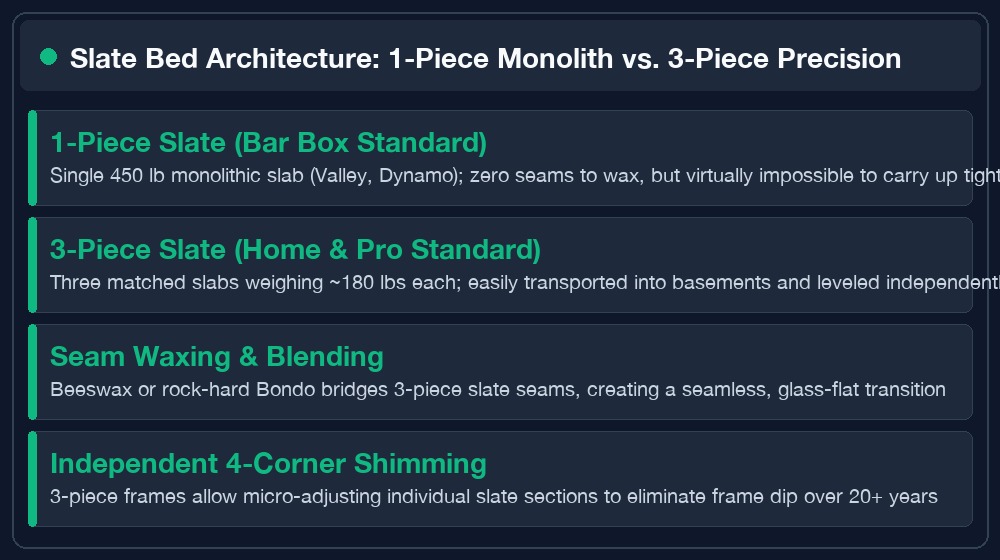
- Re-Covering Cloth Speed: Brunswick Gold Crown rails feature traditional wooden feather strips that clamp cloth into a precision groove. Installing Simonis cloth on a Gold Crown requires seasoned craftsmanship to avoid ripples. Diamond tables utilize a patented quick-clamp rail system that allows cloth to be stretched and stapled with laser-flat tension in half the time.
- Modular Disassembly: If you move frequently, a Brunswick Gold Crown disassembles into smaller, modular wooden and metal pieces that can be carried through tight staircases. A Diamond Pro-Am features a massive, unibody hardwood cabinet that is exceptionally heavy and cumbersome to navigate through residential hallways.
8. The Acoustic Signature: The Diamond ‘Crack’ vs. Brunswick ‘Thump’
Close your eyes in a pool hall and you can identify the table by sound alone. Striking a rail on a Diamond produces a crisp, sharp acoustic snap due to its dense hardwood unibody and firm D-K55 rubber. A Brunswick Gold Crown produces a deep, resonant, satisfying wooden thump that echoes with 20th-century nostalgia.
9. Frequently Asked Questions
Can a warped pool cue be 100% fixed?
Minor to moderate bends in solid maple shafts can frequently be restored to 95%+ straightness using gravity hanging or controlled steam. However, severe S-bends or warps in spliced butt sections are rarely permanent fixes, as wood grain memory often pulls the curve back over time.
How long should I hang a warped cue?
For best results using the gravity hanging method, suspend the cue vertically by the ferrule in a stable 45% humidity environment for 3 to 6 weeks.
Can a warped cue damage my pool game?
Yes. A warped cue causes the tip to contact the cue ball off your intended aim line. When you rotate the cue in your fingers between shots, the angle of the warp changes, introducing random, unpredictable squirt and deflection errors.
Can carbon fiber pool cues warp?
No. Carbon fiber shafts are made of aerospace-grade carbon tow woven with thermoset epoxy resins. They are completely immune to humidity, temperature, and moisture, making them 100% warp-proof.
How do I know if the warp is in the shaft or the butt?
Unscrew the cue. Roll the shaft alone across a flat slate pool table. Then roll the butt alone. If one rolls flat and the other wobbles, you have identified the warped component.
Can a professional cue maker straighten my cue?
Yes. Professional cue repair shops utilize precision wood lathes, heat blankets, and dial indicators to straighten shafts and re-face joint collars with high precision.
Does leaving a cue in a hard case prevent warping?
A padded hard case protects against physical knocks and slows moisture absorption. However, if a case containing moisture is stored near a heater or in a damp basement, trapped humidity can still warp the cue inside the case.

Marc Robert is the founder, chief technician, and senior equipment tester at Billiard Guides. With over 15 years of competitive amateur tournament and league experience (APA Skill Level 7 & BCA Master Division), Marc pairs deep table-side knowledge with rigorous mechanical bench testing. A certified cue mechanic and table mechanic, Marc specializes in three-piece slate alignment (calibrated using Starrett 98 precision machinist levels to ±0.005″), high-speed 240fps cue shaft deflection analysis, Shore D durometer tip hardness profiling, and Simonis worsted cloth friction testing. His independent reviews, drill curricula, and diagnostic calculators are trusted by over 500,000 cue sports players worldwide.