Selecting the dimensions for your home billiard table is one of the most critical, permanent investments any cue sports enthusiast will ever make. Unlike furniture that can be easily rearranged on a weekend whim, an 800 to 1,200-pound slate pool table anchors your room for decades. In American residential game rooms, the market is dominated by three primary slate sizes: standard 8-foot (popularly known as the quintessential home table), 8.5-foot “Pro 8”, and regulation 9-foot (the international tournament standard). But which size is truly right for your game, your available square footage, and your competitive ambitions? Does practicing on an 8-foot table hurt your performance in tournament leagues played on 9-foot Diamond or Brunswick equipment? Exactly how much cue clearance do you need around the perimeter? In this definitive 2,100+ word buyer’s guide, we compare 8ft, 8.5ft, and 9ft tables across playing dynamics, publish room dimension blueprints, calculate cue stroke clearance, and guide you to the perfect table choice for your home.
Table of Contents
1. 8ft vs. 8.5ft vs. 9ft: Specifications & Dimension Matrix
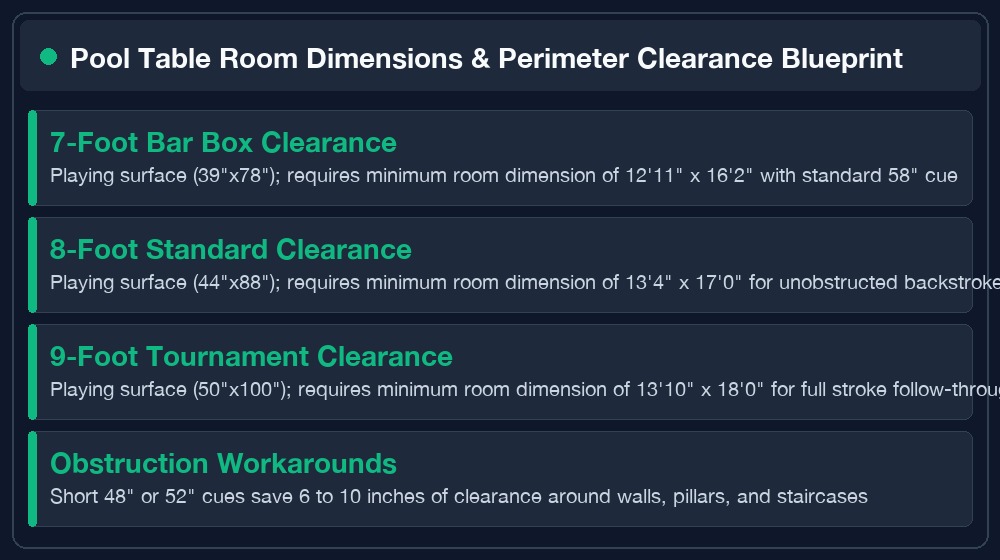
The playfield dimensions of a billiard table are governed by a strict 2:1 mathematical aspect ratio (the length of the playing surface between cushion noses must be precisely twice the width). Here is the technical breakdown across the three major table sizes:
| Table Size Category | Playfield Dimensions (Nose to Nose) | Total Playing Area | Minimum Room Size (58” Cue) | Average Assembled Weight |
|---|---|---|---|---|
| Standard 8-Foot | 44” × 88” (112 × 224 cm) | 3,872 sq. in. (26.9 sq. ft.) | 13′ 4” × 17′ 0” (4.1 × 5.2 m) | 750 – 875 lbs |
| 8.5-Foot “Pro 8” | 46” × 92” (117 × 234 cm) | 4,232 sq. in. (29.4 sq. ft.) | 13′ 6” × 17′ 4” (4.1 × 5.3 m) | 850 – 975 lbs |
| Regulation 9-Foot | 50” × 100” (127 × 254 cm) | 5,000 sq. in. (34.7 sq. ft.) | 13′ 10” × 18′ 0” (4.2 × 5.5 m) | 1,050 – 1,250 lbs |
2. Playability Dynamics: The Mechanical & Mental Differences
Playing on an 8-foot table feels dramatically different from shooting on a 9-foot tournament table:
- Shot Distance & Margin of Error: A regulation 9-foot table features a massive 5,000 square inches of slate—nearly 30% more surface area than an 8-foot table! Over full-table shots (6 to 8 feet), an angular sighting error of just 0.4 degrees causes an object ball to miss the pocket. On an 8-foot table, that same shot is only 4 to 5 feet, forgiving minor tip alignment errors.
- Traffic & Cluster Congestion: In 8-ball, fifteen balls on an 8-foot table create high traffic and clustered pockets. Players must navigate tight routes, execute delicate breakouts, and control cue ball speed with extreme delicacy. On a 9-foot table, balls disperse widely on the break, opening up natural pocket lanes but demanding laser-accurate long shotmaking.
- Position Play Demands: On a 9-foot table, position errors are severely punished. If you leave yourself an 8-foot cut shot, pocketing percentage drops significantly. On an 8-foot table, recovery shotmaking is much more forgiving.
3. What Is an 8.5-Foot “Pro 8” Table? (The Industry Compromise)
The 8.5-foot table (46” × 92”) was invented by billiard manufacturers to solve a common residential dilemma: players who want the competitive feel of a 9-foot table but lack the 18-foot room length required for full clearance:
- The Geometry: An 8.5ft table provides 4,232 square inches of playfield. It demands tighter position play and longer cut shots than a standard 8ft, providing an authentic tournament simulation.
- The Space Advantage: It requires only 13’6” × 17’4” of floor space—just 4 inches longer than a standard 8ft table. Many players find it is the sweet spot for finished basements and bonus rooms.
4. Room Dimension Engineering: The 5-Foot Clearance Rule
The single most catastrophic mistake in game room design is buying a table that is too large for the room. To determine if your room can accommodate a table, use the Standard Cue Clearance Formula:
Room Length = Playfield Length + (2 × Cue Length)
Because a standard two-piece pool cue is 58 inches (4 feet 10 inches) long, you need a minimum of 5 feet (60 inches) of unobstructed clearance in every direction from the rubber cushion nose to the nearest wall, post, or cabinet. When the cue ball is frozen against a rail, you need 58 inches for the cue stick plus 2 to 3 inches for your backswing stroke!
| Table Size | Room Size with 58” Cue | Room Size with 52” Cue | Room Size with 48” Cue |
|---|---|---|---|
| Standard 8-Foot | 13′ 4” × 17′ 0” | 12′ 4” × 16′ 0” | 11′ 8” × 15′ 4” |
| 8.5-Foot Pro 8 | 13′ 6” × 17′ 4” | 12′ 6” × 16′ 4” | 11′ 10” × 15′ 8” |
| Regulation 9-Foot | 13′ 10” × 18′ 0” | 12′ 10” × 17′ 0” | 12′ 2” × 16′ 4” |
5. Resale Value & Market Liquidity: Which Size Holds Value?
If you ever move or decide to upgrade your table, market liquidity matters:
- Standard 8-Foot Tables (Highest Liquidity): The 8-foot table represents over 75% of the total residential billiard market. If you decide to sell a Brunswick or Olhausen 8ft table on Facebook Marketplace or Craigslist, you will find dozens of eager family buyers because it fits standard 14×18-foot suburban rooms.
- Regulation 9-Foot Tables (Niche Tournament Market): 9-foot tables are harder to sell to casual homeowners due to room constraints. However, serious tournament players actively seek used 9ft Diamond Pro-Am or Brunswick Gold Crown tables, and high-end models command exceptional resale prices.
- 8.5-Foot Tables (Moderate Resale): While beloved by knowledgeable players, replacement cloth (pre-cut felt) must be ordered specifically for “Pro 8” dimensions, and some casual buyers are confused by the non-standard designation.
6. Pro vs Amateur Perspective: Will Practicing on an 8-Foot Table Ruin Your Game?
A common fear among league players is that practicing at home on an 8-foot table will ruin their stroke when playing APA, BCA, or tournament matches on 9-foot equipment:
- The Truth About Fundamentals: Alignment, vision center, stance, pendulum stroke, and cue ball speed control are identical regardless of table size. In fact, because an 8-foot table produces tighter clusters in 8-ball, home practice sharpens your cluster-breakout and safety skills.
- The Transition Adjustment: When transitioning from an 8ft home table to a 9ft tournament table, players typically need only 20 to 30 minutes of warm-up lag drills to calibrate visual perspective on long full-table cut shots.

7. Step-by-Step Room Assessment Checklist Before Buying
Follow this five-step physical audit before signing a purchase contract:
- Measure Usable Clear Floor Space: Measure from the baseboards—not the drywall. Subtract any furniture, barstools, cue racks, or radiators that project into the room.
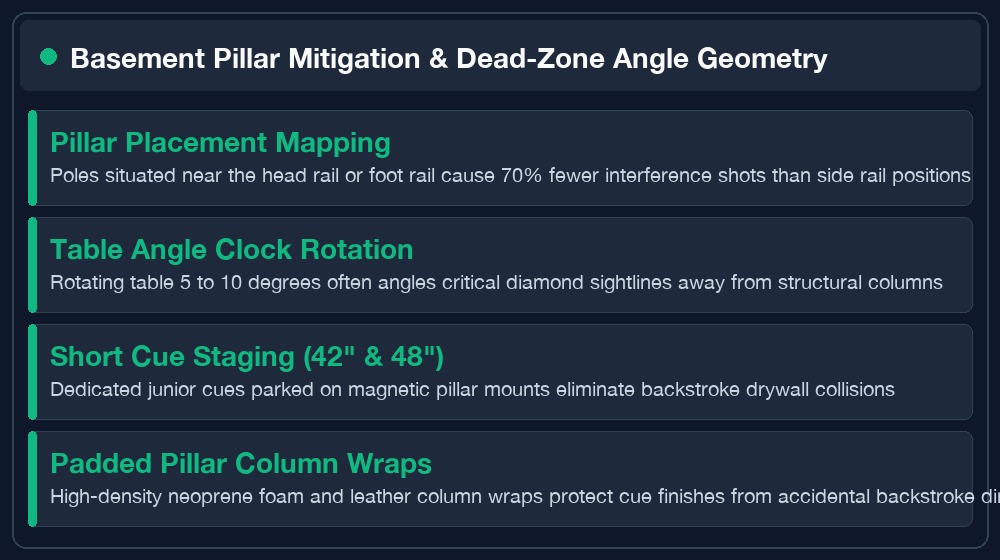
- Identify Structural Obstacles: Note the exact location of any basement support columns, stairwells, or low-hanging ductwork.
- Tape the Playfield on the Floor: Use blue painter’s tape to mark the exact playfield dimensions (e.g., 44” × 88” for an 8ft table) directly on your flooring.
- Simulate Rail Shots with a Cue: Place a cue ball on the taped line and hold a 58-inch cue stick in shooting stance. Perform a full backswing toward each wall. If the cue butt hits the wall or drywall, you have identified a clearance bottleneck.
- Check Delivery Access Pathways: Slate slabs and heavy hardwood frame boxes must navigate stairwells, 90-degree hallway turns, and basement entries. Ensure pathways are at least 36 inches wide.
8. The Ultimate Buying Verdict: Which Table Is Right for You?
- Buy an 8-Foot Table If: Your room length is between 17 and 18 feet, you want the most versatile, family-friendly table, you value high resale liquidity, and you want great competitive play without cramping your room.
- Buy an 8.5-Foot Pro 8 If: Your room has at least 17’6” of length, you want slightly more challenging shotmaking than an 8ft table, but your room cannot quite accommodate a full 18-foot tournament 9-footer.
- Buy a 9-Foot Regulation Table If: Your room exceeds 14′ × 18′ of clear space, you compete seriously in BCA/CSI/WPA national tournaments, and you demand the uncompromising championship standard in your home.
9. Frequently Asked Questions
Is an 8-foot pool table considered standard?
Yes. The 8-foot table (44” × 88”) is the universal standard for residential homes in the United States, representing over 75% of all consumer pool table sales.
Can I use a 52-inch cue if my room is slightly too small?
Yes. Many homeowners with a minor obstacle (such as a single basement support pole or chimney breast) keep a 52-inch or 48-inch “trouble cue” on hand for the rare shot where the cue ball is frozen against a tight rail.
What table size is used in APA league play?
APA leagues predominantly compete on 7-foot commercial bar tables (Valley, Dynamo) or 8-foot tables, depending on whether the host venue is a tavern or dedicated billiard club. National championships in Las Vegas feature 7-foot tables.
What table size is used in professional tournaments?
Premier international professional tournaments (Matchroom World Pool Championship, US Open, Mosconi Cup) are played exclusively on regulation 9-foot tables (50” × 100” playfield).
How much clearance do I need around a pool table?
You need a minimum of 5 feet (60 inches) of clear, unobstructed space in every direction from the cushion nose to the nearest wall or furniture piece.
Does felt color affect perceived table size?
Yes. Traditional green felt absorbs light, making tables appear slightly smaller and more compact. Modern tournament blue (such as Simonis 860 Tournament Blue) reflects light evenly, enhancing visual perspective across the cloth.
Can a room with a 7-foot ceiling accommodate a slate table?
Yes. A 7-foot ceiling provides ample vertical clearance for playing pool. However, you must choose a slim perimeter LED light or low-profile fixture to prevent cue sticks from striking the light on jump shots.

Marc Robert is the founder, chief technician, and senior equipment tester at Billiard Guides. With over 15 years of competitive amateur tournament and league experience (APA Skill Level 7 & BCA Master Division), Marc pairs deep table-side knowledge with rigorous mechanical bench testing. A certified cue mechanic and table mechanic, Marc specializes in three-piece slate alignment (calibrated using Starrett 98 precision machinist levels to ±0.005″), high-speed 240fps cue shaft deflection analysis, Shore D durometer tip hardness profiling, and Simonis worsted cloth friction testing. His independent reviews, drill curricula, and diagnostic calculators are trusted by over 500,000 cue sports players worldwide.