Chinese 8-Ball (widely recognized globally as Chinese Pool, Joy Pool, or Heyball) has exploded into one of the most lucrative and fiercely competitive professional cue sports in the world. Combining the tactical rules and heavy American 2 1/4-inch phenolic balls of 8-ball with the brutal, unforgiving hardware of English snooker, Chinese 8-Ball presents a colossal challenge to even world-champion players. Played on 9-foot slate tables covered in dense, directional napped English wool baize and featuring narrow, rounded snooker-style pocket jaws (with zero corner pocket facing bevels), a ball struck just 1 millimeter off-center will violently reject back onto the green. In this comprehensive official guide, we break down Chinese 8-Ball rules, examine table specifications and snooker pocket geometries, review official foul penalties, analyze tactical safety play, and compare Heyball against American 8-Ball.
Table of Contents
1. The Architecture of Chinese 8-Ball: Snooker Hardware Meets American Pool
To understand why Chinese 8-Ball is so punishingly difficult, one must examine the hybrid physical environment engineered by table manufacturers like Joy Billiards and Xingpai:
- 9-Foot Snooker Bed Construction: The table playing surface measures 50 inches by 100 inches, resting atop heavy 45mm precision-ground 3-piece slate slabs heated by internal thermostatic heating blankets to eliminate humidity drag.
- Directional English Wool Baize: Unlike slick American worsted wool (Simonis), Chinese Pool utilizes heavy, napped English woolen cloth (Strachan 6811 Tournament baize). The cloth features a distinct directional nap running from the head rail to the foot rail. Rolling with the nap increases ball speed; rolling against the nap creates heavy drag and ball deflection.
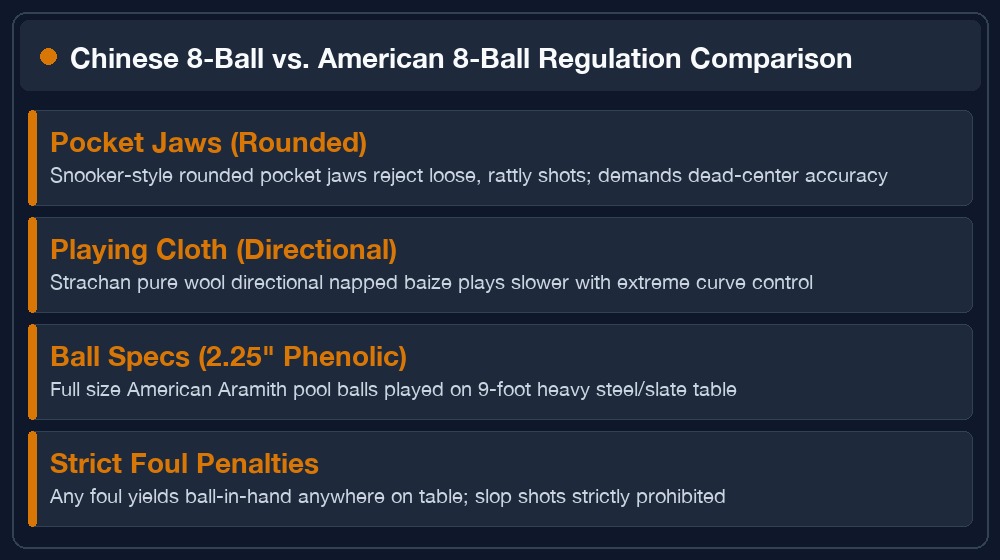
- Rounded Snooker Pocket Jaws: Standard American tables feature flat 45-degree neoprene pocket facings that guide angled balls into the pocket. Chinese 8-Ball tables feature rounded snooker-style pocket radiuses cut to approximately 84mm (3.3 inches) for corners. Because a standard pool ball is 57.15mm (2.25 inches), the clearance tolerance is razor thin. Balls that brush the curved rubber jaws bounce straight back across the table.
- American Phenolic Ball Set: Players shoot with full-size, heavy 2 1/4-inch Aramith or Cyclop phenolic balls (weighing 6 oz), rather than lightweight 2 1/16-inch snooker balls, demanding tremendous stroke power to move balls through the heavy baize nap.
| Hardware Specification | Chinese 8-Ball (Joy / Heyball) | American 8-Ball (WPA / Diamond) |
|---|---|---|
| Pocket Throat Geometry | Rounded snooker radiuses (82 – 85 mm) | Mitered 45° flat neoprene facings (114 mm / 4.5″) |
| Cloth Material | Heavy directional napped wool (Strachan 6811) | Flat-woven non-directional worsted (Simonis 860) |
| Table Cushion Profile | Steel block snooker L-shaped cushions | Wood sub-rail K-66 / K-55 triangular rubber |
| Pocket Drop Shelf | Deep curved drop shelf (zero cheat margin) | Shallow bevel drop shelf (allows pocket cheating) |
| Typical Cue Tip Size | 10.0mm – 11.5mm conical snooker/hybrid cue | 11.8mm – 13.0mm pro-taper American pool cue |
2. Official Joy / WPA Chinese 8-Ball Rules & Regulations
While the objective remains pocketing your assigned group (solids or stripes) and concluding with the 8-ball, official tournament regulations (IHPA / Joy World Championship rules) feature strict protocols:
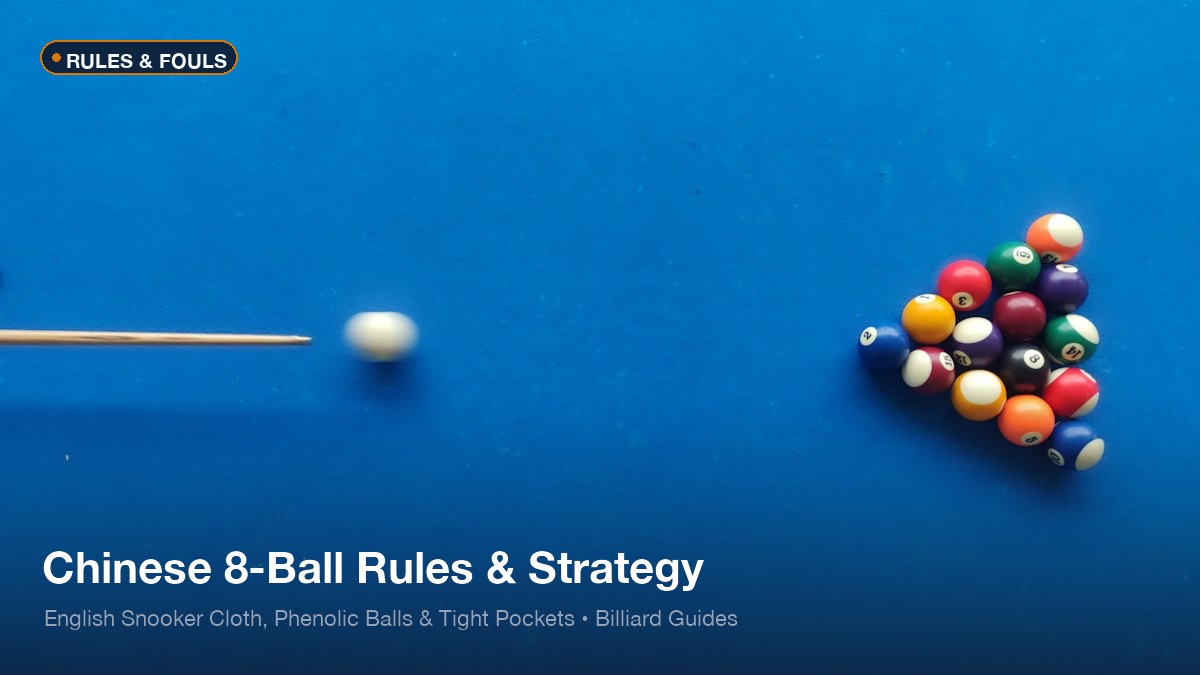
- The Opening Break Requirement: The cue ball is placed anywhere behind the head string. To constitute a legal break, the breaker must either pocket an object ball OR drive at least four numbered balls to contact rail cushions. If the breaker fails to meet this quota without scratching, the incoming player can accept the table, re-rack and break, or request the original breaker to re-break.
- Open Table After the Break: Regardless of whether balls were pocketed on the break, the table is always “Open.” Group selection (solids or stripes) is determined only when a player legally pockets a nominated ball in a called pocket on a regular shot.
- Call-Shot Mandate: Chinese 8-Ball is a strict call-shot game. A player must designate the intended ball and intended pocket on every shot. Flukes, kiss-ins, or accidental pocketings result in loss of turn, with illegally pocketed balls remaining pocketed.
- Legal Shot Execution: On all shots, the cue ball must contact a ball of the player’s legal group first, and subsequently at least one ball must contact a cushion or drop into a pocket. Failure to do so is a foul resulting in Ball-in-Hand.
3. Foul Penalties and Ball-in-Hand Dynamics
Fouls in Chinese 8-Ball grant the incoming player Cue Ball in Hand anywhere on the entire table surface, except for break fouls (where the cue ball must be placed behind the head string in the “kitchen”). Standard fouls include:
- Scratching the cue ball into a pocket or driving it off the table bed.
- Failing to strike a legal object ball first.
- Failing to drive any ball to a cushion after legal contact.
- Touching any ball with clothing, bridge, or cue stick (touch foul).
- Executing a push shot or double-hit (cue tip contacting cue ball twice).
- Shooting while any ball on the table is still moving or spinning.
| Violation Scenario | Chinese 8-Ball Penalty | American 8-Ball Penalty |
|---|---|---|
| Scratch on the Break | Ball in hand behind head string (“Kitchen”) | Ball in hand behind head string |
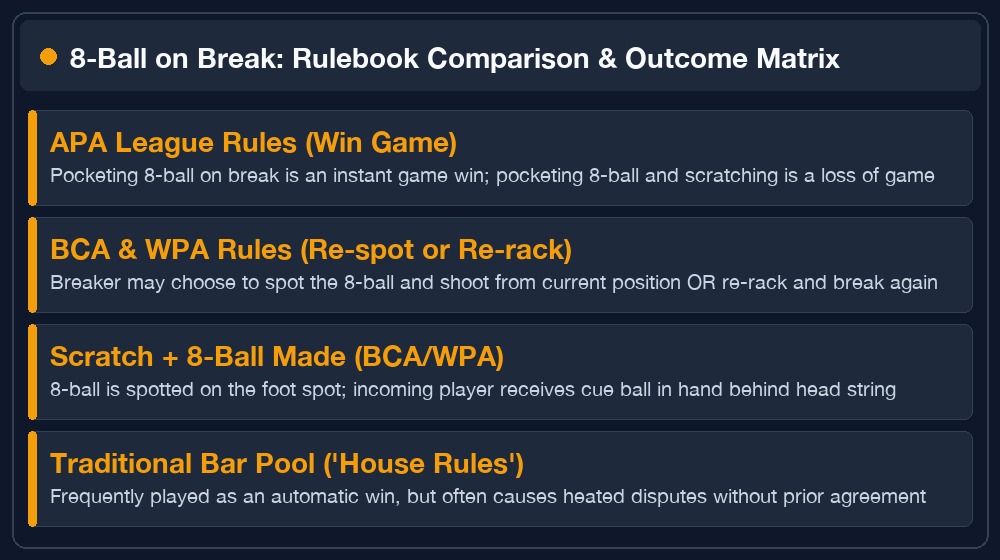
| Pocketing the 8-Ball on the Break | 8-ball is spotted; shooter continues | Win of game (APA) or option to spot/re-rack (BCA) |
| Scratch While Pocketing 8-Ball | Immediate Loss of Frame / Game | Immediate Loss of Game |
| Deliberate Unsportsmanlike Foul | Loss of Frame or Match DQ | Warning or Loss of Game |
4. Defensive Strategy and Safety Battles on Snooker Pockets
Because pocketing difficult cut shots is virtually suicidal on Chinese 8-Ball tables, defensive play is elevated to an art form. Unlike American pool where players attempt aggressive run-outs, Chinese 8-Ball matches frequently evolve into 20-minute tactical safety duels:
Snookering Behind Groups: Top professionals routinely execute “snookers,” tucking the cue ball frozen against an opponent’s ball or behind the 8-ball. Escaping a snooker on rounded pocket rails requires millimeter-precise kick shots, as an inaccurate kick gives up Ball-in-Hand.
Jaw Freezing: A classic tactical move involves nudging an object ball into the curved pocket jaws without pocketing it. A ball wedged into a rounded pocket jaw blocks the pocket mouth completely, preventing your opponent from using that pocket for the rest of the frame.
5. Steel Block Cushions & Directional Baize Friction Dynamics
A crucial technical element that distinguishes Chinese 8-Ball tables from standard American pool tables is the cushion rail backing. American tables feature wooden sub-rails where rubber cushions are bonded directly to wood. Official Joy tournament tables utilize solid steel block cushion backings weighing hundreds of pounds. When a heavy 6-ounce phenolic ball strikes a steel-backed rail, virtually zero vibrational kinetic energy is absorbed by the rail frame. This creates an explosive, hyper-responsive rebound with razor-sharp reflection angles.
Additionally, the directional nap of the English Strachan 6811 baize introduces asymmetric drag. When shooting toward the foot spot (with the nap), the ball rolls with minimal resistance and holds its straight line. When shooting backward toward the head string (against the nap), the standing wool fibers exert opposing friction, shortening ball roll by 15% and causing spinning cue balls to grab and swerve dramatically. Professional players must constantly adjust their speed and English calculations depending on which direction they are shooting across the table.
How does table heating affect ball speed on Chinese 8-Ball tables?
Heated slates maintain the cloth at a constant 35°C (95°F), which drives out ambient humidity that would otherwise cause the dense wool fibers to swell. Heated tables roll approximately 25% faster than unheated tables and eliminate chalk residue clinging to the ball contact points.
6. Cue Selection for Chinese 8-Ball: Snooker Ash vs. American Carbon
Equipment choice in Chinese 8-Ball is unique. Most world champions (such as Zheng Yubo and Gareth Potts) use specialized hybrid cues featuring:
- Conical Tip Diameters: 10.5mm to 11.5mm tips (significantly smaller than standard 12.5mm American pool cues, but larger than 9.5mm snooker cues) to balance potting accuracy with the mass needed to move 6 oz balls.
- Stiff Ash or Carbon Shafts: High-density North American ash or carbon fiber shafts designed to punch through heavy directional wool baize with zero shaft whiplash.
- Brass or Titanium Ferrules: Thin metallic ferrules that provide an ultra-crisp acoustic feedback and instant kinetic transfer on heavy impacts.
7. Pro vs. Amateur Adaptation Case Study
During an international exhibition in Yushan, five top-ranked American professional pool players competed against five Chinese Heyball specialists on brand new Joy tournament tables. In the first three matches, the American pros suffered heavy defeats, averaging just 1.2 racks per match. The Americans consistently missed cut shots along the rails by attempting to “cheat” the pocket facings as they would on Diamond tables, only to watch the balls chatter between the curved jaws and bounce out.
By Match 4, the Americans adjusted their game plan: they switched from aggressive pot attempts to defensive snooker containment, dialed back stroke speed to accommodate the directional baize nap, and aimed strictly for the exact center throat of the pockets. Their win rate rebounded to 45%. Lesson: You cannot muscle or cheat a Chinese 8-Ball table; you must master surgical center-pocket delivery.
8. Table Maintenance & Slate Heating Protocols
Official Joy Chinese Pool tables feature built-in electric heating elements beneath the slate bed. Maintaining table speed requires keeping the heating blankets set to 35°C (95°F) to drive moisture out of the heavy wool cloth. In addition, the directional baize must be ironed every two days using a specialized thermostatic billiard iron moving exclusively in the direction of the nap (head rail to foot rail) to maintain a slick, lightning-fast playing surface.
9. Frequently Asked Questions (FAQs)
What is the difference between Chinese 8-Ball and American 8-Ball?
Chinese 8-Ball is played on 9-foot snooker-style tables with rounded pocket jaws and directional napped wool cloth, using heavy American 2 1/4-inch balls. American 8-Ball is played on tables with flat 45-degree neoprene pocket facings and smooth worsted wool felt.
Are the pockets smaller on a Chinese 8-Ball table?
Yes. Chinese 8-Ball corner pockets measure approximately 82mm to 85mm (3.3 inches) wide, compared to 114mm (4.5 inches) on standard American tables. The rounded pocket radiuses make rail-running cut shots exceptionally difficult.
What happens if you pocket the 8-ball on the break in Chinese 8-Ball?
Under official Joy and WPA rules, pocketing the 8-ball on the break is NOT a win. The 8-ball is re-spotted on the foot spot, and the breaker continues shooting with the table remaining open.
Is Chinese 8-Ball a call-shot game?
Yes. Every non-break shot requires the player to clearly nominate the intended object ball and intended pocket. Flukes, accidental pocketings, or combination slops result in loss of turn.
What type of cue is best for Chinese 8-Ball?
Most players use specialized hybrid cues featuring 10.5mm to 11.5mm tips, stiff ash wood or carbon fiber shafts, and brass or titanium ferrules to balance potting precision on tight pockets with the power needed for heavy balls.
Why do Chinese 8-Ball tables have heated slate?
The slate bed is heated with thermostatic electric blankets to eliminate atmospheric humidity from the heavy English wool cloth, dramatically increasing ball speed and ensuring consistent roll dynamics.
What happens on a scratch in Chinese 8-Ball?
A scratch or foul during regular play grants the incoming player Cue Ball in Hand anywhere on the entire table surface. A scratch on the opening break grants ball in hand behind the head string.

Marc Robert is the founder, chief technician, and senior equipment tester at Billiard Guides. With over 15 years of competitive amateur tournament and league experience (APA Skill Level 7 & BCA Master Division), Marc pairs deep table-side knowledge with rigorous mechanical bench testing. A certified cue mechanic and table mechanic, Marc specializes in three-piece slate alignment (calibrated using Starrett 98 precision machinist levels to ±0.005″), high-speed 240fps cue shaft deflection analysis, Shore D durometer tip hardness profiling, and Simonis worsted cloth friction testing. His independent reviews, drill curricula, and diagnostic calculators are trusted by over 500,000 cue sports players worldwide.