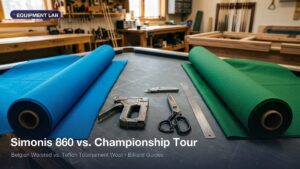
When refelting a high-end slate pool table, there is only one name recognized as the global gold standard: Iwan Simonis. Manufactured in Verviers, Belgium since 1680, Simonis worsted cloth is the official playing surface of virtually every major international championship. But when choosing a cloth for your home table or pool hall, you immediately encounter the great debate: Simonis 860 vs. Simonis 760. While Simonis 860 is the world’s most popular tournament-grade cloth offering sublime spin control, Simonis 760 is an ultra-durable, lightning-fast high-nylon blend designed for blistering ball speed. In this comprehensive 2026 showdown, we test speed, ball burn resistance, cue ball bite, and durability to help you choose the perfect cloth.
Simonis 860 vs. 760: Which Is for You?
Choose Simonis 860: If you play 9-ball, 8-ball, or one-pocket and demand authentic tournament speed, razor-sharp spin response, and true cue ball draw.
Choose Simonis 760: If you have a commercial room, play bank pool or straight pool, or want blazing speed with maximum puncture/tear resistance.
Table of Contents
Worsted Cloth vs. Standard Woolen Felt: What Makes Simonis Different?
Most standard residential pool tables come covered in inexpensive woolen felt (often called “napped cloth”). Woolen felt is made from carded, uncombed wool fibers that are felted together, resulting in a fuzzy, thick texture that develops directional “nap,” pills over time, slows ball roll, and tracks moisture in humid rooms.
In contrast, Simonis is a true worsted cloth:
- Napless, Combed Wool: The wool fibers are combed so they lie parallel before being tightly spun and woven under massive mechanical tension. There is zero nap and zero fuzz.
- Laser-Straight Roll: Because the surface is completely flat and directional-free, balls roll true at any angle, completely eliminating “ball roll-off” or curve caused by felt grain.
- Immunity to Humidity: Worsted cloth does not absorb ambient basement humidity like thick felt, ensuring identical ball speed year-round.
Simonis 860 Breakdown: The Tournament Standard
The Benchmark of Professional Pool
Simonis 860 is the most widely installed tournament cloth in the world. Engineered specifically for 9-ball, 8-ball, and 10-ball, its blend consists of 90% combed worsted wool and 10% nylon with a substantial fabric weight of approximately 410 g/m² (14 oz/yd²).
Key Playing Characteristics:
- Unrivaled English / Spin Bite: The high 90% wool content gives the cue ball the ideal amount of microscopic friction needed to bite into the cloth on draw shots, follow, and rail kicks.
- Predictable Pace: While far faster than standard bar-box felt, 860 offers controlled deceleration, allowing players to play soft touch shots and freeze the cue ball behind blocking balls.
- Reduced Ball Marks: Simonis 860 dissipates high-velocity friction heat efficiently, drastically reducing ball burn spots when paired with high-grade phenolic billiard balls.
Simonis 760 Breakdown: The Ultra-Speed Beast
Speed, Durability & Heavy Play
Simonis 760 was originally designed for straight pool, carom, Russian pyramid, and high-traffic commercial environments. It features a 70% combed worsted wool and 30% nylon blend with a lighter weight of roughly 355 g/m² (12.5 oz/yd²).
Key Playing Characteristics:
- Blistering Ball Speed: Simonis 760 is noticeably faster than 860—approximately 15% to 20% faster. Light strokes carry balls across the full length of a 9-foot table effortlessly.
- Toughest Durability: The 30% nylon blend creates extraordinary tensile strength. It is virtually immune to cue tip gouges, jumps, and tearing, making it the favorite of commercial pool halls where patrons abuse equipment.
- Trade-Off: Because the nylon surface is slicker, the cue ball exhibits slightly less traction on extreme draw shots compared to 860.
Direct Technical Comparison: Simonis 860 vs. 760 vs. 860HR
| Specification | Simonis 860 | Simonis 760 | Simonis 860HR (High Resistance) |
|---|---|---|---|
| Material Blend | 90% Wool / 10% Nylon | 70% Wool / 30% Nylon | 70% Wool / 30% Nylon |
| Weight | ~410 g/m² (14 oz/yd²) | ~355 g/m² (12.5 oz/yd²) | ~410 g/m² (14 oz/yd²) |
| Ball Speed | Tournament Fast (Balanced) | Ultra Fast (Blistering) | Tournament Fast |
| Cue Ball Grip & Spin | Maximum Traction | Moderate Slickness | Very High Traction |
| Tear / Gouge Resistance | Excellent (Residential) | Commercial Grade Maximum | Commercial Grade Maximum |
| Best Use Case | Dedicated 8-Ball & 9-Ball Home Rooms | Commercial Bars & Bank Pool | Heavy Home Play + Tournaments |
Table Size Considerations: 7-Foot vs 8-Foot vs 9-Foot
Your table dimensions play a significant role in determining whether 760 or 860 is the better match:
- 7-Foot Tables (Bar Boxes): We strongly recommend Simonis 860. Because 7-foot tables have shorter rolling distances, Simonis 760 can make the table feel like a runaway ice rink, causing cue balls to scratch in corner pockets with even slight over-strokes.
- 8-Foot Tables: Either cloth performs admirably. If you prefer deliberate position play, choose 860; if you love easy long-distance draw shots with minimal stroke effort, 760 is a thrill to shoot on.
- 9-Foot Tournament Tables: Simonis 860 is the standard for 9-foot competition tables worldwide. It allows true multi-rail position play without runaway cue ball speed. (Before ordering, verify your room clearance with our Pool Table Room Size Calculator).
How to Care for Your Simonis Worsted Cloth
Worsted cloth requires different maintenance than fluffy woolen felt. Protect your investment with these rules:
- Never Use a Rotating Vacuum: Upright vacuums with rotating brush heads stretch and tear the combed wool weave. Use a brushless upholstery attachment or a specialized Simonis X-1 static cleaning tool.
- Brush Straight, Not in Circles: Use a horsehair brush along the length of the table toward the head rail to collect chalk dust.
- Use Clean Phenolic Balls: Worn polyester balls cause thermal burn spots on cloth at speeds above 20 mph. Use genuine phenolic balls (such as Aramith) to maintain pristine condition (see Can Billiard Balls Go Bad?).
- Follow Professional Installation Steps: Ensure your slate is perfectly level (How to Level a Pool Table) and stretch the bed cloth evenly across all rails according to our step-by-step guide to Refelting a Pool Table.
Frequently Asked Questions (FAQ)
Is Simonis 860 or 760 faster?
Simonis 760 is faster than Simonis 860. With a 30% nylon blend and a lighter 355 g/m² weave, Simonis 760 produces roughly 15% to 20% more ball roll speed with less rolling resistance than Simonis 860.
Does Simonis cloth pill or develop fuzz?
No. Unlike standard woolen felt which sheds loose short fibers and develops fuzzy pills, Simonis worsted cloth is woven with tightly combed long-staple wool fibers that cannot pill or create directional nap.
How long does Simonis pool table cloth last?
In a residential home setting, Simonis 860 or 760 typically lasts between 5 and 10 years when brushed regularly and covered when not in use. In commercial pool rooms, it lasts between 1 and 3 years under continuous daily tournament play.

Marc Robert is the founder, chief technician, and senior equipment tester at Billiard Guides. With over 15 years of competitive amateur tournament and league experience (APA Skill Level 7 & BCA Master Division), Marc pairs deep table-side knowledge with rigorous mechanical bench testing. A certified cue mechanic and table mechanic, Marc specializes in three-piece slate alignment (calibrated using Starrett 98 precision machinist levels to ±0.005″), high-speed 240fps cue shaft deflection analysis, Shore D durometer tip hardness profiling, and Simonis worsted cloth friction testing. His independent reviews, drill curricula, and diagnostic calculators are trusted by over 500,000 cue sports players worldwide.