Moving a slate pool table is one of the heaviest, most unforgiving moving challenges any homeowner can undertake. Standard 8-foot slate tables weigh between 700 and 1,000 pounds, with the slate alone accounting for up to 600 pounds of brittle, fragile stone. Attempting to lift or drag an assembled pool table will inevitably warp the wooden frame, crack the slate, or cause serious physical injury. However, by properly disassembling the table into manageable components, transporting the slate vertically, and reassembling with precision leveling, you can safely move your table without paying $500 to $1,000+ for professional movers.
Will Your Table Fit the New Destination Room?
Before disassembling and hauling 800 lbs of slate down stairs or across town, verify that your new room has sufficient cue backswing clearance around all walls and support columns.
⚡ Moving Specifications at a Glance
Table of Contents
The Golden Rules of Pool Table Moving
Before turning a single wrench, burn these three cardinal rules of pool table mechanics into your mind:
Never lift or drag a pool table in one piece—not even 3 inches across a room. Dragging puts severe lateral shearing force on the leg joints, snaps the wooden mortise and tenon frame pins, and causes the 3 slate slabs to shift against each other, breaking the delicate beeswax seam seals and chipping the stone edges.
Slate has immense compressive strength but virtually zero tensile/flexural strength. If you lay an 8-foot slate flat on the floor of a moving truck, the vibration and shock from a single pothole will flex the center of the slab and crack it completely in half. Slate must always be transported vertically on its edge, strapped securely against padded truck walls.
If your existing felt is in great condition and you plan to reinstall it, gently roll the cloth face-outward around a cardboard shipping tube. Never fold felt into a square, as the creased creases permanently distort the weave and disrupt cue ball roll.
Essential Tools & Moving Equipment Checklist
Moving a table without the right gear risks dropped slates, damaged doorframes, and back injuries. Here is the verified equipment checklist:
| Equipment / Tool | Primary Purpose | Mechanic Recommendation |
|---|---|---|
| Heavy-Duty Moving Dolly | Rolls heavy slate slabs and wooden frame safely through doorways | XtrHawl 1,000 Lb Heavy-Duty Furniture Dolly |
| Staple & Tack Puller | Removes pocket and bed cloth staples without tearing fabric | Upholstery Heavy-Duty Staple Puller Tool |
| Heavy-Duty Staple Gun | Reattaches bed felt and rail cloth during reassembly | Arrow T50 Heavy-Duty Manual Stapler |
| Digital Precision Level | Calibrates table frame and slates to 0.05° at destination | COROLLATA Digital Magnetic Angle Inclinometer |
| Pure Slate Beeswax | Re-melts into slate joints to eliminate seams on reassembly | Mary Tylor 100% Pure Natural Beeswax |
| Socket Wrench Set | Unbolts rail bolts and internal frame brackets | Standard 9/16″ and 1/2″ deep socket wrench |
| Moving Blankets & Straps | Cushions slates and secures them upright in truck | Heavy quilted moving pads + Ratchet tie-down straps |
Step 1: Systematic Top-Down Disassembly
Disassembly must strictly follow a top-down protocol: Pockets → Rails → Felt → Slate → Frame → Legs.
- Remove the Drop Pockets: Crawl beneath each corner and side pocket. Remove the screws or upholstery tacks securing the pocket cups to the bottom of the slate liner with your tack puller. Slide pockets out and store them in labeled bags.
- Unbolt the Rails: Using your 9/16″ or 1/2″ socket wrench, remove the 3 to 4 heavy bolts securing each rail from beneath the slate frame. Keep rail bolts, washers, and dome locknuts in a designated bag. Lift each rail straight off and wrap in a moving blanket.
- Remove the Bed Cloth: Carefully pull out all perimeter staples with your staple puller. If the cloth was edge-glued, slowly peel it away from the vertical slate rim. Roll the cloth onto a cylinder tube.
- Locate & Remove Slate Mounting Screws: Standard 3-piece slates are secured to the frame with 4 to 6 countersunk wood screws per slab (12 to 18 screws total). Scrape away any beeswax covering the screw heads using a flathead screwdriver or putty knife, then back the screws out completely using a drill or impact driver.
Step 2: Safe Slate Handling & The Vertical Rule
This is the most critical phase of the move. Each slab of 1-inch diamond-honed slate weighs approximately 150 to 220 pounds.
How to Safely Lift and Transport Slate:
- Two-Person Lift (Minimum): Position one person at each end of the slate slab. Lift straight up together with your legs—never your lower back.
- Turn Vertically Immediately: Once lifted off the frame, rotate the slab so it is standing upright on its long edge. Carrying slate horizontally (flat) creates internal bending stress that can fracture the stone down the center.
- Transfer to a Heavy-Duty Dolly: Place the vertical slab onto a carpeted 1,000 Lb Furniture Dolly. One person guides the dolly while two people balance the slab upright.
- Wrap in Quilted Blankets: Wrap each slab completely in two heavy moving blankets and secure with packing tape before moving outside to the truck.
Step 3: Disassembling the Frame & Legs
With the slates removed, the remaining structure is lightweight:
- Frame Cross-Members: Check if the wooden cabinet frame is a solid unit or unbolts into separate side aprons and crossbeams. If it unbolts, remove corner brackets and mark components with painter’s tape.
- Leg Removal: Turn the frame upside down onto moving blankets. Unbolt each leg from the corner gussets. Store leg bolts with the legs.
Step 4: Loading the Moving Truck Safely
Arranging components inside the moving truck in the correct order prevents damage on transit:
Truck Loading Protocol
- Position 1 — The Cabinet Frame & Legs: Place the wooden frame and wrapped legs against the front bulkhead wall of the truck (closest to the driver’s cab) and strap them securely.
- Position 2 — The Slate Slabs (Against the Wall): Stand the three wrapped slate slabs vertically against the wooden side wall of the truck. Place cardboard or foam between each slab to prevent stone-on-stone contact. Fasten heavy-duty ratchet straps around the slabs and anchor to the truck’s E-track wall rails. Test with your hands: the slabs must not rock or shift even 1/2 inch.
- Position 3 — Rails & Pockets: Place the wrapped rails and accessory boxes in a safe corner where heavy items cannot fall against them.
Step 5: Reassembly, Seam Sealing & Re-Leveling at the Destination
Once you arrive at your new home or game room, follow the professional reassembly sequence:
- Position and Level the Frame: Reattach legs to the wooden frame in the exact location chosen in the room. Use your digital angle level to ensure the frame is level on the floor substrate before slates are placed. (See our detailed pool table leveling guide).
- Set the Slate Slabs: Carefully place the middle slate slab first, centering it over the frame crossbeams. Next, set the head and foot slates into position. Insert slate mounting screws loosely.
- Shim the Slates Flush: Slide composite shims between the slates and wooden frame until all three slabs form one continuous plane. Test the seams by sliding your fingernail across them; there should be zero lip or transition ridge.
- Torque Slate Screws & Seal Seams: Tighten slate screws while monitoring the digital level to avoid torque warp. Melt pure beeswax into the seams and screw countersinks with a propane torch, and scrape flush with a 6-inch putty knife.
- Re-stretch Felt & Bolt Rails: Stretch the bed cloth tightly across the table using the compass stretch pattern and staple into the frame using your Arrow T50 stapler. (If upgrading your cloth during the move, check our complete pool table refelting guide). Reattach the rails, torque bolts firmly, and reinstall pocket liners.
Moving a Table Short Distances (Same Room or Floor)
If you are simply shifting the table across the same room for new carpeting or a remodel, you do not always need to fully strip the slates, provided you have the proper tools:
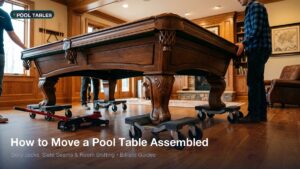
The 4-Dolly Method (Same-Floor Rolling):
You can move an intact pool table short distances across flat, threshold-free hardwood or laminate flooring using four heavy-duty dollies:
- Place one 1,000 Lb Furniture Dolly directly beside each table leg.
- With two people lifting each corner, raise each leg straight up and set it down in the carpeted center well of the dolly.
- With 4 people pushing slowly at the frame (never push by the rails or pockets), roll the table gently into its new position.
- Lift the table off the dollies and immediately re-check leveling with your digital level.
Caution: Never attempt this over doorway thresholds or down steps. The sudden bump will shear the slate seams and crack the beeswax seal.
Frequently Asked Questions (Moving FAQ)
How much does it cost to hire professional pool table movers?
Professional billiard movers charge between $400 and $700 for a standard local move (disassembly, transport within 20 miles, and complete reassembly with leveling). If the move involves flights of stairs, long distances, or new cloth installation, total costs range between $750 and $1,200.
Can you move a pool table without taking it apart?
Only non-slate (MDF/wood bed) tables can be moved without disassembly. A slate pool table should never be moved intact through doors, down stairs, or in a truck. The 800+ lb weight will bend the frame, crack the brittle slate, and destroy the table’s structural integrity.
How heavy is each piece of slate?
On a standard 8-foot 3-piece slate table, each individual slab weighs between 170 and 220 pounds. For 9-foot tournament tables, slabs weigh up to 260 pounds each. Always use two people to lift each piece of slate.
Do I need to replace the felt when moving a pool table?
Not necessarily. If your felt was stapled and carefully removed with a tack puller without ripping, it can be re-stretched during reassembly. However, if the felt is older than 3 years or was originally glued down, mechanics recommend installing fresh cloth like Simonis 860 while the table is already apart.